
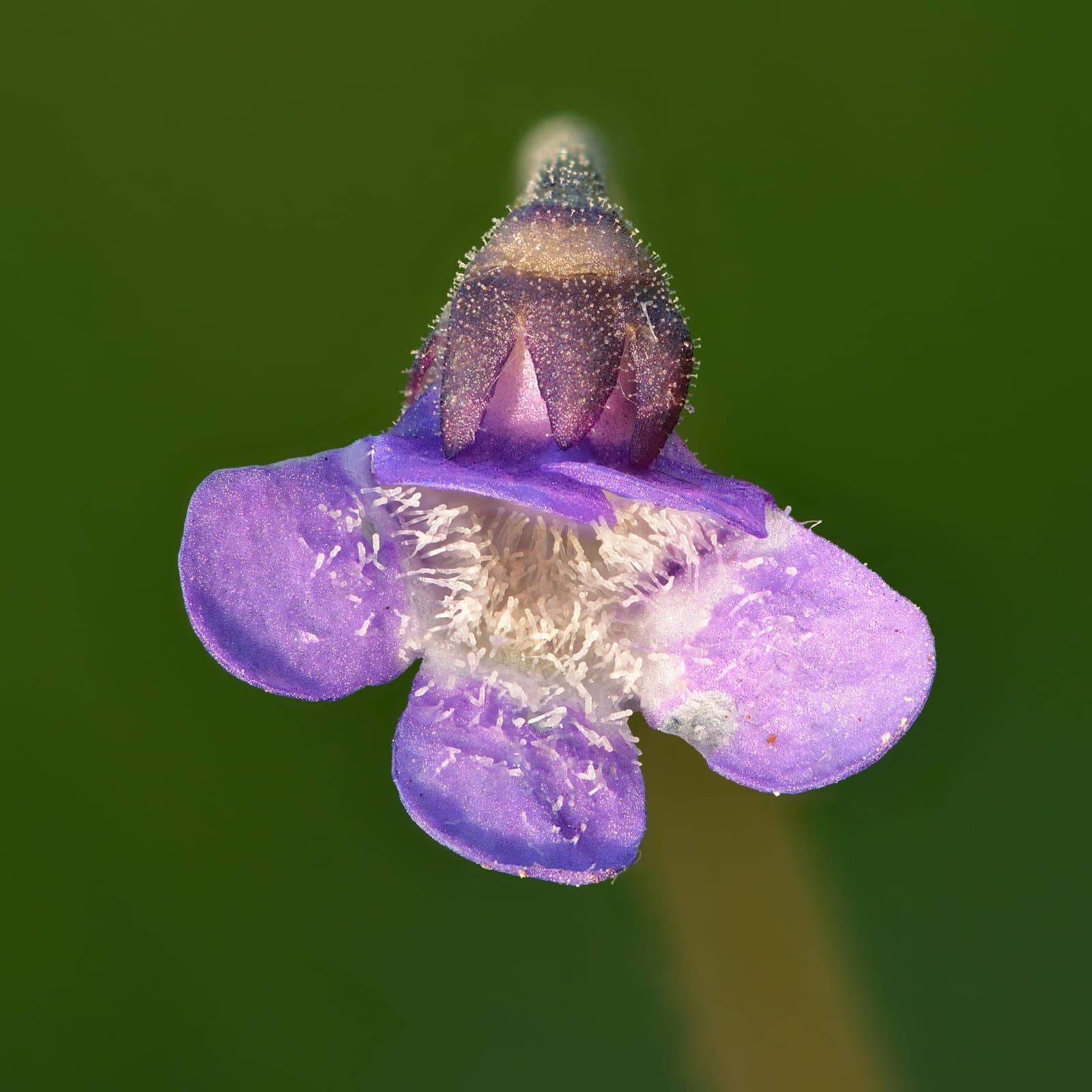
Common butterwort takes its name from the greasy sheen on its rosette of yellow-green leaves, a texture produced by thousands of sessile mucilage glands that give the flypaper trap its glue. A second type of gland, mixed in among the first, releases digestive enzymes once an insect is stuck, and the leaf margin curls very slightly inward over several hours to bring more of the trapped prey into contact with them - a passive trap with none of the sundew's visible motion. It is circumboreal, native to cold bogs and wet, often mineral-rich ground across the Arctic and subarctic Northern Hemisphere, with disjunct populations reaching south along the US Pacific coast and into the Great Lakes and New England, and a separate group of relatives native to the Mexican highlands. Unlike the strictly acidic, mineral-free regime that Sarracenia and Dionaea demand, P. vulgaris often grows on calcareous seeps and tolerates far more mineral content in its soil and water - one of several ways the butterworts solve the same poor-soil problem on their own terms; how and why carnivory evolved.
Grow in full sun to part shade in constant moisture, in a peat, sand, and grit mix that can include a little limestone chip without harm - a real departure from the pure-peat rule elsewhere in this group. Each fall the rosette contracts into a tight, non-carnivorous winter resting bud called a hibernaculum, which survives hard freezes that would kill the summer leaves outright; keep it barely moist and cold rather than dry or warm over winter, and resist the urge to fertilize or feed it insects, which it does not need.
Scandinavian and Icelandic dairy tradition put the leaf's enzymes to direct use: fresh milk poured over butterwort leaves curdles and thickens into a tart, yogurt-like product, a folk technique - tätmjölk, in Swedish - that predates any understanding of the plant's carnivory. The same greasy leaves gave rise to old folk applications on chapped skin and minor sores.
Ecoregions:TundraTaigaHudson PlainNorthern ForestsNorthwestern Forested MountainsMarine West Coast ForestEastern Temperate ForestsGreat Plains
Botrytis (grey mould)
Grey fuzzy mould on petals and stems, worst in cool wet conditions.
Remove affected parts immediately. Improve air circulation. Avoid overhead watering. Apply copper fungicide if severe.
Root rot
Plants wilt, yellow, and stunt even in moist soil; lower stems and roots turn brown, soft, and mushy and the plant may collapse. Most common in heavy, wet, or poorly drained ground.
Improve drainage and stop overwatering, and never plant too deep. Lift and destroy badly affected plants along with the soil around the roots. Grow in raised or free-draining beds to prevent it returning.