
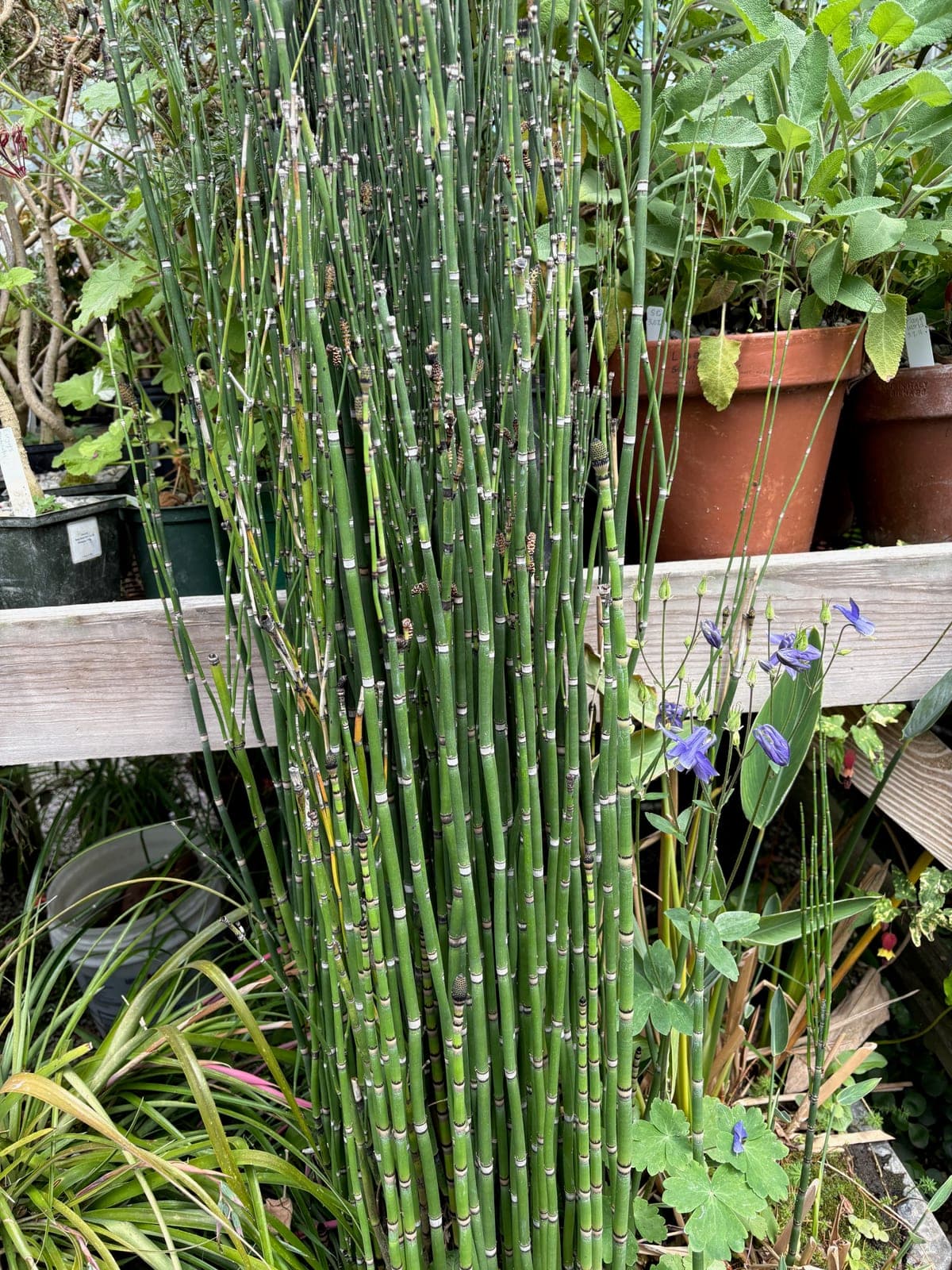
Horsetail is a living fossil, a plant unchanged for 300 million years, with hollow, jointed, evergreen stems banded in green and black that have no equivalent in the modern garden. It carries no flowers; it reproduces by spores from small cones at the stem tips. It is grown for structure, the vertical stems as striking as bamboo and more controllable in cold climates, 2 to 4 feet tall, and it is native across most of North America in wet ground.
Grow it only in containers: submerged in a pond or water feature, or in a pot sunk into a bed with a solid bottom and deep sides. In open ground it spreads by deep rhizomes and is close to impossible to eradicate once established; it comes back from any fragment and laughs at most herbicides. It takes full sun to part shade, any soil, standing water and bog, and it is hardy from zone 3 to 11.
The stems are useful as architectural elements in floral arrangements and last remarkably well in water. The silica in the stems made horsetail the scouring rush of the old kitchen, used to polish pewter and sand wood. It is toxic to horses and livestock if eaten in quantity, and deer leave it alone.
Ecoregions:Northern ForestsNorthwestern Forested MountainsMarine West Coast ForestEastern Temperate ForestsGreat PlainsNorth American DesertsMediterranean CaliforniaTemperate Sierras