
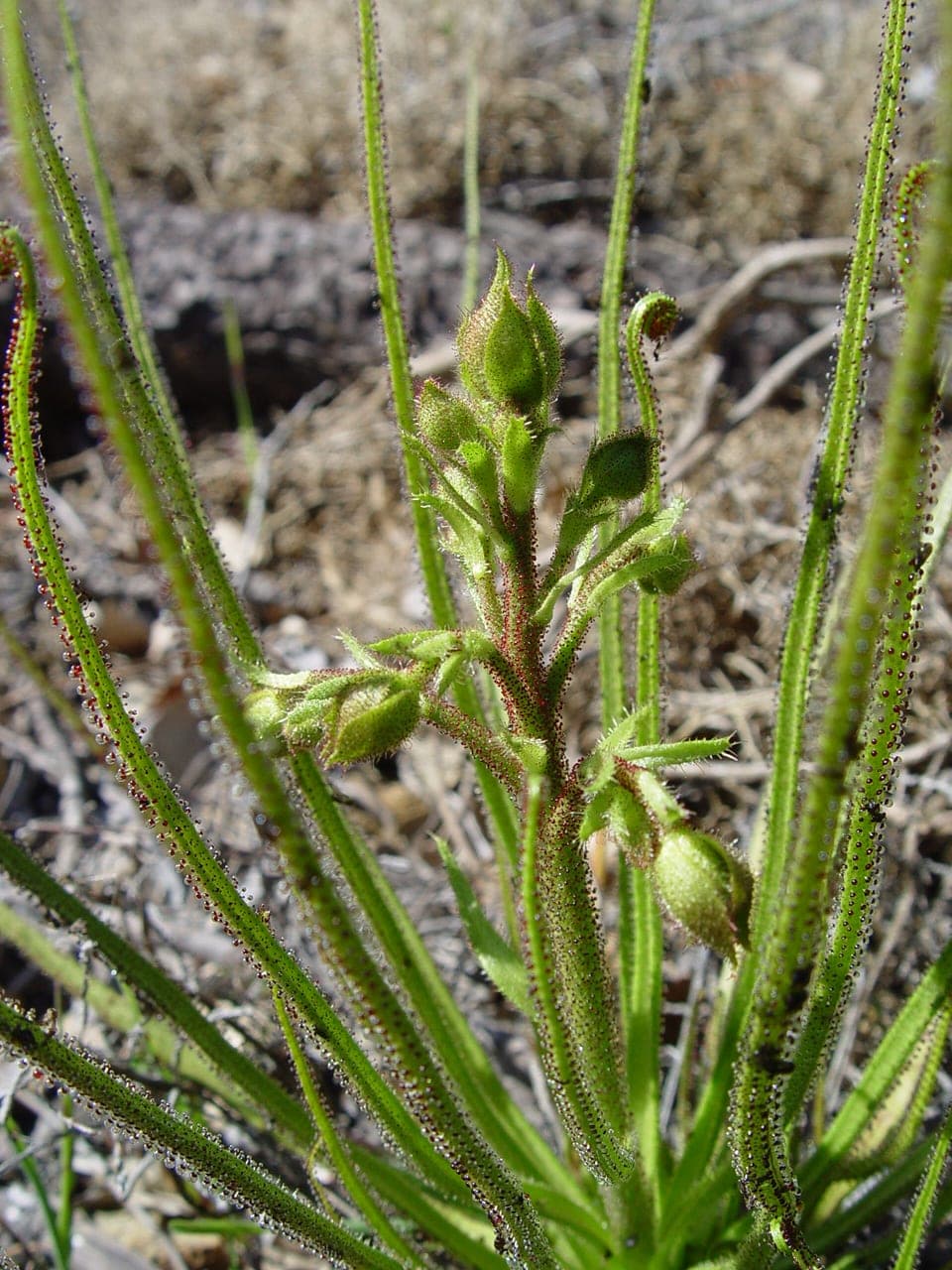
Nearly every carnivorous plant on this list wants a bog, and Drosophyllum wants the opposite: dry, sun-baked, mineral scrubland on hillsides in Portugal, Spain, and Morocco, sitting out real Mediterranean summers with no standing water anywhere near its roots. Its narrow, threadlike leaves are lined with the same kind of stalked, dew-tipped glands as a sundew, and work the same flypaper way, but it belongs to a different family altogether and evolved the trap on its own - the common name "dewy pine" points at the resemblance and the resinous, pine-like smell of the foliage rather than any relation to either plant. Unlike a Drosera, its leaves are rigid and don't move or curl around trapped insects; digestion happens in place; how and why carnivory evolved.
Cultivation flips almost every rule the rest of this catalogue follows. Full sun and excellent drainage are non-negotiable - a lean, fast-draining mix of coarse sand and mineral grit with very little organic matter, kept dry between waterings rather than standing in a tray. Wet feet, especially in winter, kill it outright, and it resents root disturbance badly enough that it is usually direct-sown or grown from seed in place rather than transplanted. In return it tolerates real drought and, for a carnivorous plant, real cold - established plants take a light freeze that would finish a bog sundew.
Root rot
Plants wilt, yellow, and stunt even in moist soil; lower stems and roots turn brown, soft, and mushy and the plant may collapse. Most common in heavy, wet, or poorly drained ground.
Improve drainage and stop overwatering, and never plant too deep. Lift and destroy badly affected plants along with the soil around the roots. Grow in raised or free-draining beds to prevent it returning.
Damping Off
Seedlings collapse at the soil line with thin, water-soaked stems; seeds may fail to emerge or rot before sprouting.
Sow in well-draining mix, avoid overwatering, and ensure good airflow. Remove affected seedlings and let the surface dry between waterings.