
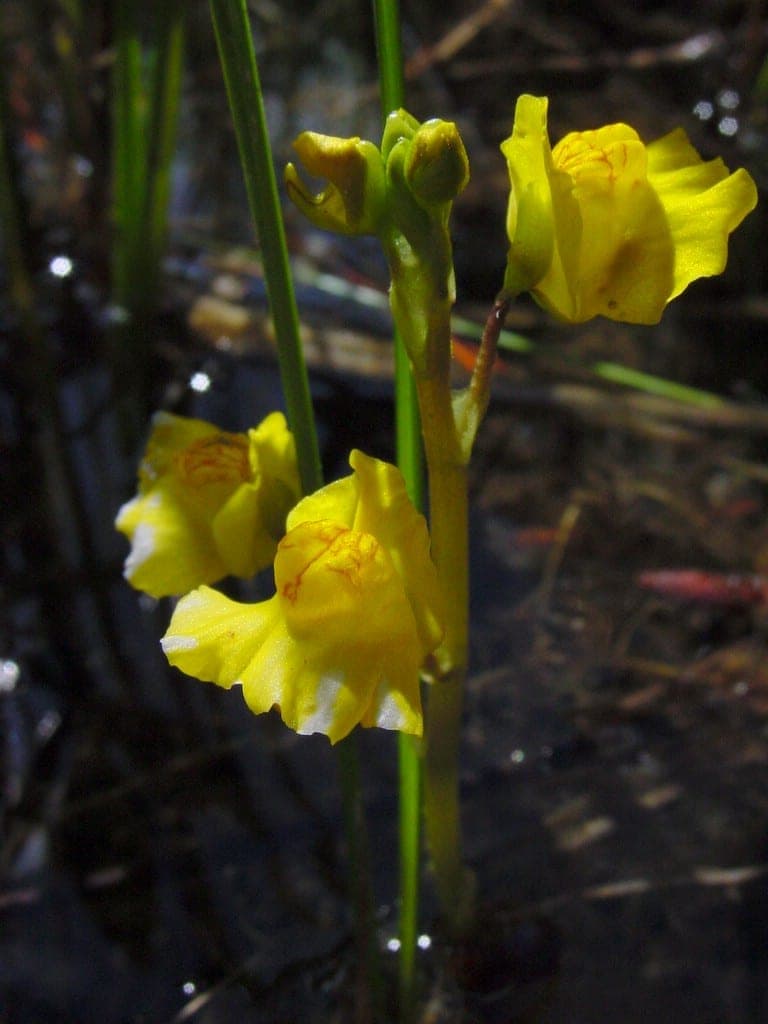
Common bladderwort is entirely rootless, a mass of finely divided underwater stems that simply floats in still, acidic, nutrient-poor water across ponds, lakes, and slow streams over most of North America. Along those stems sit thousands of tiny bladders, each one pumped down to a negative internal pressure and held shut by a trigger-hair-guarded trapdoor. Brush the hairs and the door springs open, sucking in water and whatever small organism triggered it in under a millisecond - the fastest confirmed movement in the plant kingdom, faster even than the Venus flytrap's own snap, which by comparison takes a leisurely tenth of a second. Utricularia is also the single most widely distributed carnivorous genus on Earth, found on every continent but Antarctica, which makes it as much a case study in how differently the same trap can be run as in how it works; how and why carnivory evolved.
There is no soil to prepare. The plant is grown as a floating aquatic in a still pond, tub, or aquarium with soft, acidic, mineral-poor water - the same water-quality rules as the rest of this group, rain or distilled rather than tap. Small yellow, snapdragon-like flowers rise a few inches above the surface on emergent stalks in mid-to-late summer. As the water cools in fall, the plant produces turions - dense, compact winter buds that detach, sink to the bottom, and sit out the cold before rising and resuming growth the following spring, the aquatic equivalent of the hibernaculum a butterwort forms on land.
Ecoregions:TaigaNorthern ForestsNorthwestern Forested MountainsMarine West Coast ForestEastern Temperate ForestsGreat PlainsNorth American Deserts