
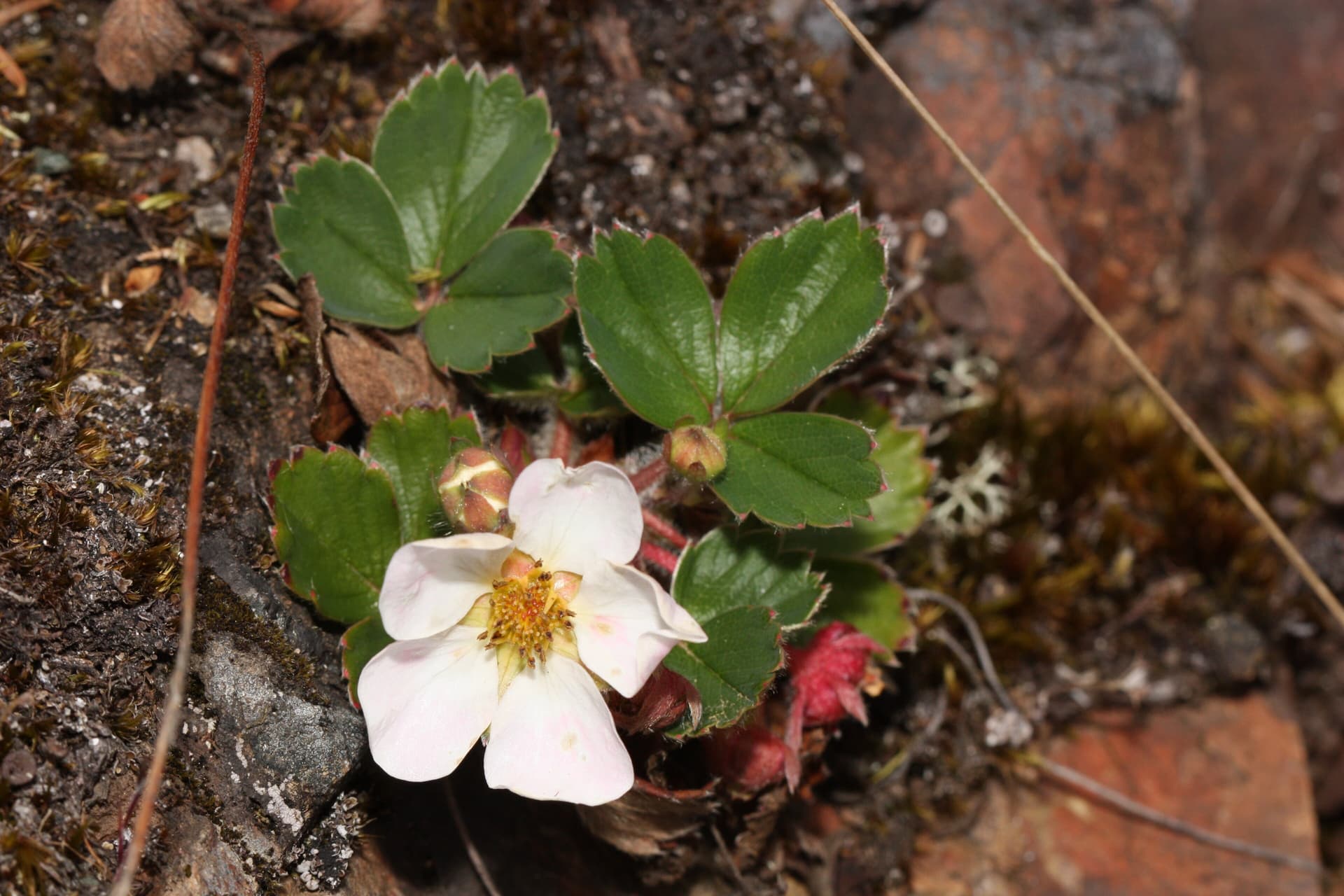
Fragaria virginiana is a stoloniferous native perennial found across much of North America, from open woodlands and meadow edges to rocky slopes. Along with the Chilean strawberry (F. chiloensis), it is one of the two wild species crossed in 18th-century France to produce the modern cultivated strawberry. In the garden it forms a low mat of trifoliate leaves 4–8 in tall, useful for naturalizing shaded edges or as a ground cover beneath deciduous trees.
Plants spread by surface runners that root at nodes, colonizing areas quickly and making them effective for stabilizing slopes and suppressing weeds. Preferred soil pH is 5.5–6.5; plants tolerate clay if drainage is adequate. A light mulch over crowns reduces frost heaving in cold climates, though the species is reliably hardy to Zone 3a. Fruit is smaller than cultivated varieties but markedly more intense in flavor.
The fruits are edible and long used for fresh eating and preserves. Leaf infusions have been used in traditional medicine as a mild astringent for digestive complaints and to soothe oral inflammation. The plant provides early-season forage for native bees and its fruit is consumed by songbirds and small mammals throughout summer.
Ecoregions:TaigaNorthern ForestsNorthwestern Forested MountainsMarine West Coast ForestEastern Temperate ForestsGreat PlainsNorth American Deserts
Botrytis (grey mould)
Grey fuzzy mould on petals and stems, worst in cool wet conditions.
Remove affected parts immediately. Improve air circulation. Avoid overhead watering. Apply copper fungicide if severe.
Powdery mildew
White or grey powdery coating on leaves - usually starting on older growth in humid conditions or when nights cool.
Improve air circulation by thinning plants. Apply neem oil or potassium bicarbonate spray at first sign. Avoid overhead watering.
Red Stele Root Rot
Stunted plants that wilt despite moist soil. Roots show a rotted core; cutting a root lengthwise reveals a reddish-brown central stele.
Plant only in well-draining soil and avoid waterlogged sites. Remove and destroy infected plants. Replant resistant varieties and rotate to a new bed location.
Angular Leaf Spot
Small water-soaked spots on leaves that turn brown and angular, bounded by leaf veins. Spots may dry and drop out, leaving holes. Fruit can develop small sunken lesions.
Avoid overhead watering and working among wet plants. Remove infected leaves, rotate crops on a 2–3 year cycle, and use copper-based sprays if the disease spreads.
Pepper Anthracnose Fruit Rot
Sunken, circular lesions on ripening fruit with concentric rings and pink or black spore masses in the center. Spreads quickly in warm, wet weather.
Remove and destroy infected fruit. Avoid overhead watering and improve airflow with proper spacing. Rotate away from peppers and tomatoes for 2–3 years. Use disease-free seed and apply copper-based fungicide preventively in wet seasons.
Verticillium Wilt
Lower leaves yellow and wilt, often on one side of the plant, with brown streaking in the stem and crown tissue when cut open. Plants are stunted and decline over the season.
Remove and destroy affected plants. Avoid planting in soil that has grown infected tomatoes, peppers, or other susceptible crops. Rotate beds and improve drainage; there is no cure once a plant is infected.
Fungal leaf spot
Brown or purplish spots on the leaves, often ringed with a yellow halo, that spread and merge in warm, humid, or wet weather; heavily spotted leaves yellow and drop early.
Pick off spotted leaves and clear fallen debris to remove overwintering spores. Improve air circulation by thinning, and water at the base so foliage dries quickly. If it persists, apply a copper- or sulfur-based fungicide at the first sign.