
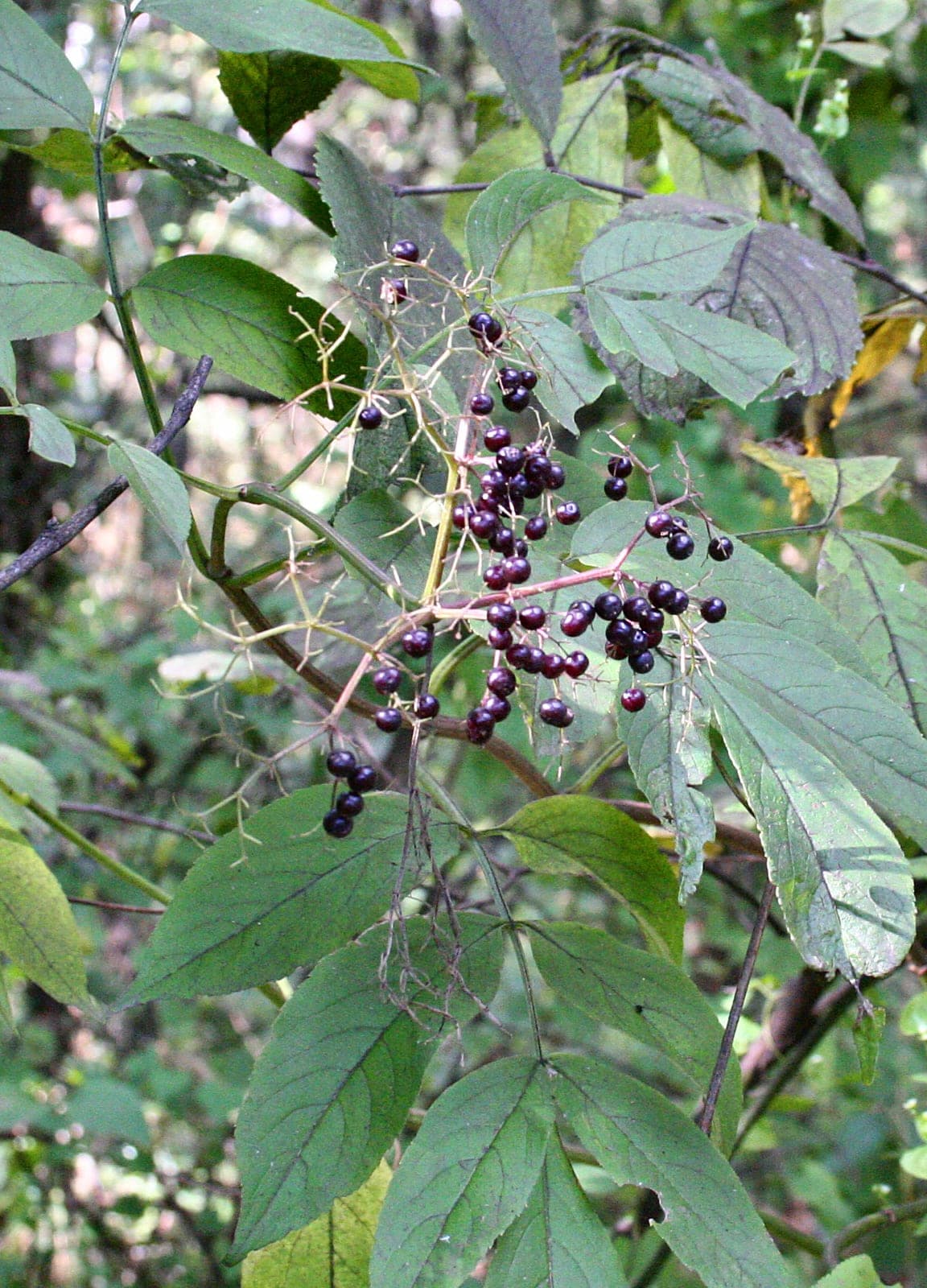
Placeholder: straight-species elderberry (Sambucus canadensis), not this cultivar - swap for a confirmed 'Magnolia Hill' photo.
'Magnolia Hill' is a wild selection of American elderberry found on an old plantation site in the North Carolina Piedmont and introduced by elderberry breeder Rodger Lenhardt of Norm's Farms. It is a vigorous grower that flowers slightly ahead of the species type, and its defining trait is a fruit cluster that ripens uniformly - the berries across a whole cluster turn dark purple-black together, instead of the typical mix of ripe and unripe fruit on the same head. That makes a single harvest pass practical instead of several passes over a few weeks. Maintained with the annual hard cutback below, it stays a compact 5-8 ft; left unpruned it can climb to 16 ft, like the straight species.
Culture follows straight Sambucus canadensis: full sun to part shade, moist fertile soil, and heavy suckering that should be thinned annually to keep the plant in bounds. It is self-fruitful but sets a heavier crop with a second elderberry nearby to cross-pollinate. Cutting canes to the ground in late winter channels the plant's energy into vigorous new canes, which is where it fruits most heavily, and keeps it at the compact end of its range. Raw seeds and unripe berries contain sambunigrin, a cyanogenic glycoside that causes nausea and vomiting; cook all berries before use.
Ecoregions:Northern ForestsEastern Temperate ForestsGreat PlainsTropical Wet Forests
Powdery mildew
White or grey powdery coating on leaves - usually starting on older growth in humid conditions or when nights cool.
Improve air circulation by thinning plants. Apply neem oil or potassium bicarbonate spray at first sign. Avoid overhead watering.
Cercospora Leaf Spot
Small round spots with tan or gray centers and reddish-purple borders on leaves. Spots merge in severe cases, causing leaves to brown and die back.
Remove infected leaves and avoid overhead watering. Space plants for airflow and rotate crops. Apply a copper-based fungicide if the infection spreads.
Botrytis (grey mould)
Grey fuzzy mould on petals and stems, worst in cool wet conditions.
Remove affected parts immediately. Improve air circulation. Avoid overhead watering. Apply copper fungicide if severe.
Phytophthora Root Rot
Wilting despite moist soil, yellowing leaves, stunted growth, and dark, decayed roots and crown tissue. Vines may collapse during hot weather.
Plant in well-draining soil and avoid waterlogging. Remove and destroy affected vines. Improve drainage with raised beds or amended soil and avoid overwatering.
Aphids
Aphididae →Clusters of small soft insects on new growth and flower buds.
Knock off with a strong jet of water. Ladybirds and lacewings are natural predators. Insecticidal soap as last resort.
Elderberry Borer
Desmocerus palliatus →Cane tips wilt and collapse in early summer. Oval exit holes appear on cane surfaces accompanied by sawdust-like frass at the stem base. Larvae tunnel through the pith, causing individual canes to die back completely while the rest of the plant may remain healthy.
Cut all infested canes to ground level immediately and destroy them; do not compost. No effective chemical control exists once larvae are established inside canes. Monitor in late spring for adult beetles (Desmocerus palliatus - metallic blue-green with yellow spots) and remove dead or weakened wood during dormant pruning to reduce overwintering habitat. Vigorous plants maintained through annual renewal pruning are less susceptible.