
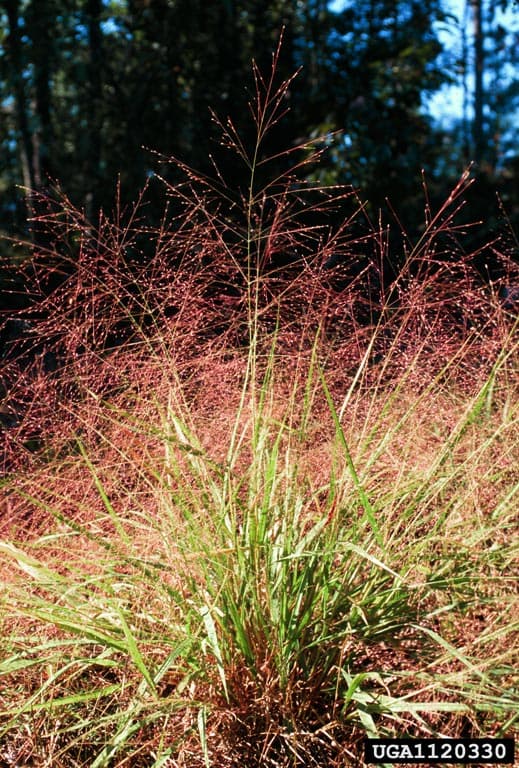
PL. —Eragrostis spectabilisBotanical illustration — drop image
Eragrostis spectabilis

Purple Lovegrass

SummerFall
5a9bHardiness zone
Peak bloom windowZone 6b · frost-offset weeks
Winter
Not in bloom
Spring
Not in bloom
Summer
Peak bloom
Fall
Not in bloom
Peak bloom
In bloom
Background

Purple lovegrass is a warm-season native grass ranging from southern Canada to northeastern Mexico. Its primary ornamental feature is a wide, airy cloud of reddish-purple spikelets that emerges in late summer, fading to copper-bronze through fall and persisting as open skeletal structure well into winter.

It thrives in dry, sandy, or gravelly soils with full sun and sharp drainage, and once established it handles drought and poor fertility with minimal care. The mature seed head breaks free from the plant and tumbles in wind, distributing seed widely; gardeners who want to limit spread should clip seed heads before they detach. As a warm-season grass, foliage greens up late in spring. It is well suited to stabilizing sandy or eroded slopes and filling difficult dry spots where more demanding plants fail.

Care guide
SunFull sun
WaterLow
SoilSandy, well-drained, dry
Spacing18–24 in
Height12–24 in
Zone5a – 9b
Native RegionAL, AR, CT, DE, DC, FL, GA, IL, IN, IA, KS, KY, LA, ME, MD, MA, MI, MN, MS, MO, NE, NH, NJ, NY, NC, ND, OH, OK, PA, RI, SC, SD, TN, TX, VT, VA, WV, WI
Direct sow
Seasonal tasks
spring
watchCheck crowns for signs of rot if spring soils remain wet; relocate or improve drainage rather than treating with fungicide.
cutCut old stems to within 3–4 inches of the ground before new growth begins in early spring.
watchLeave standing stems and remaining seed heads through winter for structure and bird foraging; cut back in late winter before growth resumes.
sowSurface-sow seeds in raked, weed-free soil once soil has warmed. Do not cover; seeds require light to germinate.
summer
watchMonitor for fungal leaf spot during humid stretches. Good air circulation around established clumps is the main preventive.
fall
cutClip seed heads before they detach and tumble if limiting self-seeding within beds; leave them if naturalizing is the goal.