
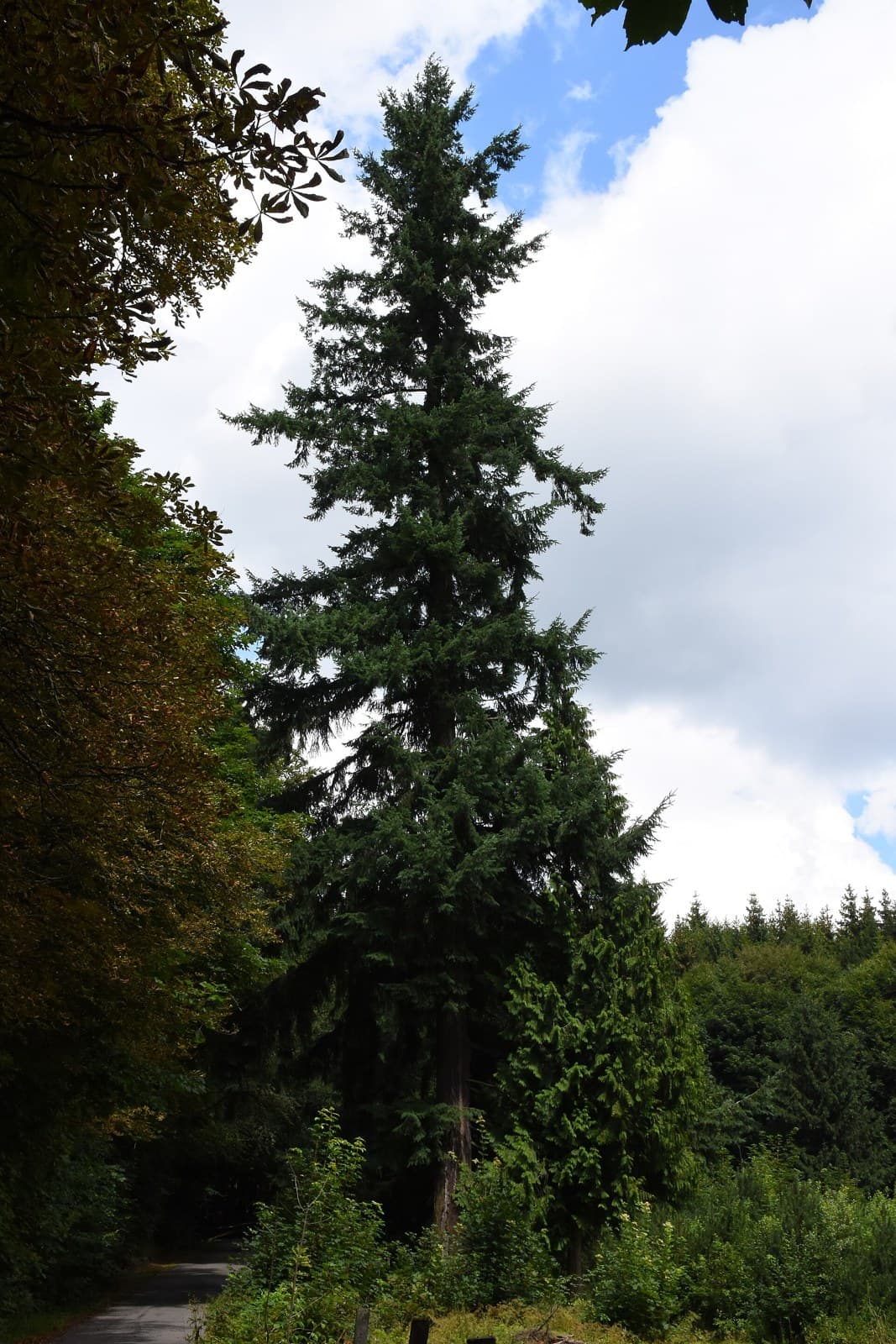
Douglas fir (Pseudotsuga menziesii) is not a true fir but a distinct genus in the pine family, native to western North America. The most commercially harvested timber species on the continent, it is also a significant landscape tree where space permits, forming a tall, layered, pyramidal silhouette. Two varieties suit different gardening climates: the coast variety (var. menziesii) grows fast and large, best west of the Cascades; the Rocky Mountain variety (var. glauca) is smaller, slower, more cold-hardy, and tolerates drier continental conditions. The distinctive cones, with three-pointed bracts protruding beyond each scale, make identification straightforward.
Plant in full sun in well-drained, slightly acidic soil. Both varieties are shallow-rooted during youth and need supplemental irrigation for the first three to five years. Established Rocky Mountain trees are considerably more drought-tolerant than coast trees. Trees hold their natural pyramidal form with little to no pruning. Expect 1–2 ft of annual growth on good sites. Avoid compacted soils and areas with standing water; poor drainage promotes Armillaria and Phytophthora root diseases. A mulch ring kept away from the trunk conserves soil moisture and reduces competition from turf.
Indigenous peoples of western North America brewed needle tea as a vitamin C source and used the inner bark as a famine food. Resin was applied topically to wounds and skin ailments. In the broader landscape, Douglas fir provides critical nesting habitat for the northern spotted owl and marbled murrelet; its seeds are a primary food source for red squirrels and crossbills.
Ecoregions:Northwestern Forested MountainsMarine West Coast ForestGreat PlainsNorth American DesertsMediterranean CaliforniaSouthern Semi-Arid HighlandsTemperate Sierras
Swiss Needle Cast
Second-year and older needles yellow, then bronze, and drop prematurely beginning in late spring. Only current-year needles are retained, giving branches a tufted, sparse appearance and progressively thinning the canopy. Tiny black pseudothecia of the fungus Phaeocryptopus gaeumannii are visible in needle stomatal rows under 10× magnification.
Apply copper-based fungicide beginning when new buds break in spring; repeat two to four times at two- to three-week intervals through bud elongation. Fungicide suppresses the disease but does not eliminate established infections. Avoid planting coast-variety Douglas fir outside its native Pacific Northwest coastal range, where disease pressure is consistently more severe. Select site-appropriate seed sources and favor the Rocky Mountain variety in interior climates.
Dothistroma Needle Blight
Red to dark brown bands form across the middle of current-year needles in late summer. Needle tips die while bases remain green. Small dark fruiting bodies develop within the bands. Heavy infection causes premature needle drop and progressive crown thinning.
Apply copper-based fungicide when new candles are half-elongated in spring, then repeat 3–4 weeks later. Rake and dispose of fallen needles. Avoid overhead irrigation. Increase spacing between trees to improve air circulation and reduce canopy humidity.
Armillaria Root Rot
Thinning, yellowing canopy with progressive dieback; white, fan-shaped mycelial mats visible beneath bark at or just below the soil line; honey-colored mushroom clusters appearing at the trunk base or on surface roots in autumn.
No chemical cure exists. Improve drainage and avoid any injury to roots or trunk. Remove severely infected trees along with as much root material as possible. Do not replant susceptible species in the same spot.
Phytophthora Root Rot
Wilting despite moist soil, yellowing leaves, stunted growth, and dark, decayed roots and crown tissue. Vines may collapse during hot weather.
Plant in well-draining soil and avoid waterlogging. Remove and destroy affected vines. Improve drainage with raised beds or amended soil and avoid overwatering.
Botryosphaeria Canker
Dark, sunken cankers on stems and major branches, most often occurring after drought stress or mechanical wounding. Bark peeled back from affected areas reveals brown, discolored wood beneath. Branch tips wilt and die back progressively inward.
Prune infected branches at least 6 inches below the visible canker margin using sterilized tools, and dispose of all cuttings away from the garden. Reduce plant stress by maintaining consistent irrigation during dry periods and avoiding bark wounds during maintenance. No curative fungicide is available; keeping plants vigorous is the primary preventive strategy.