
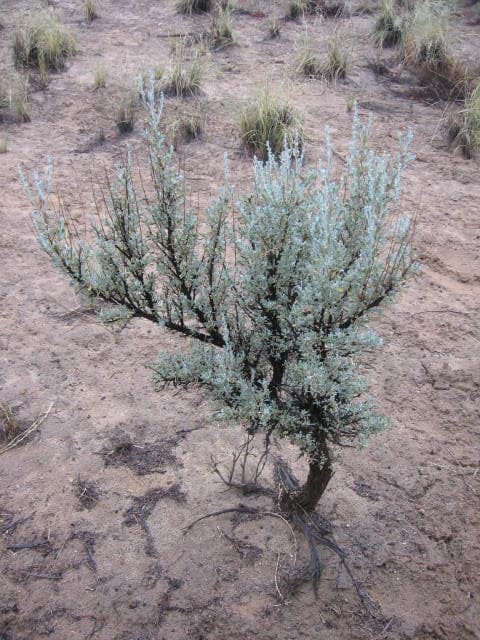
Big sagebrush dominates roughly 170 million acres of western North America, from British Columbia south to Baja California, and is the ecological signature plant of the Great Basin. Its silver-gray, three-toothed leaves retain a sharp aromatic scent year-round. In cultivation, it delivers persistent structural presence and exceptional drought tolerance on dry, sunny sites where most ornamentals fail.
Established plants need no supplemental irrigation in arid climates and decline rapidly in any soil that holds moisture. Alkaline to neutral pH and sharp drainage are non-negotiable. Several subspecies differ meaningfully in size and site tolerance: basin big sagebrush (subsp. tridentata) reaches the greatest height at low elevations, while mountain big sagebrush (subsp. vaseyana) handles colder, higher-elevation sites with slightly greater precipitation. Plants establish most reliably from container stock set in fall. Despite cold-hardiness to zone 4a, performance is poor in humid eastern climates regardless of winter temperatures.
Numerous Great Basin and Columbia Plateau Indigenous peoples used sagebrush for respiratory congestion, fevers, headaches, arthritic pain, and wound care - primarily as steam treatments, poultices, and washes. Laboratory studies have confirmed antimicrobial activity in its volatile oils, attributed mainly to camphor, camphene, and alpha-thujone. Greater sage-grouse rely on it for food and year-round cover, making it a keystone species for Great Basin habitat integrity.
Ecoregions:Northwestern Forested MountainsGreat PlainsNorth American DesertsMediterranean California
Phytophthora Root Rot
Wilting despite moist soil, yellowing leaves, stunted growth, and dark, decayed roots and crown tissue. Vines may collapse during hot weather.
Plant in well-draining soil and avoid waterlogging. Remove and destroy affected vines. Improve drainage with raised beds or amended soil and avoid overwatering.
Verticillium Wilt
Lower leaves yellow and wilt, often on one side of the plant, with brown streaking in the stem and crown tissue when cut open. Plants are stunted and decline over the season.
Remove and destroy affected plants. Avoid planting in soil that has grown infected tomatoes, peppers, or other susceptible crops. Rotate beds and improve drainage; there is no cure once a plant is infected.