
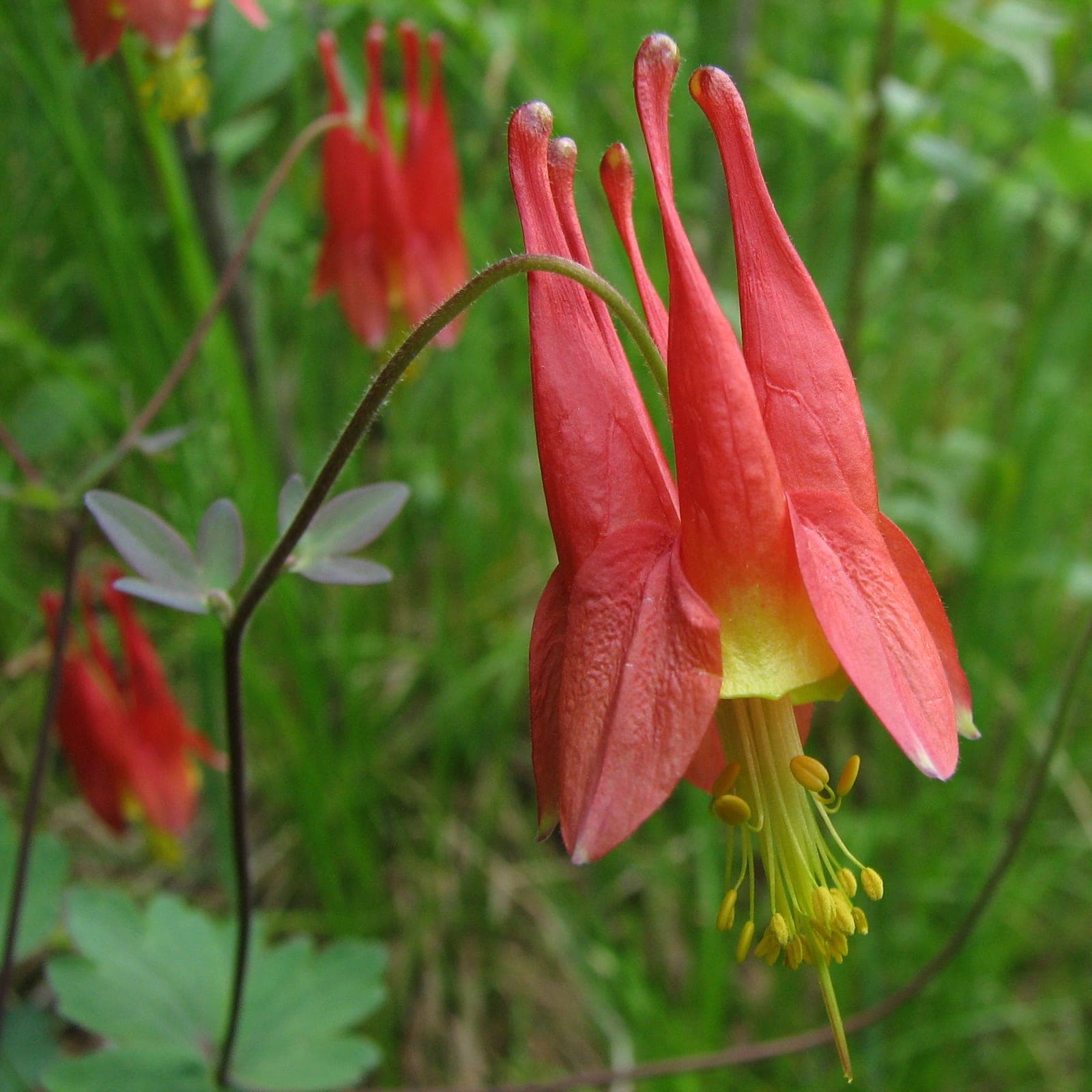
Wild columbine is a native perennial of eastern North America, found on rocky slopes, cliff faces, and open woodland edges from the Maritimes south through Georgia and west to the Great Plains. Its red and yellow nodding flowers appear in mid-spring and are among the earliest available to northward-migrating hummingbirds; the elongated spurs also accommodate several long-tongued native bee species, including mining bees and bumblebees.
This species is short-lived, typically persisting 3–4 years, but it self-seeds prolifically and sustains a colony indefinitely under suitable conditions. It hybridizes freely with other Aquilegia species, so seed-grown offspring may not replicate the parent plant's coloration. Cold stratification substantially improves germination; seed sown directly outdoors in fall requires no extra treatment and germinates reliably the following spring. Leaf miners commonly trace winding tunnels through foliage by midsummer but rarely threaten plant health. Plants tolerate a pH range of 5.5–7.0 and perform well in rocky or thin soils with good drainage; avoid heavy clay and standing water.
Multiple Native American groups used Aquilegia canadensis medicinally. Cherokee preparations from the root were applied as an astringent, and seed infusions were used in treatments for headache and fever. Seeds and roots contain isoquinoline alkaloids and trace cyanogenic compounds; the plant is considered toxic if consumed in quantity.
Ecoregions:Northern ForestsEastern Temperate ForestsGreat Plains
Rust
Orange to brown raised pustules on the undersides of leaves, with yellow spotting on the upper surface. Heavy infections cause leaves to yellow and drop.
Remove and destroy infected leaves. Avoid overhead watering and improve air circulation. Apply a sulfur or copper-based fungicide if it spreads. Clear plant debris in fall.
Powdery mildew
White or grey powdery coating on leaves - usually starting on older growth in humid conditions or when nights cool.
Improve air circulation by thinning plants. Apply neem oil or potassium bicarbonate spray at first sign. Avoid overhead watering.