
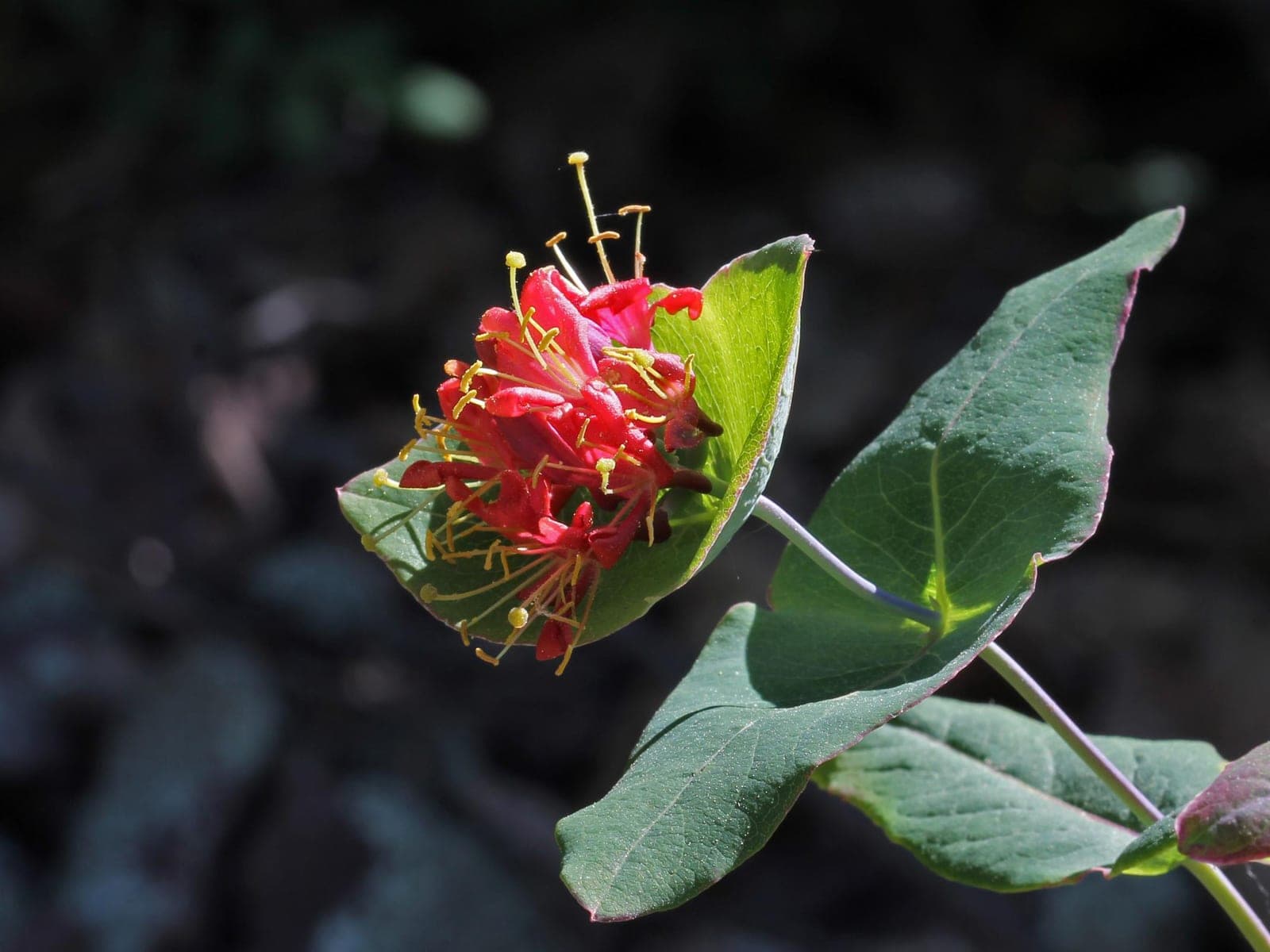
Lonicera dioica is a native, deciduous twining vine found across Canada and the eastern and central United States. Unlike invasive honeysuckle species, it integrates into woodland gardens without spreading aggressively. Its perfoliate upper leaves - where the stem appears to pass through a single fused leaf pair - are a reliable identification feature that distinguishes it from other native vines.
In the wild it occupies woodland edges, rocky slopes, and thicket margins, scrambling over shrubs and low trees. It requires a trellis, fence, or host plant to climb and establishes steadily rather than explosively. Four botanical varieties exist across its range - var. dasygyna, var. dioica, var. douglasii, and var. orientalis - with minor differences in leaf texture and flower coloration. The plant is cold-hardy to zone 3b and tolerates a range of soils as long as drainage is adequate. A mulch layer helps cool roots and retain moisture at the warmer end of its zone range.
Tubular, yellowish to reddish flowers appear in late spring and draw hummingbirds and long-tongued native bees. Red berries follow in summer and provide forage for songbirds but are mildly toxic to humans. Some Indigenous groups in the Great Lakes region historically used the plant as a diuretic.
Ecoregions:Northern ForestsNorthwestern Forested MountainsEastern Temperate ForestsGreat Plains
Powdery mildew
White or grey powdery coating on leaves - usually starting on older growth in humid conditions or when nights cool.
Improve air circulation by thinning plants. Apply neem oil or potassium bicarbonate spray at first sign. Avoid overhead watering.
Honeysuckle Leaf Blight
Brown or black spots on leaves that enlarge and merge, followed by curling, browning, and early leaf drop, often worse in wet seasons.
Remove and destroy infected leaves, thin growth to improve airflow, avoid overhead watering, and apply a copper-based fungicide if the problem recurs.