
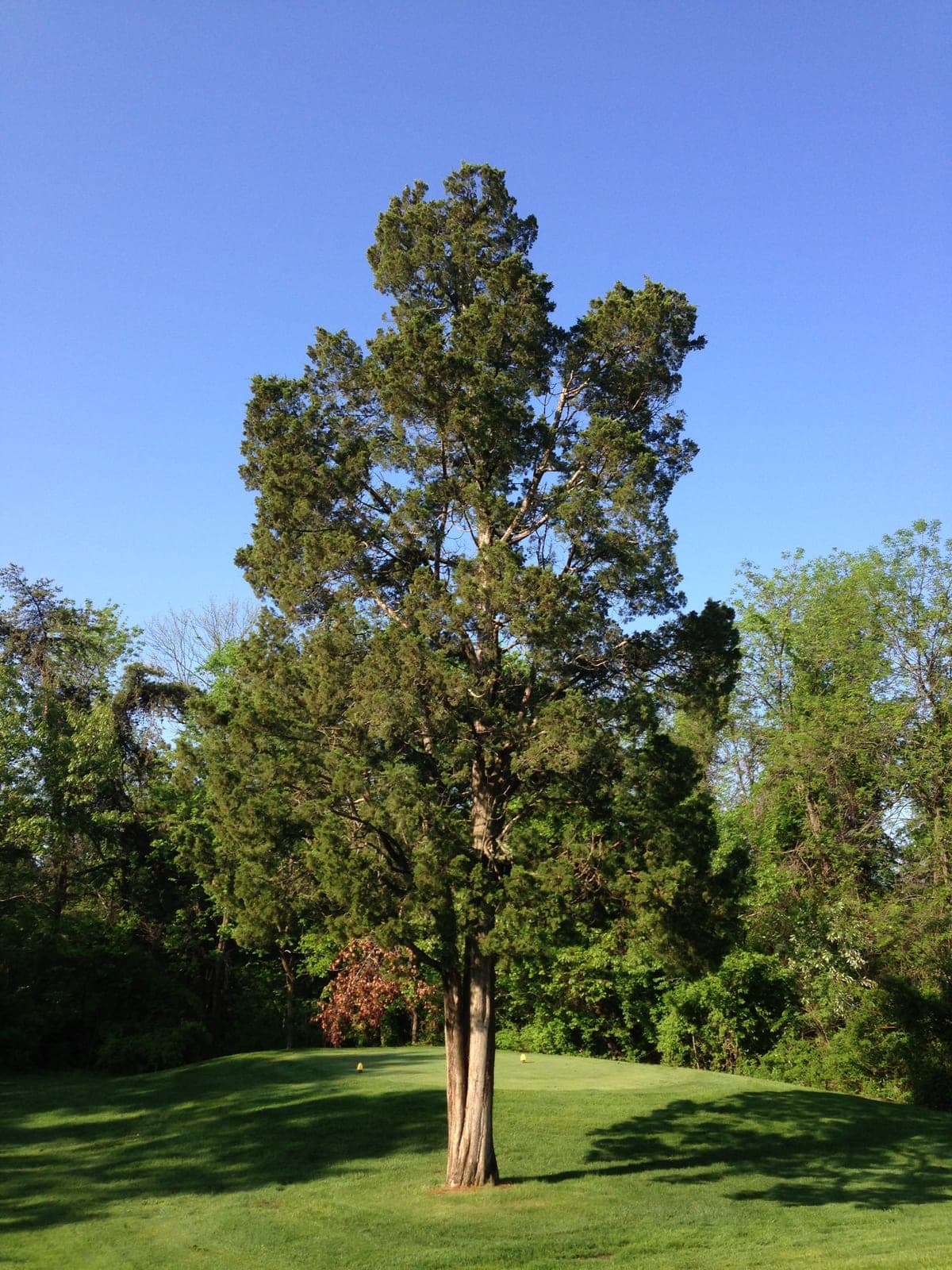
Eastern red cedar is the most widespread native conifer in eastern North America, found from southeastern Canada to the Gulf of Mexico and west to the edge of the Great Plains. Despite its common name, it is a true juniper, not a cedar. Long-lived and highly adaptable, it works as a windbreak, privacy screen, or wildlife anchor in both formal and naturalistic landscapes, and it is one of the few large evergreens reliably hardy through zone 2.
The tree tolerates nearly any well-drained soil - clay, sand, alkaline limestone outcrops, or acidic uplands - and becomes very drought tolerant once established. It grows roughly 12–24 inches per year when young. An important ecological caveat: it is the primary alternate host for cedar-apple rust, producing distinctive orange gelatinous galls on branches during warm, wet springs and completing its disease cycle on apple and crabapple. Avoid planting near apple orchards or crabapple collections. A mulch ring 3–4 inches deep helps establishment; keep mulch away from the trunk. In open grassland or prairie restoration settings, unmanaged populations can spread aggressively from bird-dispersed seed.
The fleshy blue-gray seed cones are eaten by cedar waxwings, American robins, bluebirds, and more than 50 other bird species, making this one of the most ecologically productive native trees for winter wildlife. The aromatic, decay-resistant heartwood has been used for fence posts, closet linings, and hope chests for centuries. Cherokee and other Native peoples used bark and foliage preparations to address respiratory complaints and urinary conditions. The berries serve as a juniper-berry flavoring for spirits and game meats in regional cooking.
Ecoregions:Northern ForestsEastern Temperate ForestsGreat Plains
Cedar-Apple Rust
Hard, reddish-brown galls up to 2 inches in diameter form on twigs and small branches. During warm, wet spring weather, galls swell and produce bright orange, gelatinous, finger-like telial horns up to 1 inch long. Repeated infections weaken individual branches. On alternate hosts (apple, crabapple), the disease causes yellow to orange leaf spots, premature defoliation, and distorted fruit.
Prune and bag galls before telial horns emerge in spring; do not compost removed material. Apply a preventive fungicide - myclobutanil or propiconazole - to high-value apple or crabapple hosts nearby during the spring spore release window. Where feasible, avoid siting Juniperus virginiana within several hundred feet of apple orchards. Choosing rust-resistant apple and crabapple cultivars breaks the disease cycle more reliably than chemical control alone.