
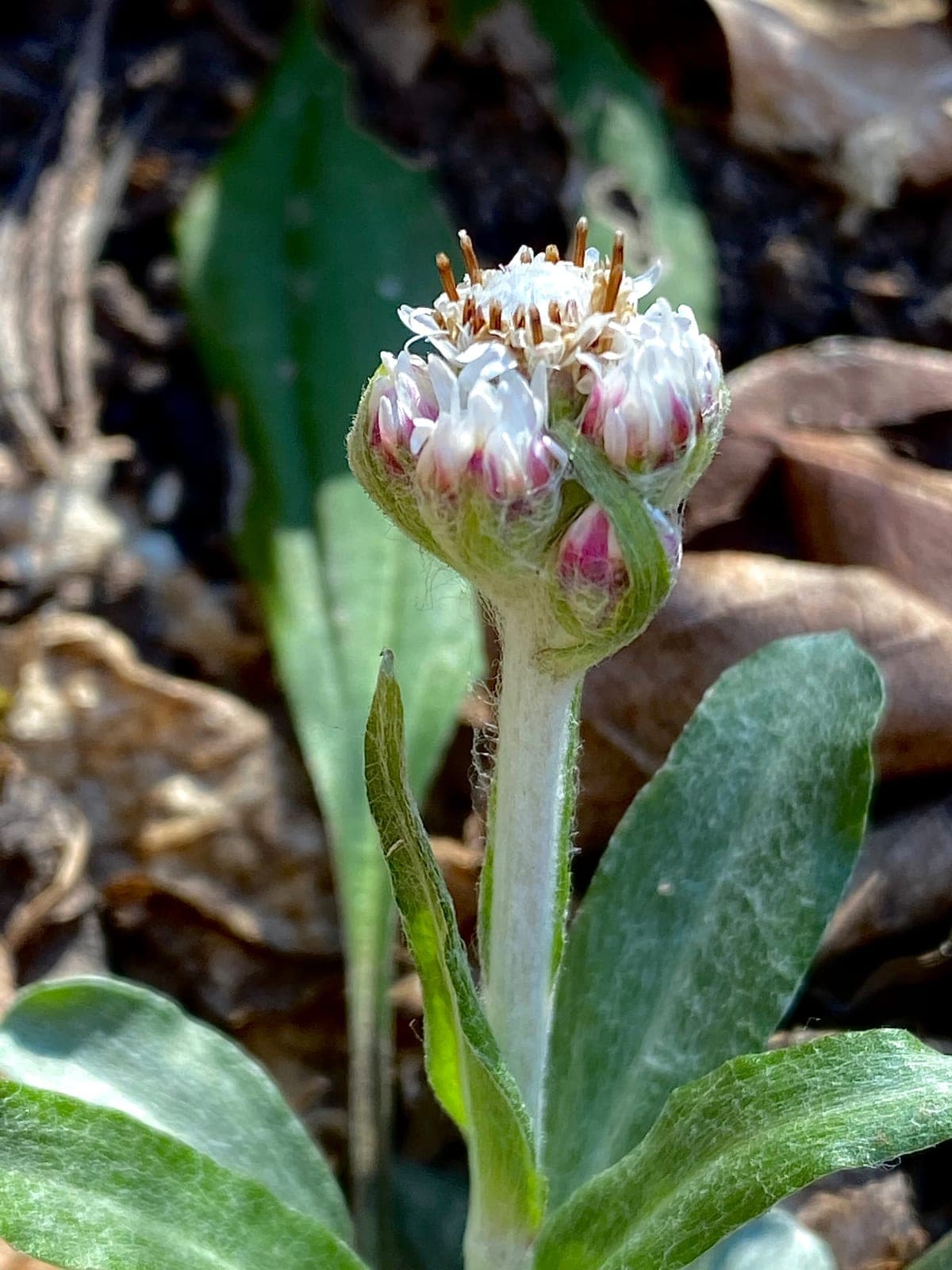
A widespread species across eastern North America, extending west into the Dakotas and south into New Mexico. It has evolved from sexually reproducing ancestors and now mostly reproduces apomictically, setting seed without pollen - most populations, including the plants offered here, are entirely female. Male clones and sexual reproduction occur occasionally, which produces a range of morphologies and makes the species notoriously hard to key out.
Plants were long identified as Parlin's Pussytoes (Antennaria parlinii) before genetic work split them out as a distinct subspecies with only subtle physical differences - hence the subspecies name "fallax," Latin for "deceitful."
It forms low, fuzzy gray-green rosettes that spread slowly into a mat, sending up short flower stalks in early spring tipped with clusters of small, papery, pussytoe-like blooms.
Ecoregions:Northern ForestsEastern Temperate ForestsGreat Plains
Rust
Orange to brown raised pustules on the undersides of leaves, with yellow spotting on the upper surface. Heavy infections cause leaves to yellow and drop.
Remove and destroy infected leaves. Avoid overhead watering and improve air circulation. Apply a sulfur or copper-based fungicide if it spreads. Clear plant debris in fall.
Crown Rot
Lower leaves yellow and wilt; the base of the rosette turns brown and soft, sometimes with white fungal threads at the soil line. Plants collapse in wet conditions.
Remove and destroy affected plants. Improve drainage and avoid overhead watering. Do not mulch directly against the crown. Space plants for airflow and avoid replanting in the same wet spot.