
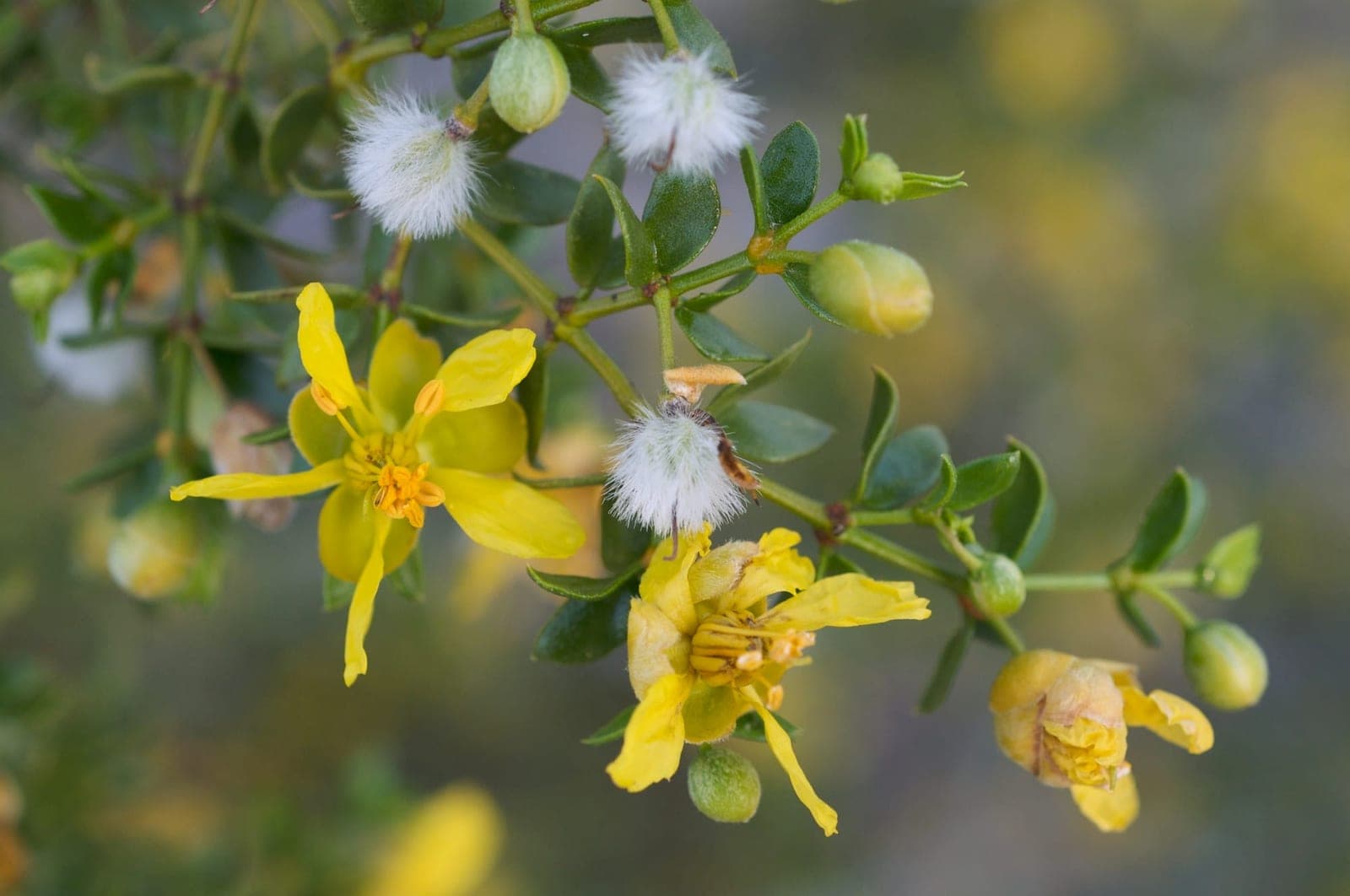
Creosote bush is the dominant shrub across the Mojave, Sonoran, and Chihuahuan Deserts, blanketing millions of acres from California to Texas and deep into Mexico. For xeric and desert-style gardens, it provides year-round evergreen structure, small yellow flowers triggered by rainfall, and unmatched drought endurance once established.
The waxy resin coating every leaf surface limits water loss and produces the plant's signature earthy scent - sharpest immediately after rain. Creosote is strongly allelopathic, releasing phenolic compounds that suppress germination of nearby plants; the characteristic even spacing of wild stands is self-generated by this chemistry. Some clonal rings in the Mojave are estimated to exceed 11,000 years in age. In cultivation, plant from containers in fall into fast-draining, alkaline to neutral soil with full sun. Soil must drain rapidly; the plant fails in organic-rich, moisture-retentive beds. Establishment watering should be spaced out from the start to push roots deep, not frequent.
Indigenous peoples of the Southwest - including the Seri, Tohono O'odham, and Cahuilla - used creosote leaves for arthritis, respiratory illness, skin infections, and kidney complaints. The plant's primary active compound, nordihydroguaiaretic acid (NDGA), has documented antioxidant, antifungal, and antiviral activity in laboratory studies. Sold commercially as chaparral, concentrated preparations have been linked to liver and kidney toxicity in humans; the FDA removed NDGA from the generally recognized as safe list in 1968.
Ecoregions:Great PlainsNorth American DesertsMediterranean CaliforniaSouthern Semi-Arid HighlandsTemperate Sierras
Texas Root Rot
Sudden wilting of branches or the entire canopy, often following a wet period. White cottony fungal mats develop on infected roots. Wood at the crown appears dark and water-soaked. Decline can progress to tree death within weeks.
No effective chemical cure exists. Ensure excellent drainage and avoid overwatering. Remove and destroy all infected plant material. Avoid replanting susceptible species in the same soil for several years.
Root rot
Plants wilt, yellow, and stunt even in moist soil; lower stems and roots turn brown, soft, and mushy and the plant may collapse. Most common in heavy, wet, or poorly drained ground.
Improve drainage and stop overwatering, and never plant too deep. Lift and destroy badly affected plants along with the soil around the roots. Grow in raised or free-draining beds to prevent it returning.