
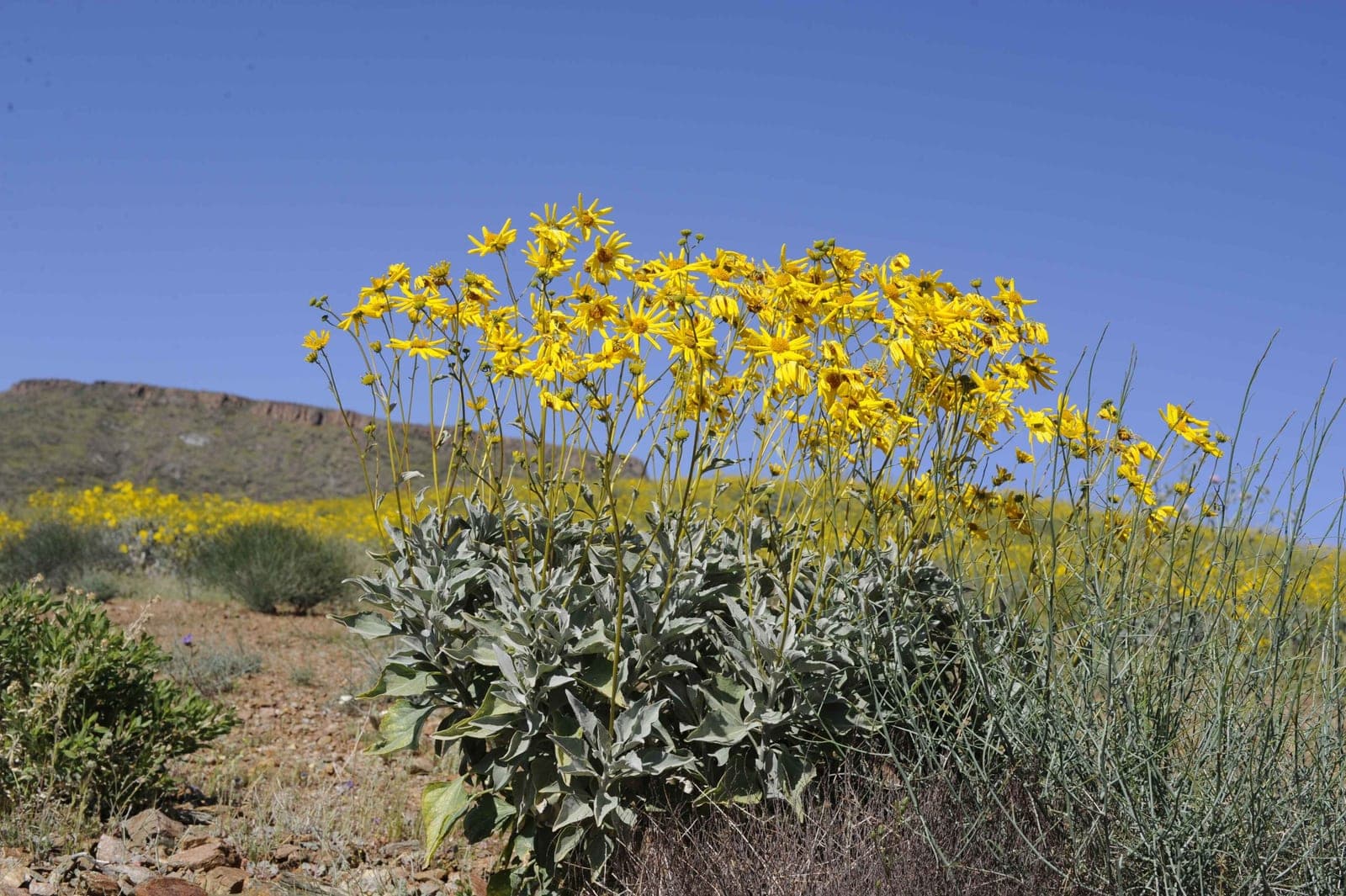
Encelia farinosa is a rounded desert shrub native to the Sonoran and Mojave deserts of the southwestern United States and northwestern Mexico. Dense white hairs coat the leaves, giving the plant a silver-gray appearance that reflects solar radiation and limits water loss. It produces abundant yellow daisy-like flowers from late winter through spring and is one of the most reliable low-water shrubs for hot, arid landscapes.
The plant is drought-deciduous, shedding most of its leaves during prolonged dry or extreme heat periods and regrowing foliage once moisture returns. It establishes quickly from seed, self-seeds readily, and naturalizes on well-drained rocky or sandy slopes below 3,000 feet elevation. Individual plants are relatively short-lived by shrub standards, typically 5–10 years, but the stand persists through self-seeding. Overwatering in summer, particularly in heavy clay soil, is the primary cause of failure in cultivation. Mulching directly against the crown accelerates rot and should be avoided.
Several Indigenous groups of the Sonoran Desert applied resin scraped from the stems directly to aching teeth as a topical analgesic. Spanish missionaries in Baja California burned the same resin as church incense. Phytochemical studies have identified encelin and related sesquiterpene lactones in the plant with demonstrable anti-inflammatory activity in laboratory models, though no standardized clinical preparations exist.
Ecoregions:North American DesertsMediterranean CaliforniaSouthern Semi-Arid HighlandsTemperate Sierras
Phytophthora Root Rot
Wilting despite moist soil, yellowing leaves, stunted growth, and dark, decayed roots and crown tissue. Vines may collapse during hot weather.
Plant in well-draining soil and avoid waterlogging. Remove and destroy affected vines. Improve drainage with raised beds or amended soil and avoid overwatering.
Powdery mildew
White or grey powdery coating on leaves - usually starting on older growth in humid conditions or when nights cool.
Improve air circulation by thinning plants. Apply neem oil or potassium bicarbonate spray at first sign. Avoid overhead watering.