
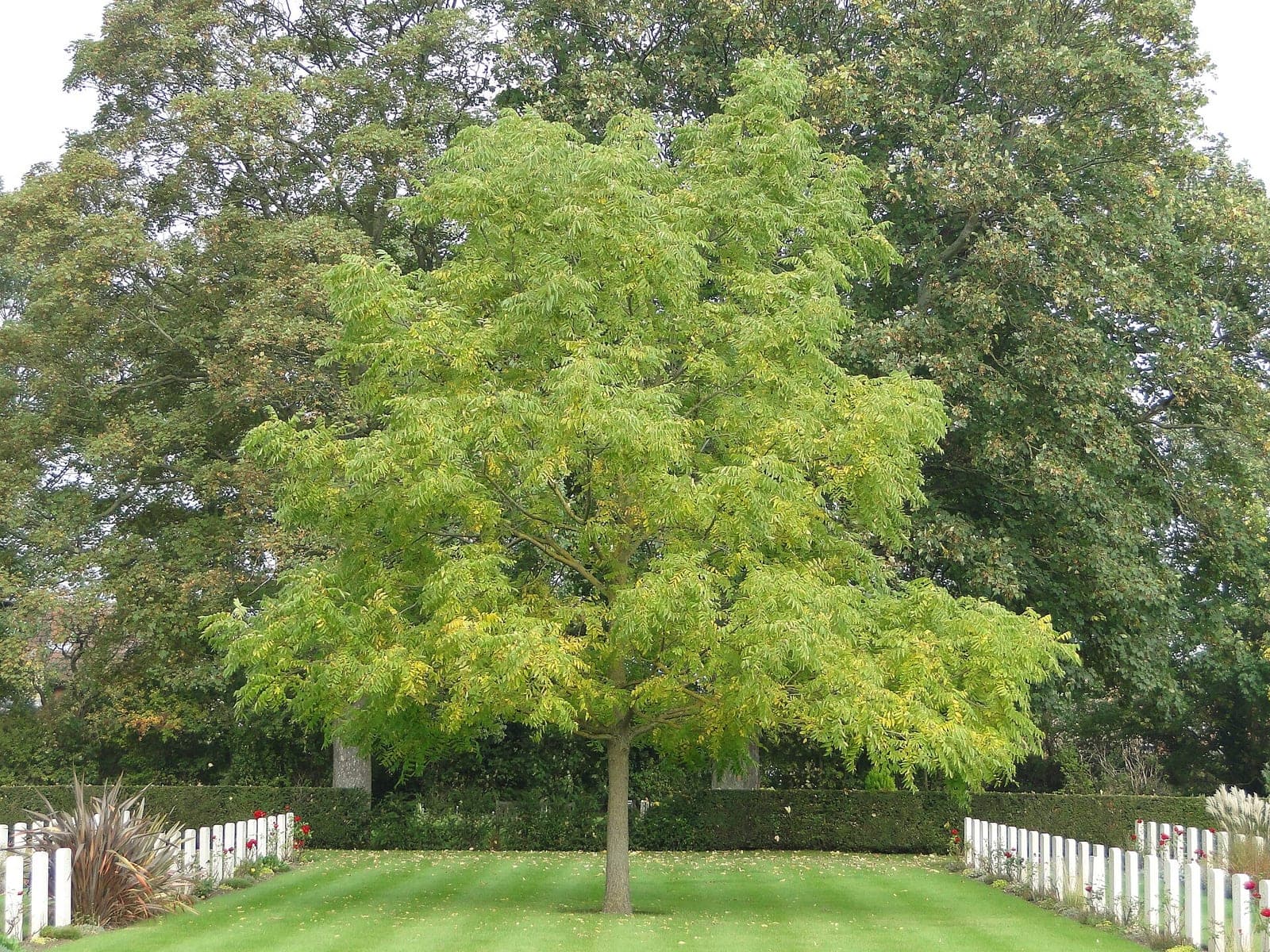
Black walnut is one of North America's most valuable native hardwoods, native to central and eastern North America and most abundant in rich riparian bottomlands. It produces edible nuts with an intense flavor distinct from English walnut and is a critical food source for squirrels, turkeys, and other wildlife. The deeply furrowed dark bark and large compound leaves with 15–23 leaflets make it unmistakable at maturity.
The tree synthesizes juglone - concentrated in roots, husks, leaves, and bark - that suppresses or kills many neighboring plants, a well-documented allelopathic effect. Sensitive genera including Solanum, Malus, Vaccinium, and many ornamentals should be kept at least 50–60 ft from the trunk. Black walnut develops a deep taproot early, making later transplanting impractical; choose a permanent site before planting. Trees typically require 10–15 years to yield a meaningful nut crop. Near-neutral pH and deep, fertile loam produce the fastest growth.
Black walnut hulls have been used in herbal traditions for intestinal parasites and fungal skin conditions, with the hulls containing high concentrations of juglone, tannins, and iodine. The nuts are used in baking, confections, and ice cream. Green hulls yield a dark brown to near-black natural dye that stains skin and fabric persistently.
Ecoregions:Northern ForestsEastern Temperate ForestsGreat Plains
Fungal leaf spot
Brown or purplish spots on the leaves, often ringed with a yellow halo, that spread and merge in warm, humid, or wet weather; heavily spotted leaves yellow and drop early.
Pick off spotted leaves and clear fallen debris to remove overwintering spores. Improve air circulation by thinning, and water at the base so foliage dries quickly. If it persists, apply a copper- or sulfur-based fungicide at the first sign.
Armillaria Root Rot
Thinning, yellowing canopy with progressive dieback; white, fan-shaped mycelial mats visible beneath bark at or just below the soil line; honey-colored mushroom clusters appearing at the trunk base or on surface roots in autumn.
No chemical cure exists. Improve drainage and avoid any injury to roots or trunk. Remove severely infected trees along with as much root material as possible. Do not replant susceptible species in the same spot.
Crown Rot
Lower leaves yellow and wilt; the base of the rosette turns brown and soft, sometimes with white fungal threads at the soil line. Plants collapse in wet conditions.
Remove and destroy affected plants. Improve drainage and avoid overhead watering. Do not mulch directly against the crown. Space plants for airflow and avoid replanting in the same wet spot.
Thousand Cankers Disease
Walnut twig beetles (Pityophthorus juglandis) introduce the fungus Geosmithia morbida as they bore beneath the bark, producing small (2–4 cm) individual cankers that are invisible from outside. As beetle populations build and cankers coalesce, bark darkens and branch dieback progresses from small twigs downward through scaffold limbs. Crown thinning accelerates rapidly once coalescing cankers girdle major limbs; tree death can follow within a few years of visible crown symptoms.
No curative treatment exists. Remove and chip or burn infected wood on site - do not transport black walnut lumber, logs, or firewood out of affected areas, as this spreads the beetle. In high-value trees, systemic insecticide applications timed before peak beetle flight (late spring to early summer) may slow new colonization but cannot reverse established disease. Confirm diagnosis with a lab or extension service and report to your state department of agriculture, as this is a regulated pest in many states.