
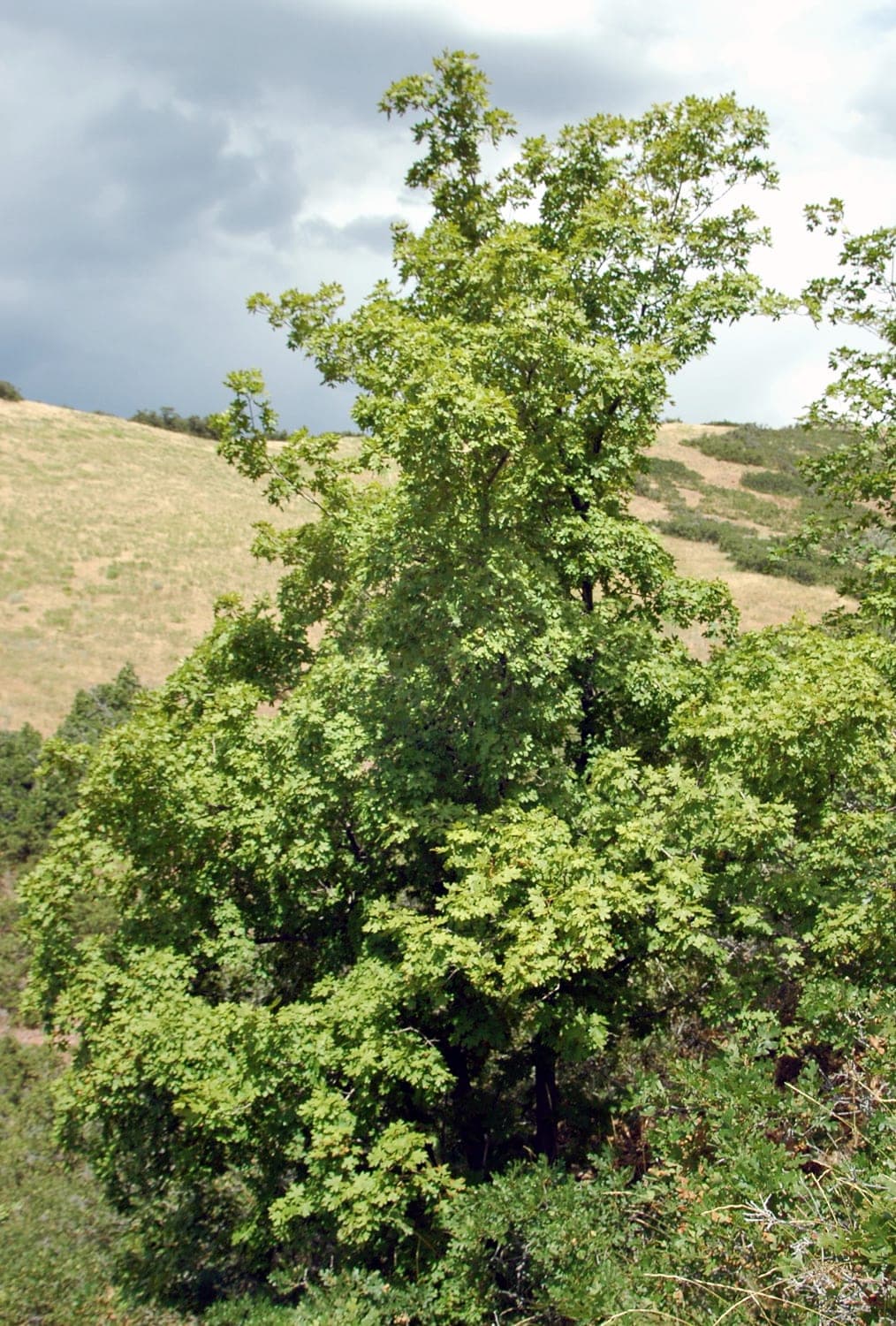
Bigtooth maple is a medium-sized deciduous tree native to interior western North America, with scattered populations from Montana to central Texas and northern Mexico. Closely related to sugar maple, it produces orange, red, and yellow fall foliage in climates where eastern maples fail under drought and alkaline soils, making it one of the most useful native ornamental trees for Rocky Mountain and High Plains landscapes.
This tree grows naturally on rocky canyon slopes, foothills, and dry mountain washes where soils are thin, well-drained, and often alkaline-conditions that defeat most other maples. Full sun produces the most intense fall color; part shade is tolerated. Mulch the root zone during establishment to conserve moisture. Deer browse young stems readily, so protect transplants for the first few growing seasons. Growth rate is moderate, around 1–2 ft per year. Alkaline and rocky soils are not a liability here but a match for the tree's native habitat.
The sap can be tapped in early spring for syrup; sugar concentration runs lower than eastern sugar maple, so more volume is needed per gallon of finished syrup. Seeds are a reliable food source for songbirds and small mammals, and the tree's early spring flowers provide nectar before most native competitors come into leaf.
Ecoregions:Northwestern Forested MountainsGreat PlainsNorth American DesertsSouthern Semi-Arid HighlandsTemperate Sierras
Maple Anthracnose
Irregular brown or tan spots that follow and spread between leaf veins, giving leaves a scorched or blighted appearance. Severe infections cause premature leaf drop. In wet springs, small cankers may appear on young shoots.
Rake and remove fallen leaves each autumn to reduce overwintering fungal spores. Avoid overhead irrigation. Apply a copper-based fungicide at bud break during wet spring conditions. Prune selectively to improve canopy airflow.
Maple Tar Spot
Pale yellow-green spots appear on upper leaf surfaces in early summer. By late summer they enlarge into raised, glossy black blotches up to 1 in across, closely resembling tar splashes. Caused by Rhytisma acerinum and related species.
Rake and destroy all fallen leaves in autumn to eliminate overwintering spores. Fungicide applications are rarely justified on established trees. Improve air circulation through selective pruning where practical.
Powdery mildew
White or grey powdery coating on leaves - usually starting on older growth in humid conditions or when nights cool.
Improve air circulation by thinning plants. Apply neem oil or potassium bicarbonate spray at first sign. Avoid overhead watering.
Verticillium Wilt
Lower leaves yellow and wilt, often on one side of the plant, with brown streaking in the stem and crown tissue when cut open. Plants are stunted and decline over the season.
Remove and destroy affected plants. Avoid planting in soil that has grown infected tomatoes, peppers, or other susceptible crops. Rotate beds and improve drainage; there is no cure once a plant is infected.
Eutypella Canker
Large, target-shaped cankers on the trunk and major limbs, with concentric rings of callus tissue surrounding sunken, dead bark. Infected wood shows orange-brown discoloration in cross section. Cankers expand over multiple years and can girdle and kill major limbs or the entire tree.
No effective chemical control exists. Remove infected branches with at least 6 in margin into healthy wood and destroy the debris. Trunk cankers may be surgically excised by a certified arborist if the canker has not girdled the stem. Remove trees with girdling trunk cankers. Prevent bark wounds during mowing and maintenance. Maintain tree vigor through mulching and adequate soil moisture to slow canker expansion.