
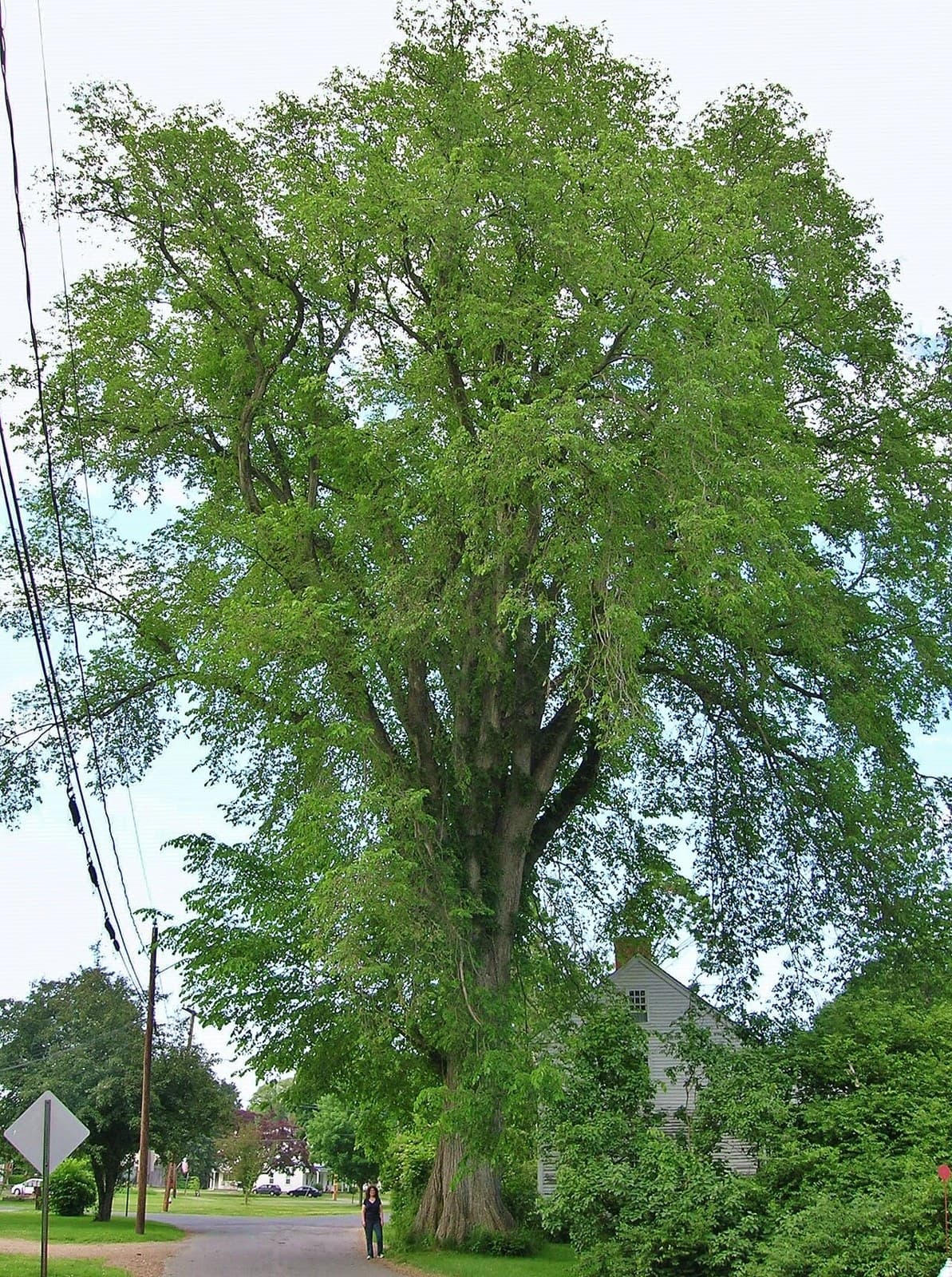
American elm is a large deciduous tree native to eastern North America, once among the most common street trees on the continent before Dutch elm disease devastated populations beginning in the 1920s. Its vase-shaped canopy, fast growth, and tolerance of compacted, wet, and alkaline urban soils made it nearly irreplaceable in the urban landscape. Disease-resistant cultivars - Princeton, Valley Forge, Jefferson, and New Harmony - have revived practical use of the species for new plantings.
Trees grow quickly, often 3–6 feet per year when young, and tolerate a wide range of soils including clay, poorly drained ground, and periodic flooding. Avoid pruning from April through October, when the elm bark beetles that vector Dutch elm disease are active; fresh wounds attract beetles directly. Mulch the root zone broadly from the start. Basal suckers appear readily on stressed or wounded trees and should be removed as soon as they emerge. Trees can live several hundred years on favorable sites.
American elm supports a dense food web: it is a documented larval host for mourning cloak, question mark, eastern comma, and dozens of moth species, making mature specimens ecologically valuable. Multiple Native American nations prepared the inner bark as a mucilaginous remedy for coughs, sore throats, and intestinal complaints, drawing on properties similar to those of slippery elm.
Ecoregions:Northern ForestsEastern Temperate ForestsGreat Plains
Dutch Elm Disease
Sudden wilting and yellowing of leaves on individual branches starting in the upper canopy, often in mid-summer. Affected shoots curl into a shepherd's-crook shape. Cutting into the bark of infected branches reveals brown or olive-green streaking in the outer sapwood. Infection can spread through root grafts to adjacent elms with no above-ground symptoms until advanced.
Prune infected branches at least 10 feet below any visible sapwood streaking; sterilize tools between cuts. Remove all pruned material from the site immediately - do not chip in place or store logs. Avoid any pruning from April through October when elm bark beetles are active. For high-value trees, a certified arborist can apply systemic fungicide injections (propiconazole or thiabendazole) as a preventive or early-infection treatment. Sever root grafts between adjacent elms where underground spread is a risk. For new plantings, select confirmed disease-resistant cultivars such as Princeton, Valley Forge, Jefferson, or New Harmony.
Verticillium Wilt
Lower leaves yellow and wilt, often on one side of the plant, with brown streaking in the stem and crown tissue when cut open. Plants are stunted and decline over the season.
Remove and destroy affected plants. Avoid planting in soil that has grown infected tomatoes, peppers, or other susceptible crops. Rotate beds and improve drainage; there is no cure once a plant is infected.
Fungal leaf spot
Brown or purplish spots on the leaves, often ringed with a yellow halo, that spread and merge in warm, humid, or wet weather; heavily spotted leaves yellow and drop early.
Pick off spotted leaves and clear fallen debris to remove overwintering spores. Improve air circulation by thinning, and water at the base so foliage dries quickly. If it persists, apply a copper- or sulfur-based fungicide at the first sign.
Powdery mildew
White or grey powdery coating on leaves - usually starting on older growth in humid conditions or when nights cool.
Improve air circulation by thinning plants. Apply neem oil or potassium bicarbonate spray at first sign. Avoid overhead watering.