
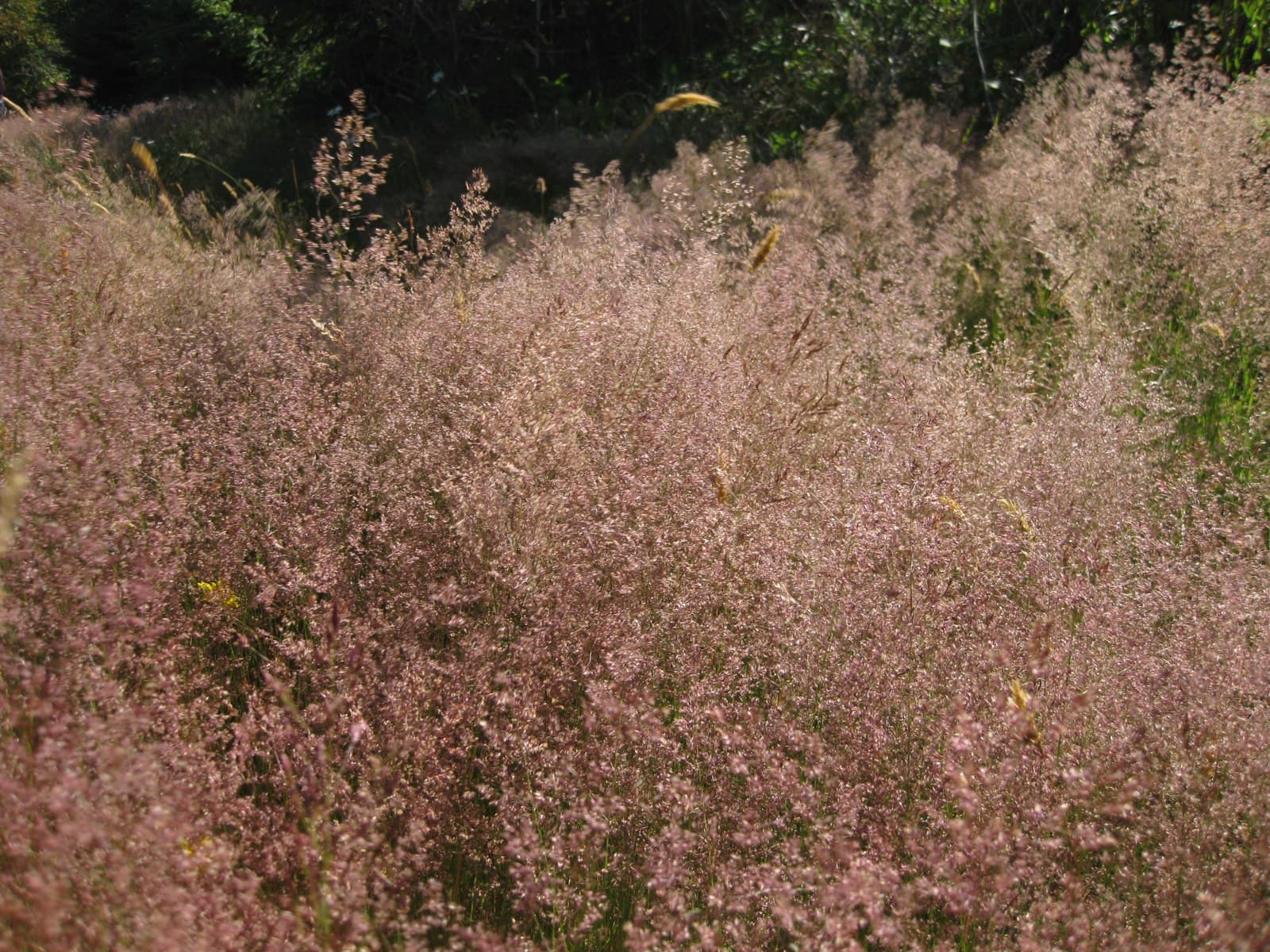
Red fescue is a fine-textured, cool-season grass native across temperate regions of the Northern Hemisphere. Its primary value in gardens is shade tolerance: it outperforms most common turfgrasses under tree canopy and on north-facing slopes, and works equally well as an unmowed groundcover on banks and dry-shade areas where little else survives.
Creeping ecotypes spread by rhizomes to form a dense mat; bunch-forming types stay compact and are common in commercial lawn seed mixes. Growth peaks when soil temperatures hold at 50–65°F, primarily in spring and early fall. Heat above 85–90°F triggers browning and semi-dormancy. Fall seeding gives the most reliable establishment. It tolerates poor to moderately fertile soil at pH 5.5–6.5 and needs little fertilizer once established; excess nitrogen reduces drought hardiness and raises disease risk. In zones 6–8 it remains evergreen through winter.
Research has confirmed Festuca rubra as a hyperaccumulator of arsenic, and it has been evaluated for phytoremediation of soils contaminated by mine drainage. Deer, rabbits, and ground-nesting birds use it for forage and cover.
Ecoregions:TundraTaigaHudson PlainNorthern ForestsNorthwestern Forested MountainsMarine West Coast ForestEastern Temperate ForestsGreat PlainsNorth American DesertsMediterranean California
Red Thread
Pink to red thread-like mycelial strands extend from leaf tips; affected blades turn tan or bleached and patches of grass appear water-soaked before drying to a straw color.
Improve drainage and air circulation around clumps. Avoid overhead irrigation, especially in the evening. Remove and dispose of heavily infected foliage. Apply a fungicide containing thiophanate-methyl or chlorothalonil if infection spreads; do not apply excess nitrogen, which favors the pathogen.
Powdery mildew
White or grey powdery coating on leaves - usually starting on older growth in humid conditions or when nights cool.
Improve air circulation by thinning plants. Apply neem oil or potassium bicarbonate spray at first sign. Avoid overhead watering.
Rust
Orange to brown raised pustules on the undersides of leaves, with yellow spotting on the upper surface. Heavy infections cause leaves to yellow and drop.
Remove and destroy infected leaves. Avoid overhead watering and improve air circulation. Apply a sulfur or copper-based fungicide if it spreads. Clear plant debris in fall.
Flag Smut
Dark teliospore masses form in long stripes along the length of infected leaf blades, which shred into ribbons as the spores mature. Infected tillers are stunted and produce no functional seed heads.
Remove and destroy infected plants before spores disperse. Do not compost infected material. Avoid replanting susceptible grasses in heavily infected soil for at least two seasons. Use certified, smut-tested seed for new seedings.