
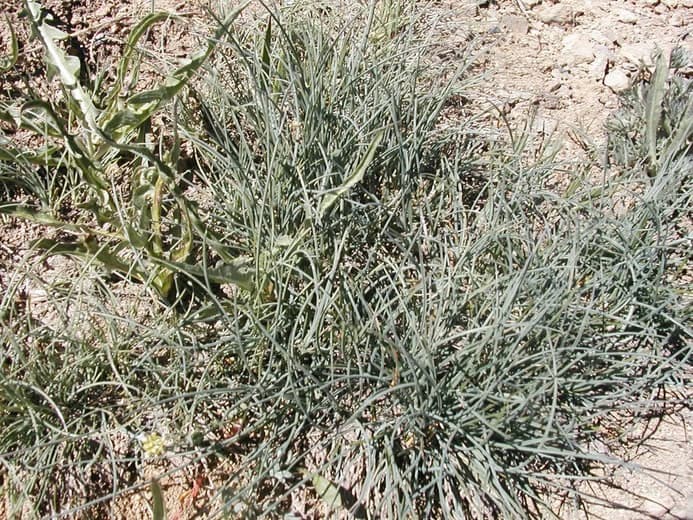
Idaho fescue is a fine-leaved, blue-green to silver-gray bunchgrass native across western North America, from British Columbia south through California and east to the Rocky Mountain foothills. It is one of the dominant grasses of Intermountain West rangelands and Pacific Northwest prairies, and in gardens it delivers year-round structural interest, very low water requirements after establishment, and a naturalistic character that integrates readily with native wildflowers and shrubs.
A cool-season species, it puts on its strongest growth in spring and fall and may go partially dormant during hot, dry summers. Clumps are long-lived but benefit from division every 4–6 years once the center begins to die out. Idaho fescue tolerates rocky, shallow, or clay-heavy soils and grows at elevations up to roughly 10,000 feet. Preferred pH is 6.0–7.5. Mulching is not typically necessary and can trap moisture at the crown. It recovers readily from periodic fire, which historically maintained the open habitats it dominates.
Ecologically, Idaho fescue is a primary forage grass for elk, mule deer, and small mammals. Its dense clumps shelter ground-nesting birds and provide larval host habitat for several native skipper butterfly species, adding wildlife value well beyond its ornamental role.
Ecoregions:Northwestern Forested MountainsMarine West Coast ForestGreat PlainsNorth American DesertsMediterranean California
Helminthosporium Leaf Spot
Small oval to elongated tan or brown lesions with reddish-purple borders appear on leaf blades and sheaths. In severe cases, blades yellow and die back from the tip downward.
Remove and dispose of heavily infected foliage. Avoid overhead irrigation and improve air circulation by thinning dense plantings. Fungicide applications are rarely warranted on established native grasses; correcting site conditions - spacing, drainage, and fertility - is the primary control.
Crown Rot
Lower leaves yellow and wilt; the base of the rosette turns brown and soft, sometimes with white fungal threads at the soil line. Plants collapse in wet conditions.
Remove and destroy affected plants. Improve drainage and avoid overhead watering. Do not mulch directly against the crown. Space plants for airflow and avoid replanting in the same wet spot.
Rust
Orange to brown raised pustules on the undersides of leaves, with yellow spotting on the upper surface. Heavy infections cause leaves to yellow and drop.
Remove and destroy infected leaves. Avoid overhead watering and improve air circulation. Apply a sulfur or copper-based fungicide if it spreads. Clear plant debris in fall.
Red Thread
Pink to red thread-like mycelial strands extend from leaf tips; affected blades turn tan or bleached and patches of grass appear water-soaked before drying to a straw color.
Improve drainage and air circulation around clumps. Avoid overhead irrigation, especially in the evening. Remove and dispose of heavily infected foliage. Apply a fungicide containing thiophanate-methyl or chlorothalonil if infection spreads; do not apply excess nitrogen, which favors the pathogen.