
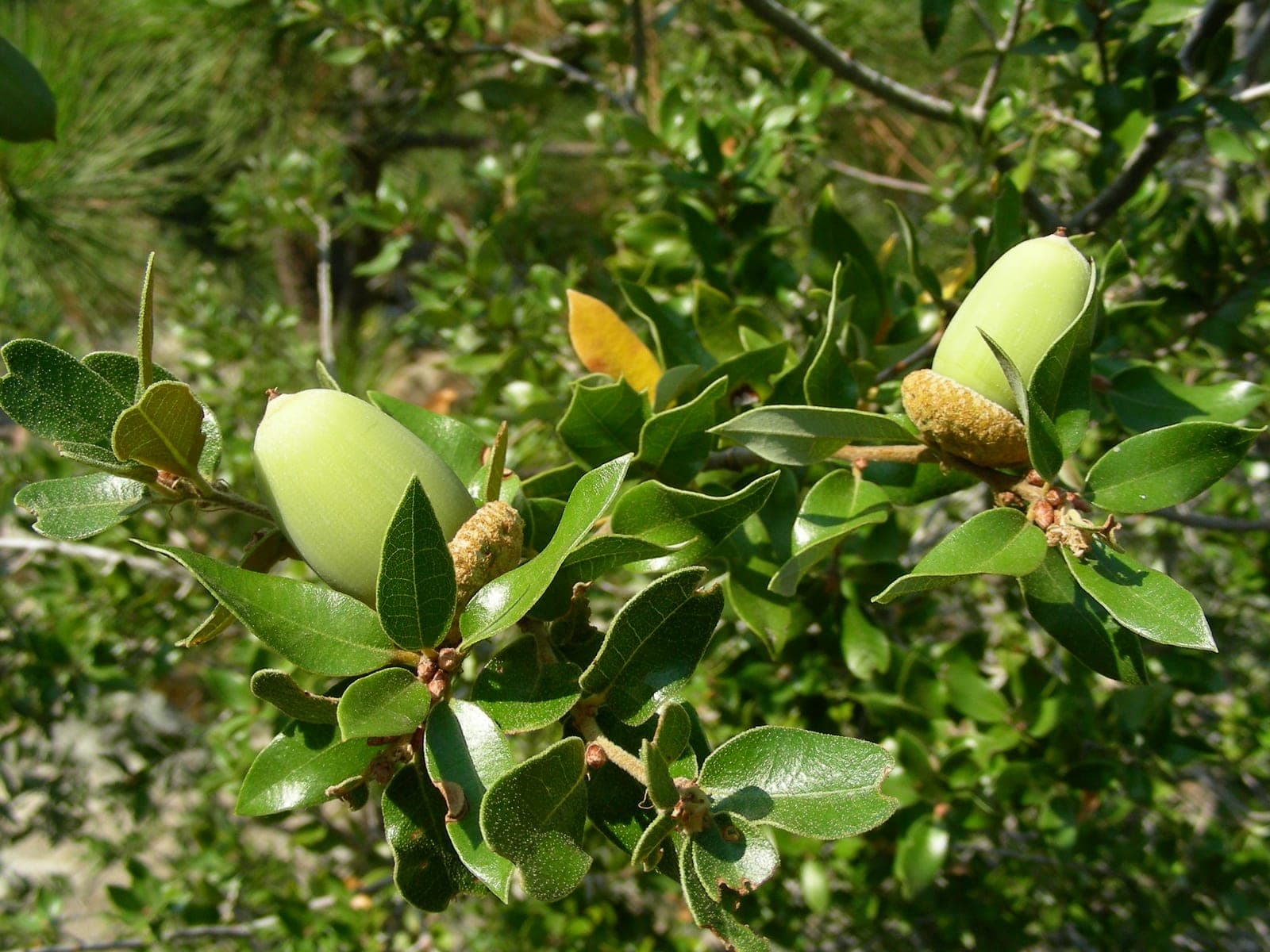
Canyon live oak is a native evergreen oak ranging across the Coast Ranges, Sierra Nevada foothills, and mountain slopes of California, north into southern Oregon, and south through Baja California, with outlying populations in Arizona and New Mexico. It is the most widespread oak in California and a structurally foundational species in chaparral, canyon woodland, and mixed-conifer forest. Gardeners in dry-summer climates grow it as a large shade tree or multi-stemmed screen with year-round foliage and high wildlife value.
Growth form varies with site: trees in sheltered canyons can exceed 60 feet with broad spreading crowns, while plants on exposed ridges stay shrubby and multi-stemmed. Leaves are glossy dark green above, geometrically flat, and may be spine-toothed or smooth on the same individual. Acorns ripen in their second year in shallow cups coated with golden felt, giving rise to the alternative name golden cup oak. The extremely dense wood was used historically to make mauls, earning yet another common name, maul oak. Established trees are highly drought tolerant and must not receive summer irrigation; excess soil moisture promotes Phytophthora root rot and increases susceptibility to sudden oak death. Avoid any soil disturbance or grade changes within the drip line.
Acorns were a dietary staple for many California Indigenous peoples, ground into flour and leached repeatedly with water to remove bitter tannins, then prepared as mush, flatbread, or soup. Oak bark is rich in tannins and has a documented history of traditional use as an astringent applied to minor wounds and taken for diarrhea and sore throat.
Ecoregions:Northwestern Forested MountainsMarine West Coast ForestNorth American DesertsMediterranean CaliforniaTemperate Sierras
Oak Wilt
Leaves wilt and brown starting at branch tips, progressing rapidly toward the trunk. Discoloration may appear as brown or yellow veining across the leaf blade. Individual branches or the entire canopy can defoliate within days to weeks. A cross-section of affected branches reveals dark streaking in the outer sapwood ring.
Contact a certified arborist for trunk injection of propiconazole fungicide, which is most effective as a preventive measure or at earliest symptom onset. Sever root grafts between infected and neighboring live oaks by cutting a trench 3–4 ft deep between trees to prevent fungal spread through connected root systems. Remove and immediately chip, burn, or bury all infected wood; do not store as firewood. Avoid any pruning from March through July when nitidulid sap-feeding beetles that carry the pathogen are most active. Apply wound sealant to all cuts made outside this window within minutes of cutting.
Sudden Oak Death
Reddish-brown to black bleeding cankers on the lower trunk ooze dark sap; inner bark beneath the canker is stained deep red-brown. Foliage may wilt and die rapidly as the canker girdles the stem. Leaf lesions occur on some hosts but are secondary on oaks.
No systemic cure is available once infection is established. Preventive trunk injections with potassium phosphite applied before infection can slow canker progression in high-risk areas. Remove and chip or burn infected wood on-site; do not transport infected material off the property. Report confirmed or suspected cases to the California Department of Food and Agriculture.
Phytophthora Root Rot
Wilting despite moist soil, yellowing leaves, stunted growth, and dark, decayed roots and crown tissue. Vines may collapse during hot weather.
Plant in well-draining soil and avoid waterlogging. Remove and destroy affected vines. Improve drainage with raised beds or amended soil and avoid overwatering.
Powdery mildew
White or grey powdery coating on leaves - usually starting on older growth in humid conditions or when nights cool.
Improve air circulation by thinning plants. Apply neem oil or potassium bicarbonate spray at first sign. Avoid overhead watering.