
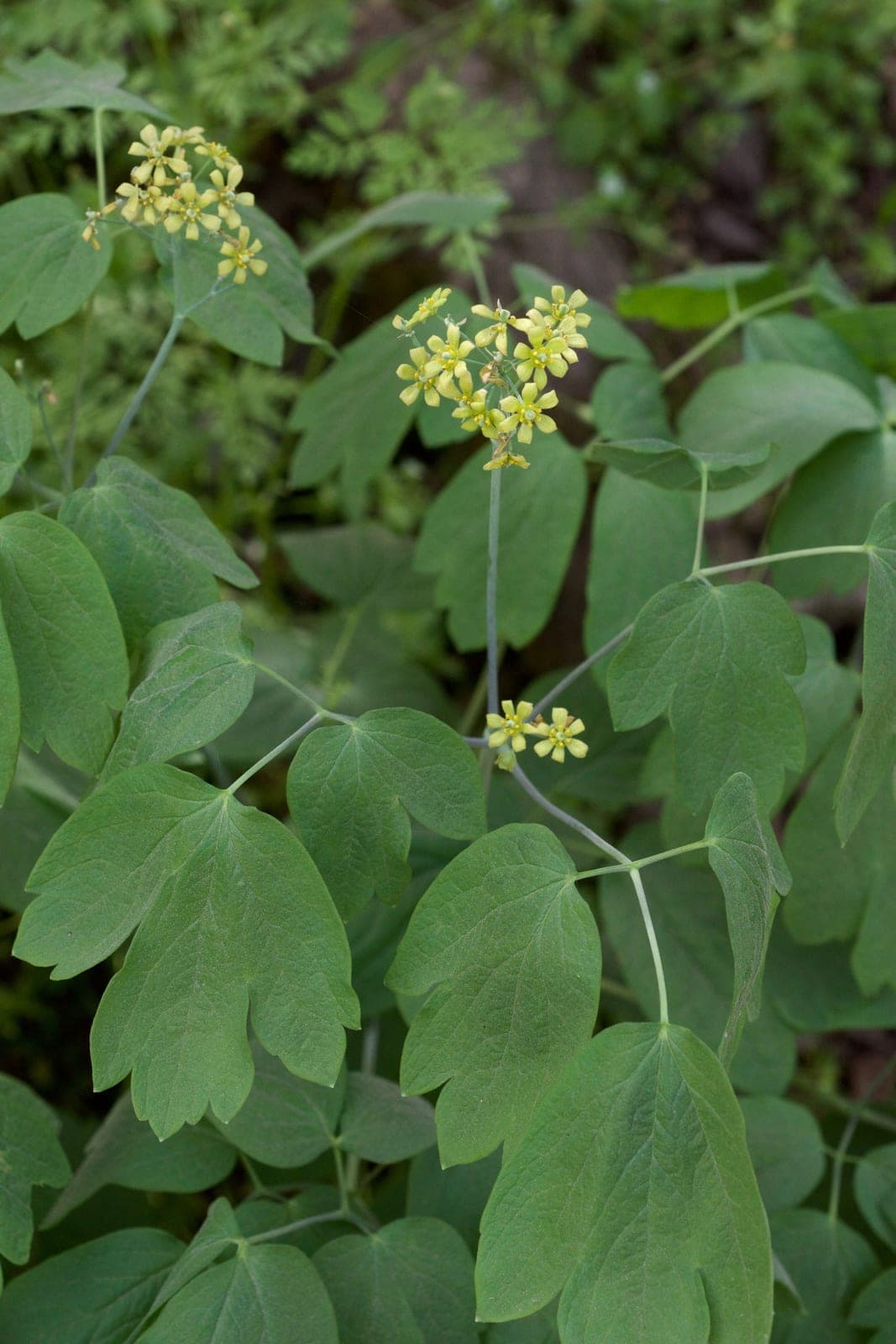
Blue cohosh is a native woodland perennial of eastern North America, recognized by its finely divided bluish-green foliage and metallic-blue seeds that ripen in late summer. A member of the barberry family, it grows naturally in rich, moist forest understories and is a reliable choice for shade gardens where few ornamentals establish well.
Plants emerge early in spring with a distinct bluish cast to their unfurling growth and spread slowly by rhizome, eventually forming loose colonies. Blue cohosh grows best in consistently moist, humus-rich soil with a pH of 5.5–7.0; a permanent organic mulch layer helps replicate the forest floor conditions it favors. It self-seeds modestly in suitable spots. The seeds, while ornamentally striking, are toxic if ingested. Established plants are long-lived and need little intervention once correctly sited.
Indigenous peoples across eastern North America used blue cohosh widely for gynecological conditions. It contains alkaloids including caulosaponin and caulophylline, which have documented uterotonic activity. Roasted seeds have historically been used as a coffee substitute.
Ecoregions:Northern ForestsEastern Temperate ForestsGreat Plains
Fungal leaf spot
Brown or purplish spots on the leaves, often ringed with a yellow halo, that spread and merge in warm, humid, or wet weather; heavily spotted leaves yellow and drop early.
Pick off spotted leaves and clear fallen debris to remove overwintering spores. Improve air circulation by thinning, and water at the base so foliage dries quickly. If it persists, apply a copper- or sulfur-based fungicide at the first sign.
Root rot
Plants wilt, yellow, and stunt even in moist soil; lower stems and roots turn brown, soft, and mushy and the plant may collapse. Most common in heavy, wet, or poorly drained ground.
Improve drainage and stop overwatering, and never plant too deep. Lift and destroy badly affected plants along with the soil around the roots. Grow in raised or free-draining beds to prevent it returning.
Damping Off
Seedlings collapse at the soil line with thin, water-soaked stems; seeds may fail to emerge or rot before sprouting.
Sow in well-draining mix, avoid overwatering, and ensure good airflow. Remove affected seedlings and let the surface dry between waterings.