
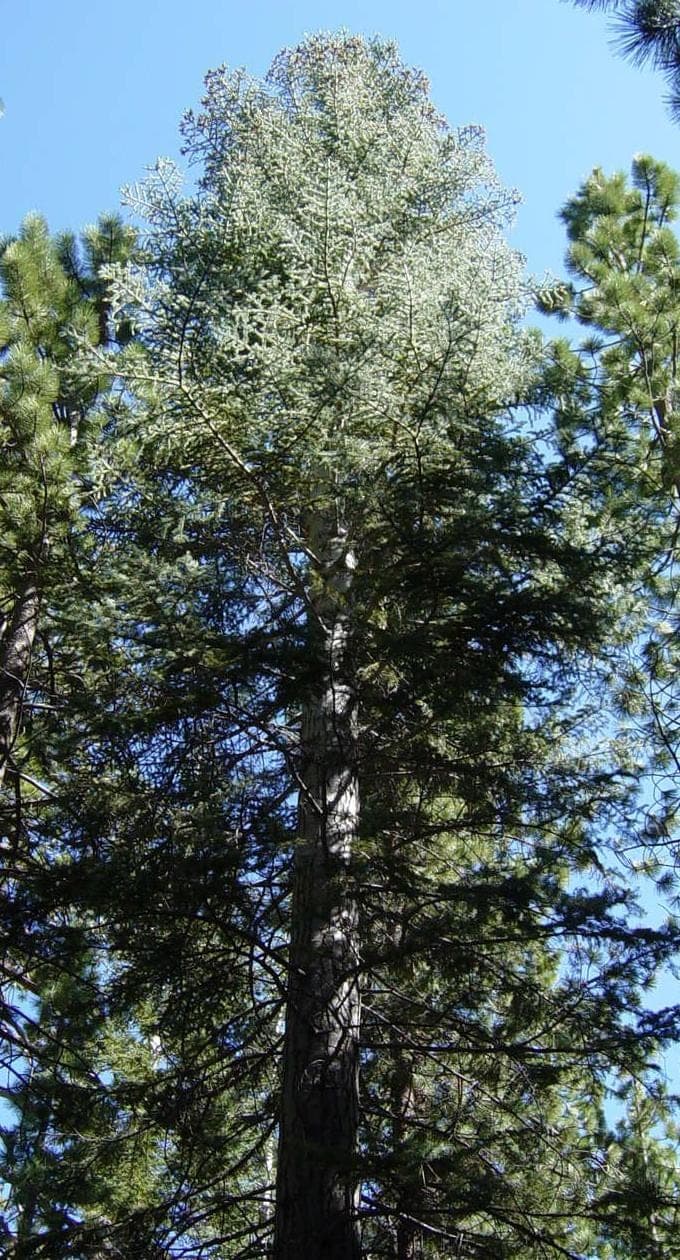
White fir (Abies concolor) is a large evergreen conifer native to the mountain ranges of western North America, from the Sierra Nevada to the southern Rockies. Its silvery blue-green needles and symmetrical pyramidal form make it one of the most ornamentally useful firs in cultivation. It tolerates heat, drought, and moderately alkaline soils far better than other Abies species, which allows it to succeed in gardens well outside its native range, including much of the eastern United States.
Plant in full sun in deep, well-drained soil of slightly acidic to neutral pH. White fir establishes slowly at first, then grows at a moderate rate once roots are settled. A 3–4 inch layer of wood chip mulch over the root zone reduces soil temperature stress and conserves moisture during establishment. The tree dislikes heavy clay, waterlogged soils, and prolonged summer heat and humidity, which can favor fungal disease in the lower zones of its range.
Native peoples throughout its range used the resin as a topical wound dressing and prepared needle infusions as a winter source of vitamin C. The dense evergreen canopy provides year-round cover and nesting habitat for birds and small mammals.
In the Northeast and the upper Midwest the native fir is balsam fir; plant that instead.
Ecoregions:Northwestern Forested MountainsNorth American DesertsMediterranean CaliforniaSouthern Semi-Arid HighlandsTemperate Sierras
Rhizosphaera Needle Cast
Needles on inner and lower branches turn purple-brown in their second year and drop prematurely, leaving progressively bare branch sections that work upward through the canopy over multiple seasons. Rows of small black fungal fruiting bodies (pycnidia) are visible along needle undersides under a hand lens.
Apply chlorothalonil or copper-based fungicide when new needles reach half their final length; repeat 3–4 weeks later. Rake and remove fallen needles beneath the tree. Maintain adequate spacing for air circulation. Treat for 2–3 consecutive springs on heavily infected trees before evaluating recovery.
Cytospora Canker
White or blue-white pitch masses ooze from bark on lower branches and the trunk. Affected branches die back progressively from the tip inward; bark beneath the resin is discolored brown and may have a resinous, sunken appearance.
Prune infected branches well below the canker margin into healthy wood and destroy all cuttings. Sterilize pruning tools with 70% isopropyl alcohol between each cut. No effective fungicide is available; prevent recurrence by avoiding drought stress, soil compaction, and mechanical bark injury.
Phytophthora Root Rot
Wilting despite moist soil, yellowing leaves, stunted growth, and dark, decayed roots and crown tissue. Vines may collapse during hot weather.
Plant in well-draining soil and avoid waterlogging. Remove and destroy affected vines. Improve drainage with raised beds or amended soil and avoid overwatering.
Armillaria Root Rot
Thinning, yellowing canopy with progressive dieback; white, fan-shaped mycelial mats visible beneath bark at or just below the soil line; honey-colored mushroom clusters appearing at the trunk base or on surface roots in autumn.
No chemical cure exists. Improve drainage and avoid any injury to roots or trunk. Remove severely infected trees along with as much root material as possible. Do not replant susceptible species in the same spot.
Rust
Orange to brown raised pustules on the undersides of leaves, with yellow spotting on the upper surface. Heavy infections cause leaves to yellow and drop.
Remove and destroy infected leaves. Avoid overhead watering and improve air circulation. Apply a sulfur or copper-based fungicide if it spreads. Clear plant debris in fall.