
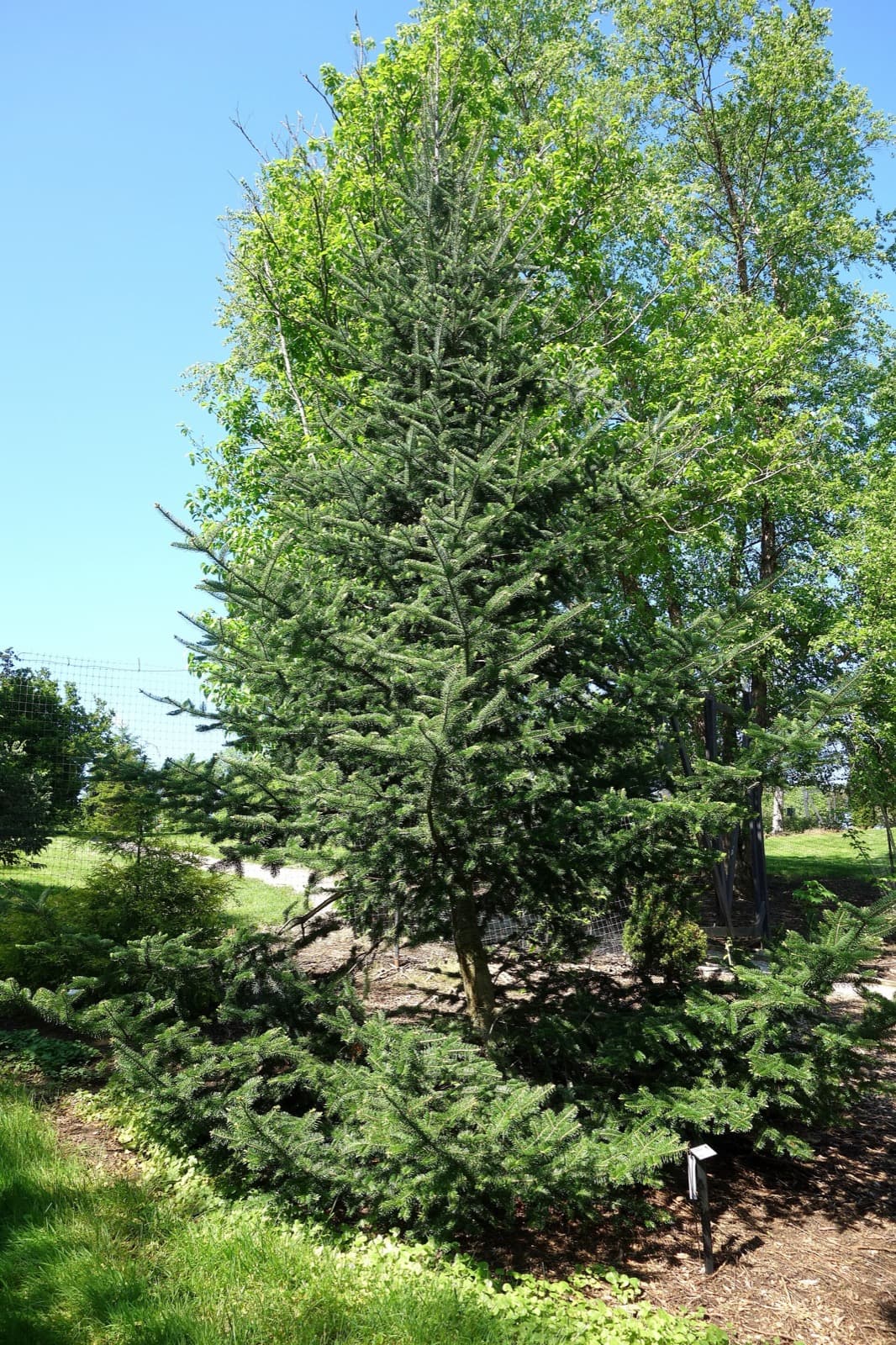
Photo: Daderot (CC0). Canaan fir, Abies balsamea var. phanerolepis, at the Stanley M. Rowe Arboretum
Balsam fir is a medium-to-large native evergreen conifer of the boreal forests of eastern North America. Cold-hardy to zone 3, it provides year-round structure, fragrance, and wildlife value in northern landscapes. Its dense pyramidal form and dark green aromatic needles suit windbreaks, screens, and specimen plantings alike. It is also the most widely planted Christmas tree species in North America.
This species requires cool, humid conditions and declines in heat or drought; zone 6 marks its practical southern limit. It thrives in moist, acidic soils with a pH of 4.5–6.0 and tolerates partial shade, particularly when young. Mulching retains soil moisture and moderates root temperature. Spruce budworm can cause severe defoliation in outbreak years, especially in large plantings and trees stressed by drought. Balsam fir is relatively short-lived among conifers, typically persisting 60–150 years.
Resin collected from bark blisters-historically called Canada balsam-was used by Indigenous peoples as a wound sealant and antiseptic and later became a standard optical-grade adhesive in microscopy. Young shoot tips harvested in spring before the needles harden are edible and used to brew aromatic tea or as a culinary flavoring. Foliage and branches are widely harvested for sachets, pillows, and holiday wreaths.
West of the Great Plains the native fir is white fir, which handles heat, drought and alkaline soil that balsam fir won't.
Ecoregions:Northern ForestsEastern Temperate Forests
Lophodermium Needle Cast
Second-year needles turn yellow then brown, typically from the base outward, and drop prematurely in spring and early summer. Small black elongated fruiting bodies appear on shed needles. Heavy infection visibly thins the canopy.
Rake and destroy all fallen needles each autumn to cut overwintering spore load. Avoid overhead irrigation. Apply a copper-based or chlorothalonil fungicide beginning when new needles reach half their mature length in early summer, with a second application 3–4 weeks later. Maintain adequate spacing to promote air circulation.
Cytospora Canker
White or blue-white pitch masses ooze from bark on lower branches and the trunk. Affected branches die back progressively from the tip inward; bark beneath the resin is discolored brown and may have a resinous, sunken appearance.
Prune infected branches well below the canker margin into healthy wood and destroy all cuttings. Sterilize pruning tools with 70% isopropyl alcohol between each cut. No effective fungicide is available; prevent recurrence by avoiding drought stress, soil compaction, and mechanical bark injury.
Armillaria Root Rot
Thinning, yellowing canopy with progressive dieback; white, fan-shaped mycelial mats visible beneath bark at or just below the soil line; honey-colored mushroom clusters appearing at the trunk base or on surface roots in autumn.
No chemical cure exists. Improve drainage and avoid any injury to roots or trunk. Remove severely infected trees along with as much root material as possible. Do not replant susceptible species in the same spot.
Rust
Orange to brown raised pustules on the undersides of leaves, with yellow spotting on the upper surface. Heavy infections cause leaves to yellow and drop.
Remove and destroy infected leaves. Avoid overhead watering and improve air circulation. Apply a sulfur or copper-based fungicide if it spreads. Clear plant debris in fall.