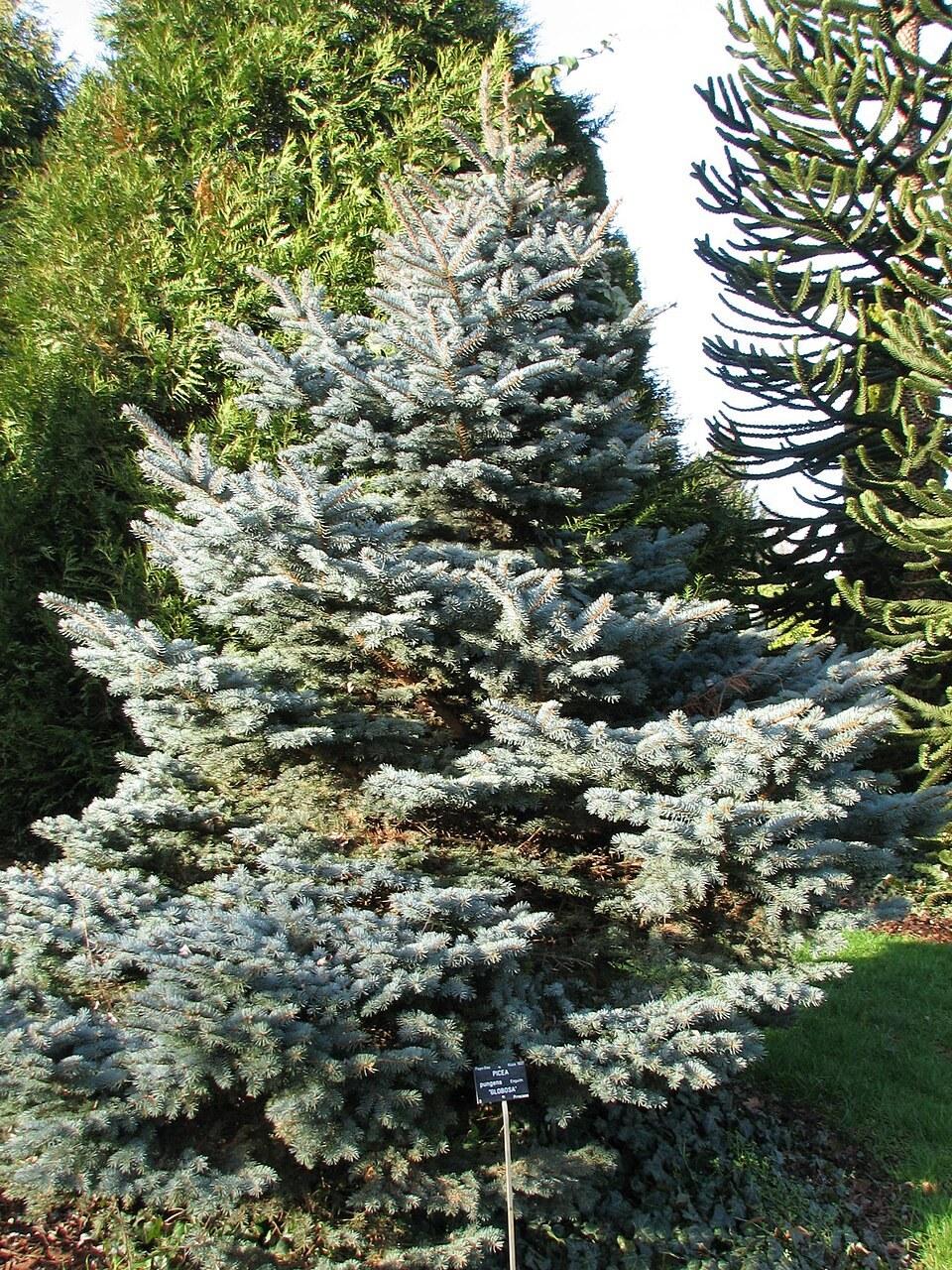
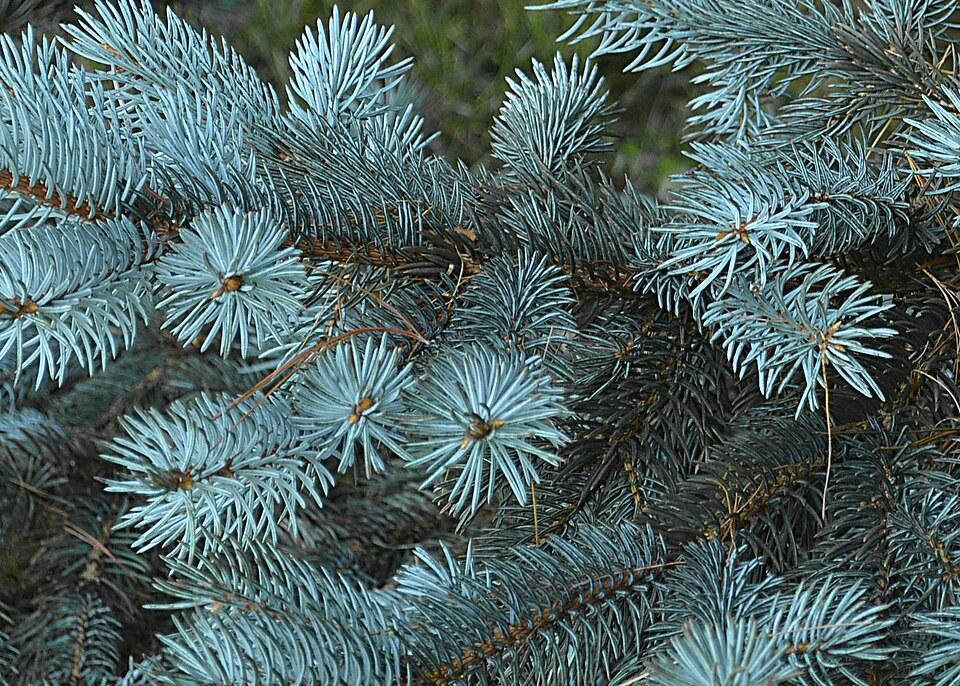
Colorado blue spruce (Picea pungens) is a dense, pyramidal evergreen native to the central and southern Rocky Mountains, where it grows along streams and on moist slopes between about 6,000 and 11,000 feet. Its stiff, sharply pointed needles range from green to an intense silver-blue; the color comes from a wax coating that is heaviest on new growth, and nursery trees are selected for it. It is the state tree of Colorado.
In gardens it is used as a specimen, a windbreak or a screen, holding its branches to the ground for decades and typically reaching 30 to 60 feet. It wants full sun, room for air to move through the branches, and soil that drains. Established trees tolerate drought, wind and cold better than most spruces, and deer rarely browse the prickly foliage.
It is far happier in the dry air of the mountain West than in humid climates. In the East, Midwest and Pacific Northwest, Rhizosphaera needle cast and cytospora canker commonly strip the lower branches of older trees, so give it an open site, avoid overhead watering and do not crowd it. Where humidity is high, white fir (Abies concolor) gives a similar blue color with fewer disease problems. For small gardens, dwarf selections such as 'Niemetz' keep the color at shrub size.
Ecoregions:Northwestern Forested MountainsGreat PlainsNorth American DesertsTemperate Sierras
These dates are for Zone 6b. Enter your ZIP to time every job to your own frost dates.
- watch · Any time in fallWater deeply before the ground freezes after a dry season; drought-stressed trees are the ones canker attacks.
- buy · Jan 2 - Jan 16Order trees - about two months before planting
- plant · Mar 13 - Apr 10Plant container or balled-and-burlapped trees while the soil is cool, in full sun with room for the mature spread; mulch and water through the first three years.
- watch · Any time in springCheck inner needles on the lower branches for purple-brown color and rows of tiny black dots, the signs of Rhizosphaera needle cast.
- watch · Any time in summerLook for sunken, resin-coated cankers on lower branches; prune cankered limbs back to the trunk in dry weather and clean tools between cuts.
Problems & troubleshooting
Common problems
Rhizosphaera Needle Cast
Needles on inner and lower branches turn purple-brown in their second year and drop prematurely, leaving progressively bare branch sections that work upward through the canopy over multiple seasons. Rows of small black fungal fruiting bodies (pycnidia) are visible along needle undersides under a hand lens.
Apply chlorothalonil or copper-based fungicide when new needles reach half their final length; repeat 3–4 weeks later. Rake and remove fallen needles beneath the tree. Maintain adequate spacing for air circulation. Treat for 2–3 consecutive springs on heavily infected trees before evaluating recovery.
Cytospora Canker
White or blue-white pitch masses ooze from bark on lower branches and the trunk. Affected branches die back progressively from the tip inward; bark beneath the resin is discolored brown and may have a resinous, sunken appearance.
Prune infected branches well below the canker margin into healthy wood and destroy all cuttings. Sterilize pruning tools with 70% isopropyl alcohol between each cut. No effective fungicide is available; prevent recurrence by avoiding drought stress, soil compaction, and mechanical bark injury.