
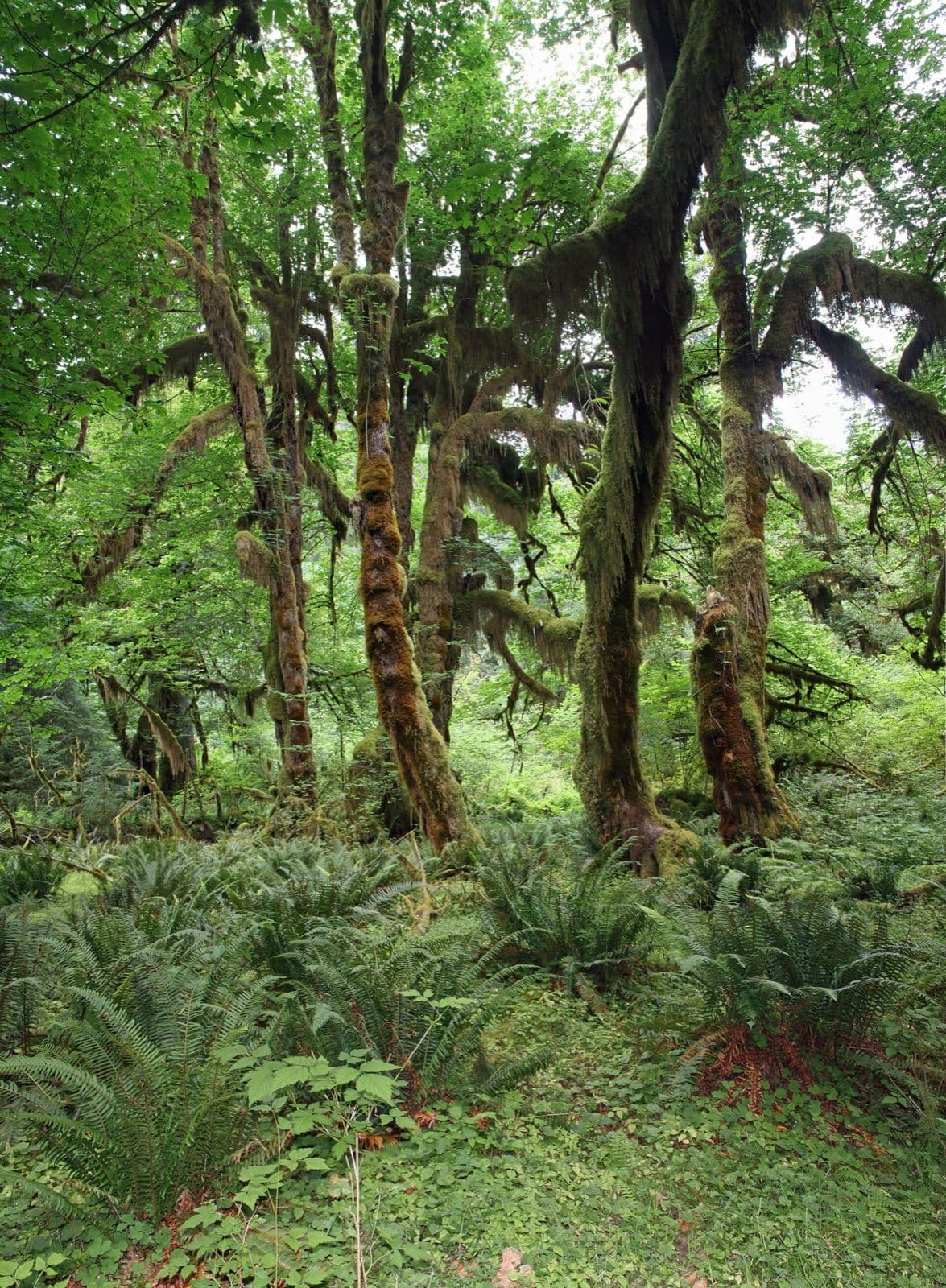
Acer macrophyllum is the largest maple species in North America, native to the Pacific Coast from southeastern Alaska to southern California. Leaves routinely exceed 12 inches across, giving the tree an unmistakable silhouette. Fall foliage turns clear golden yellow, and the paired winged seeds are among the largest produced by any maple.
Bigleaf maple grows naturally along streams, canyon bottoms, and moist lower slopes, often alongside red alder, Douglas fir, and western red cedar. It is fast-growing in its first decades and reaches 40–75 ft in cultivation. Bark on mature trees becomes deeply furrowed and typically supports thick growths of moss, lichens, and polypody fern - a distinctive textural quality in older specimens. The species tolerates occasional drought once established but performs best with consistent soil moisture and prefers a soil pH in the 5.5–7.0 range.
The sap can be tapped in late winter to produce maple syrup, though sugar concentration runs lower than in sugar maple, requiring larger volumes of sap. Indigenous peoples of the Pacific Northwest used inner bark preparations for sore throats and lung complaints. The timber is commercially significant - figured bigleaf maple is a standard tonewood for guitar backs and violin ribs and is also used in furniture and flooring.
Ecoregions:Northwestern Forested MountainsMarine West Coast ForestMediterranean California
Maple Anthracnose
Irregular brown or tan spots that follow and spread between leaf veins, giving leaves a scorched or blighted appearance. Severe infections cause premature leaf drop. In wet springs, small cankers may appear on young shoots.
Rake and remove fallen leaves each autumn to reduce overwintering fungal spores. Avoid overhead irrigation. Apply a copper-based fungicide at bud break during wet spring conditions. Prune selectively to improve canopy airflow.
Maple Tar Spot
Pale yellow-green spots appear on upper leaf surfaces in early summer. By late summer they enlarge into raised, glossy black blotches up to 1 in across, closely resembling tar splashes. Caused by Rhytisma acerinum and related species.
Rake and destroy all fallen leaves in autumn to eliminate overwintering spores. Fungicide applications are rarely justified on established trees. Improve air circulation through selective pruning where practical.
Verticillium Wilt
Lower leaves yellow and wilt, often on one side of the plant, with brown streaking in the stem and crown tissue when cut open. Plants are stunted and decline over the season.
Remove and destroy affected plants. Avoid planting in soil that has grown infected tomatoes, peppers, or other susceptible crops. Rotate beds and improve drainage; there is no cure once a plant is infected.
Armillaria Root Rot
Thinning, yellowing canopy with progressive dieback; white, fan-shaped mycelial mats visible beneath bark at or just below the soil line; honey-colored mushroom clusters appearing at the trunk base or on surface roots in autumn.
No chemical cure exists. Improve drainage and avoid any injury to roots or trunk. Remove severely infected trees along with as much root material as possible. Do not replant susceptible species in the same spot.
Eutypella Canker
Large, target-shaped cankers on the trunk and major limbs, with concentric rings of callus tissue surrounding sunken, dead bark. Infected wood shows orange-brown discoloration in cross section. Cankers expand over multiple years and can girdle and kill major limbs or the entire tree.
No effective chemical control exists. Remove infected branches with at least 6 in margin into healthy wood and destroy the debris. Trunk cankers may be surgically excised by a certified arborist if the canker has not girdled the stem. Remove trees with girdling trunk cankers. Prevent bark wounds during mowing and maintenance. Maintain tree vigor through mulching and adequate soil moisture to slow canker expansion.