
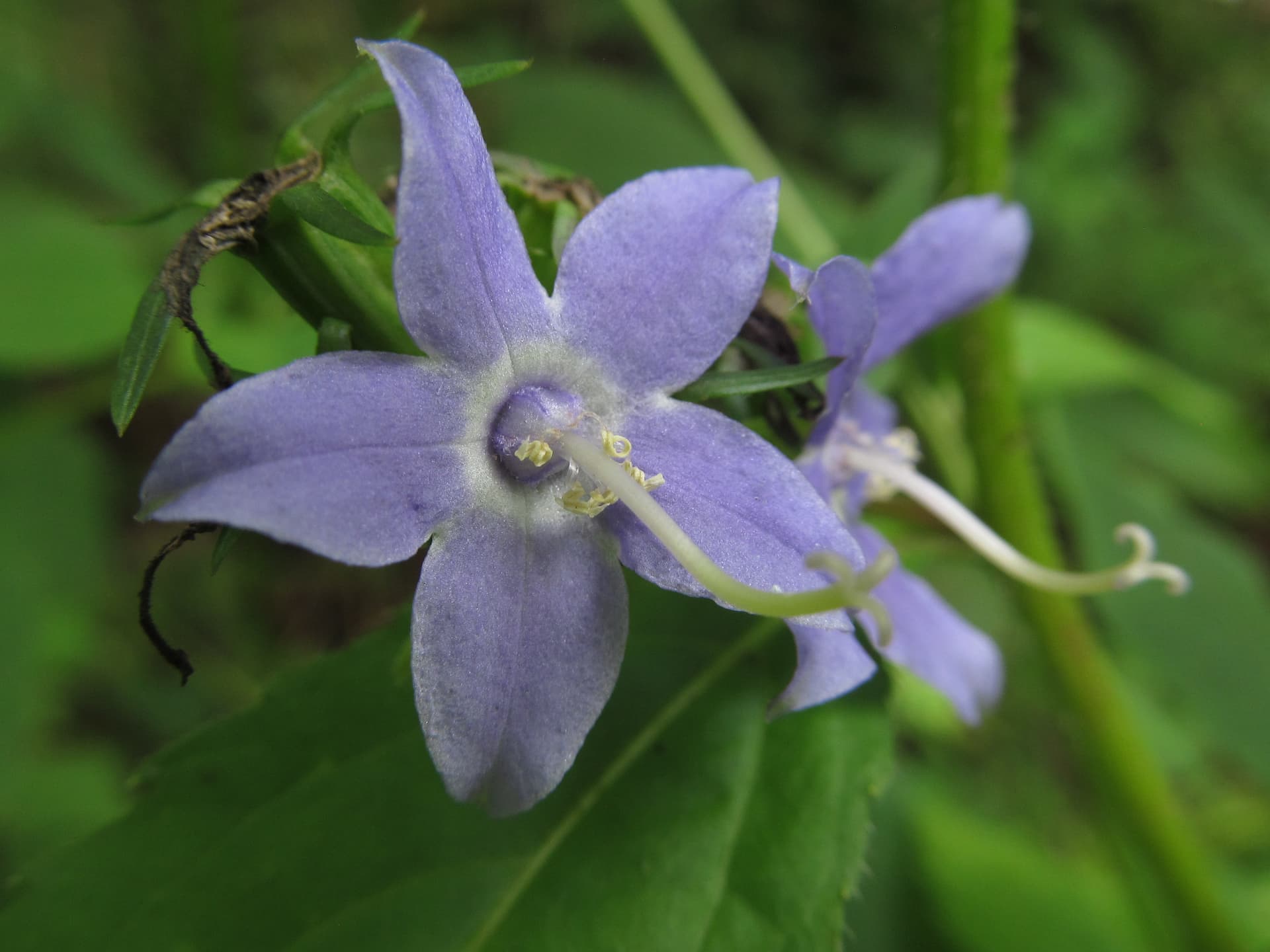
American bellflower (Campanula americana) is a native annual or biennial wildflower of eastern North America. It produces flat, star-shaped pale blue to violet flowers along upright stems from July through September, reaching heights of 3–6 feet - unusually tall for a native campanula. It colonizes woodland edges, stream banks, and shaded garden borders with little intervention.
Whether a plant behaves as an annual or biennial depends on germination timing. Seeds that sprout in fall overwinter as basal rosettes and flower the following summer; seeds that germinate in spring complete their lifecycle the same season. Under suitable conditions the species self-seeds prolifically, steadily naturalizing without becoming aggressive. It performs best in moist, humus-rich soil with consistent moisture and does best in partial to full shade, though it tolerates more sun where moisture is reliable.
The wide, accessible flower tube is well-suited to native long-tongued bees and bumblebees, which are the primary pollinators. Ruby-throated hummingbirds also visit regularly. Because it fills vertical space in shaded gaps and renews itself by seed, it functions as a reliable short-lived colonizer in naturalistic woodland plantings.
Ecoregions:Eastern Temperate ForestsGreat Plains
Powdery mildew
White or grey powdery coating on leaves - usually starting on older growth in humid conditions or when nights cool.
Improve air circulation by thinning plants. Apply neem oil or potassium bicarbonate spray at first sign. Avoid overhead watering.
Fungal leaf spot
Brown or purplish spots on the leaves, often ringed with a yellow halo, that spread and merge in warm, humid, or wet weather; heavily spotted leaves yellow and drop early.
Pick off spotted leaves and clear fallen debris to remove overwintering spores. Improve air circulation by thinning, and water at the base so foliage dries quickly. If it persists, apply a copper- or sulfur-based fungicide at the first sign.
Crown Rot
Lower leaves yellow and wilt; the base of the rosette turns brown and soft, sometimes with white fungal threads at the soil line. Plants collapse in wet conditions.
Remove and destroy affected plants. Improve drainage and avoid overhead watering. Do not mulch directly against the crown. Space plants for airflow and avoid replanting in the same wet spot.
Damping Off
Seedlings collapse at the soil line with thin, water-soaked stems; seeds may fail to emerge or rot before sprouting.
Sow in well-draining mix, avoid overwatering, and ensure good airflow. Remove affected seedlings and let the surface dry between waterings.