
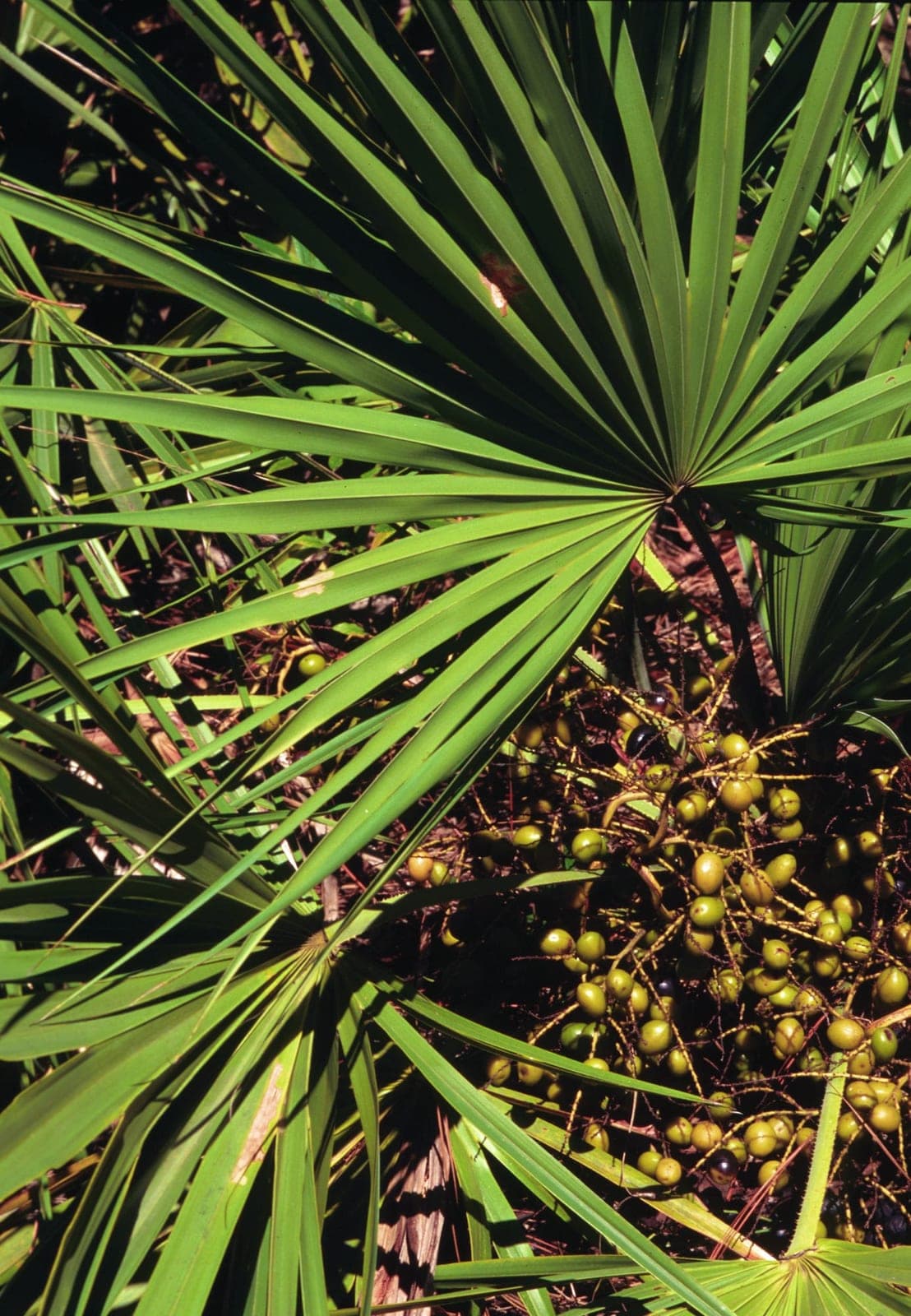
Saw palmetto (Serenoa repens) is a native fan palm of the southeastern United States, forming dense colonies in Florida flatwoods, coastal scrub, and longleaf pine savannas from South Carolina to Texas. In the landscape it functions as a bold, structural evergreen shrub with silvery-green to blue-green fan leaves and high wildlife value. Once established it tolerates drought, salt spray, and prolonged heat with little intervention.
It spreads via underground rhizomes, slowly expanding into wide-spreading clumps at a rate of only a few inches per year on above-ground stems. Sandy, acidic, well-drained soils in full sun produce the most vigorous growth, though the plant tolerates partial shade. In zones 7b–8a, hard freezes may kill top growth, but the root system almost always resprouts. The species is highly fire-adapted and has evolved to recover vigorously after burns. Avoid clay or persistently wet soils, which promote root rot. Mulching with pine straw mimics its natural habitat and supports establishment. The serrated petioles that give the plant its name can cause serious cuts; use heavy gloves when pruning.
The berries were a significant food source for indigenous peoples of the Gulf and Atlantic coastal plains, eaten fresh, dried, or processed into syrup. Modern clinical research focuses on fatty-acid-rich berry extracts for benign prostatic hyperplasia and associated lower urinary tract symptoms; saw palmetto extract ranks among the most widely sold botanical supplements globally. Preliminary evidence also explores effects on androgenetic alopecia.
Graphiola Leaf Spot (False Smut)
Small, hard, dark brown to black wart-like pustules erupt from both surfaces of fronds, often ringed by yellow halos. Heavily infected fronds yellow and die back prematurely.
Remove and destroy heavily infected fronds. Improve air circulation around the crown by pruning adjacent vegetation. Apply copper-based fungicide in spring as new growth emerges and repeat monthly through the growing season if infection pressure remains high.
Ganoderma Butt Rot
White rot of heartwood at the base and lower trunk. Large, hard, shelf-like bracket fungi with a shiny reddish-brown upper surface and cream-colored pore surface appear at or near the soil line. Infected trees lose structural integrity with little visible external warning until failure.
No effective chemical treatment once established. Remove and destroy conks before they release spores. Have a certified arborist assess structural risk; removal is often required for trees near structures or high-traffic areas. Prevent infection by avoiding root collar wounds, reducing soil compaction, and maintaining tree health.
Palm Pink Rot
Water-soaked, darkening lesions at petiole bases and on lower fronds; pink to salmon-colored spore masses develop on affected tissue; fronds collapse and hang without detaching cleanly.
Cut out and dispose of infected fronds and petiole tissue. Avoid overhead irrigation and any practice that keeps the crown wet. Improve soil drainage around the trunk. Apply copper-based fungicide to the crown and petiole bases at first sign of infection and repeat every 2–3 weeks while warm, humid conditions persist.
Phytophthora Root Rot
Wilting despite moist soil, yellowing leaves, stunted growth, and dark, decayed roots and crown tissue. Vines may collapse during hot weather.
Plant in well-draining soil and avoid waterlogging. Remove and destroy affected vines. Improve drainage with raised beds or amended soil and avoid overwatering.