
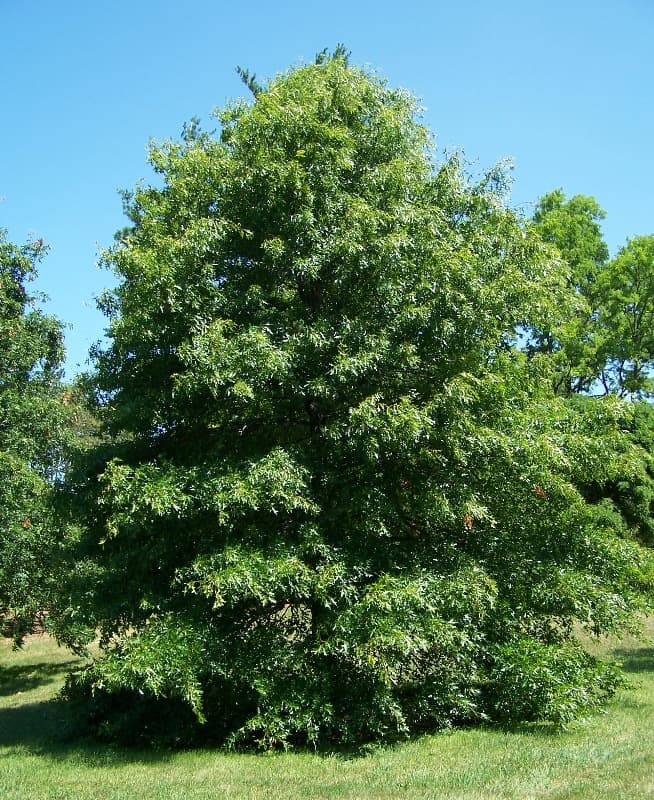
Pin oak is a native deciduous tree in the red oak group, naturally occurring in bottomland and seasonally wet sites across eastern North America. It is one of the most widely planted landscape oaks because of its relatively fast growth rate for the genus, strong pyramidal form, ease of transplanting, and tolerance of urban stressors including air pollution, compacted soil, and road runoff.
The tree has a distinctive tiered branch architecture: lower branches angle downward, middle branches spread horizontally, and upper branches point upward. Leaves are deeply cut with five to seven sharply pointed lobes separated by broad sinuses. Fall color is russet-red to bronze. Marcescent dead leaves often persist on the lower branches through winter. Pin oak tolerates seasonally wet and poorly drained soil better than most oaks, but it performs well in average moist conditions. It is a strict acid-soil plant; in high-pH or calcareous substrates it develops iron chlorosis, causing interveinal yellowing that progressively weakens the tree. Soil pH must be maintained below 6.5, and the species should not be planted on sites with alkaline bedrock, concrete rubble, or high-lime fill.
Pin oak has considerable ecological value as a native. Its small, nearly round acorns are consumed by deer, wild turkey, wood ducks, blue jays, and numerous other birds and mammals. The species supports hundreds of native Lepidoptera caterpillar species and, as trees age, provides nesting cavities for woodpeckers and other cavity-nesting birds. It ranks among the most ecologically productive trees available for residential and urban planting in the eastern United States.
Ecoregions:Eastern Temperate ForestsGreat Plains
Oak Wilt
Leaves wilt and brown starting at branch tips, progressing rapidly toward the trunk. Discoloration may appear as brown or yellow veining across the leaf blade. Individual branches or the entire canopy can defoliate within days to weeks. A cross-section of affected branches reveals dark streaking in the outer sapwood ring.
Contact a certified arborist for trunk injection of propiconazole fungicide, which is most effective as a preventive measure or at earliest symptom onset. Sever root grafts between infected and neighboring live oaks by cutting a trench 3–4 ft deep between trees to prevent fungal spread through connected root systems. Remove and immediately chip, burn, or bury all infected wood; do not store as firewood. Avoid any pruning from March through July when nitidulid sap-feeding beetles that carry the pathogen are most active. Apply wound sealant to all cuts made outside this window within minutes of cutting.
Oak Anthracnose
Brown, irregular dead areas along and between leaf veins appearing soon after bud break, typically in cool, wet springs. Affected leaves curl, wither, and drop prematurely. Severe or repeated infections cause twig dieback in the lower and interior crown.
Rake and dispose of all fallen leaves in autumn to reduce overwintering inoculum. Prune affected twigs back to healthy wood during dry winter weather and dispose of the material. Apply a copper-based or mancozeb fungicide at bud break for young trees or those with a history of severe annual infection. Healthy established trees typically recover without chemical treatment and produce a second flush of foliage.
Hypoxylon Canker
Outer bark sloughs off stressed limbs to reveal gray, tan, or black crusty fungal stromata on the exposed wood surface; affected branches die back progressively and cross-sections of sapwood show brown streaking.
No effective chemical control exists. Remove affected limbs promptly and dispose of all infected wood off-site - do not chip or compost it on the property. Reduce predisposing stress by providing deep irrigation during drought and avoiding mechanical injury to roots and bark. The fungus is opportunistic; healthy, unstressed trees resist infection.
Oak Leaf Blister
Raised, blister-like bulges on the upper leaf surface with corresponding concave depressions on the underside. Affected tissue may turn light brown or grayish by midsummer. Heavy infections can cause early defoliation but rarely threaten tree health on an established tree.
No treatment is needed on mature, vigorous trees. Rake and dispose of fallen leaves in autumn to reduce the overwintering spore load of the causal fungus (Taphrina caerulescens). On trees with a history of severe symptoms, apply a single dose of copper-based fungicide at bud swell in early spring before leaf tissue is exposed.