
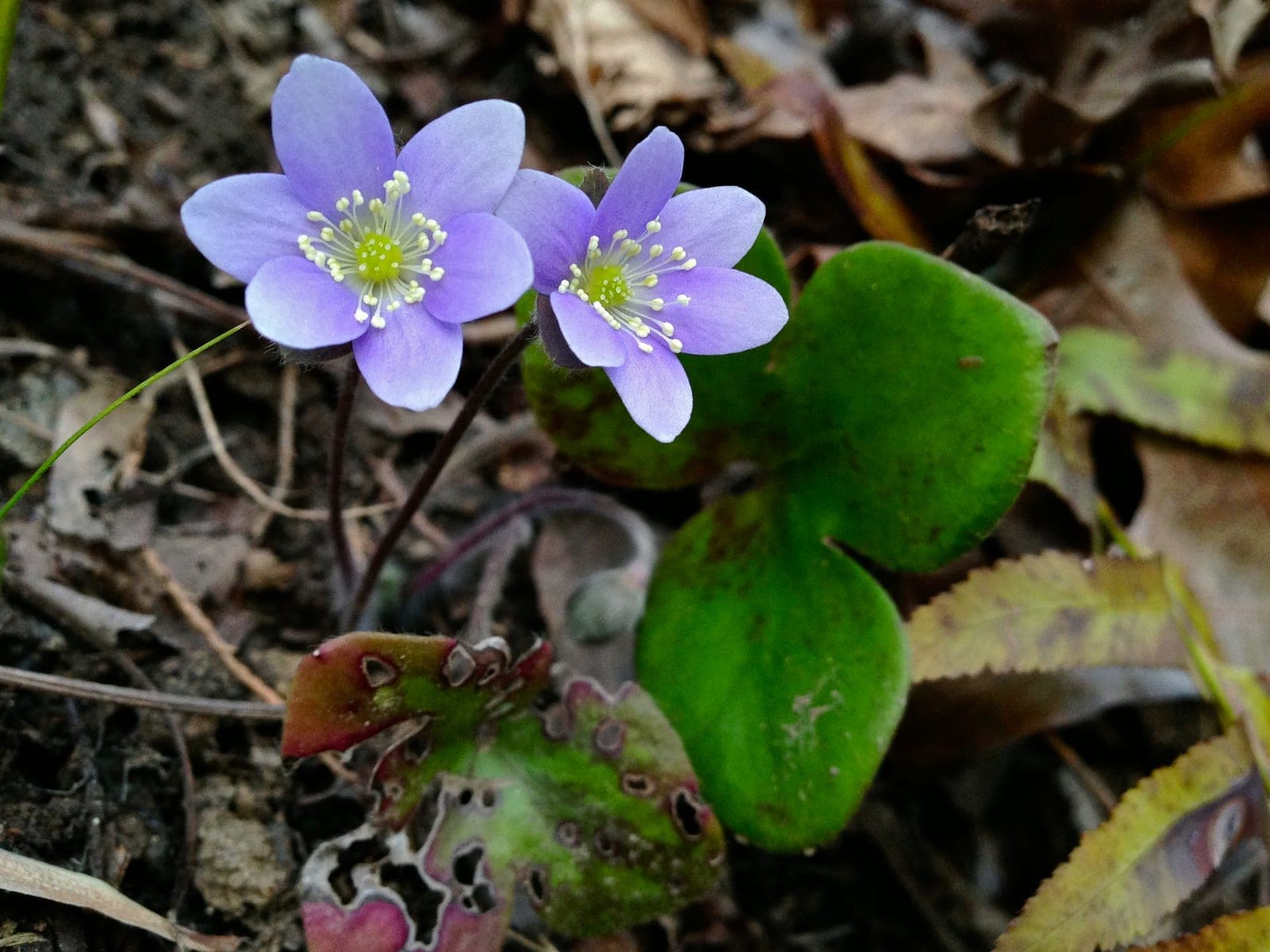
Hepatica americana is a small native wildflower in the buttercup family, blooming from late February through April across eastern North America. It is among the first perennials to appear each spring, producing lavender, pink, or white flowers on fuzzy stems before or alongside the new foliage. The leathery, three-lobed leaves mature to dark green, often marked with silver or purple, and persist through winter, providing year-round ground interest in shaded beds.
It grows best in partial to full shade beneath deciduous trees, where accumulated leaf litter mimics its native forest-floor habitat. Neutral to slightly alkaline, humus-rich, well-drained soil suits it best; heavy or waterlogged soil promotes crown and root rot. Plants self-seed slowly and expand into loose colonies over many years without becoming weedy. Cold-hardy to zone 3, hepatica tolerates hard freezes while in leaf and even while in bud.
Native peoples and early European herbalists used preparations of this plant for liver, gallbladder, and kidney complaints, a connection reflected in the genus name, derived from the Greek for liver, and reinforced by the doctrine of signatures - the lobed leaves were seen to resemble the liver. Folk use also extended to coughs and indigestion. The plant contains saponins and tannins; no strong clinical evidence supports its therapeutic use today.
Ecoregions:Northern ForestsEastern Temperate Forests
Fungal leaf spot
Brown or purplish spots on the leaves, often ringed with a yellow halo, that spread and merge in warm, humid, or wet weather; heavily spotted leaves yellow and drop early.
Pick off spotted leaves and clear fallen debris to remove overwintering spores. Improve air circulation by thinning, and water at the base so foliage dries quickly. If it persists, apply a copper- or sulfur-based fungicide at the first sign.
Root rot
Plants wilt, yellow, and stunt even in moist soil; lower stems and roots turn brown, soft, and mushy and the plant may collapse. Most common in heavy, wet, or poorly drained ground.
Improve drainage and stop overwatering, and never plant too deep. Lift and destroy badly affected plants along with the soil around the roots. Grow in raised or free-draining beds to prevent it returning.
Powdery mildew
White or grey powdery coating on leaves - usually starting on older growth in humid conditions or when nights cool.
Improve air circulation by thinning plants. Apply neem oil or potassium bicarbonate spray at first sign. Avoid overhead watering.
Foliar Nematode
Angular brown or black patches on leaves, bounded by leaf veins, starting on lower foliage and moving upward. Affected leaves wither but stay attached.
Remove and destroy infected leaves and surrounding debris. Avoid overhead watering and wetting foliage. Space plants for airflow and do not compost affected material. Severely infested plants should be dug out and discarded.