
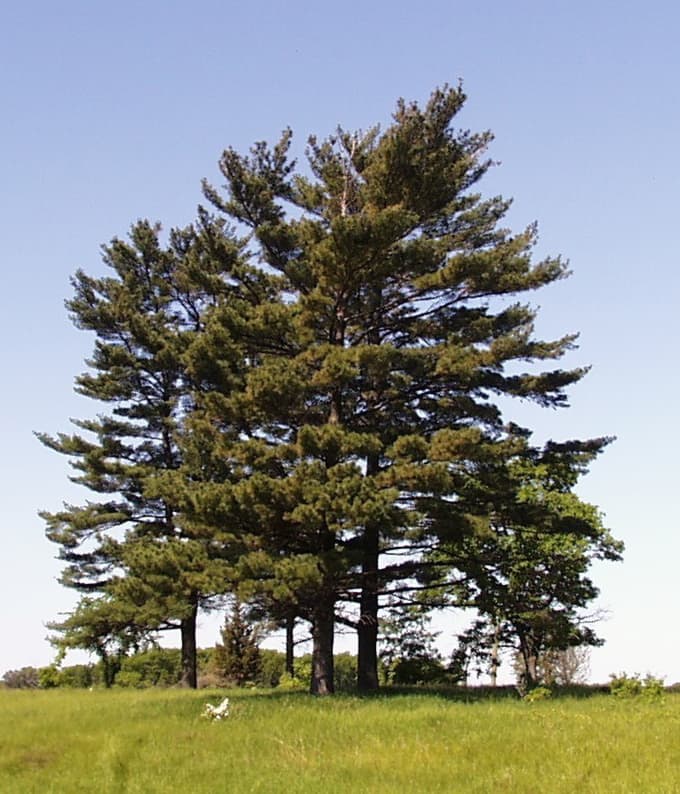
Eastern white pine (Pinus strobus) is the largest conifer native to eastern North America, reaching 50–80 ft in cultivation and over 150 ft in old-growth stands. Needles grow in bundles of five, are soft and blue-green, and make this species easy to identify at a glance. Gardeners plant it as a specimen, windbreak, or privacy screen; it establishes quickly and provides year-round structure and wildlife cover.
White pine thrives in moist, well-drained, slightly acidic soil and is sensitive to road salt, compacted soil, sustained flooding, and heavy air pollution - factors that limit its usefulness in dense urban settings. Maintain a wide mulch ring to preserve soil moisture and pH. Where white pine blister rust (Cronartium ribicola) is present, avoid planting near currants or gooseberries (Ribes spp.), which serve as alternate hosts for the fungus. White pine weevil frequently attacks the central leader; remove infested terminals promptly and train a replacement lateral upward.
Indigenous peoples across eastern North America used white pine as both food and medicine. The inner bark (cambium) was eaten fresh or dried as an emergency food. Needle infusions, naturally high in vitamin C, were used to prevent and treat scurvy. Bark and needle preparations were taken for coughs, colds, and respiratory congestion. Pine resin was applied to wounds and used as a drawing salve for splinters and skin infections - practices documented among the Haudenosaunee, Ojibwe, and other nations.
Ecoregions:Northern ForestsEastern Temperate ForestsGreat Plains
White Pine Blister Rust
Orange-yellow spore pustules appear on the undersides of leaves in late summer, followed by yellowing and premature leaf drop on the currant. On nearby five-needled pines, look for elongated sunken cankers with blistered bark producing white or orange spore masses.
Remove and destroy all infected leaves; do not compost. Avoid siting Ribes within several hundred feet of five-needled pines such as eastern white pine, western white pine, and sugar pine. Preventive copper-based fungicide applied at bud break can reduce spore load on the currant in high-risk areas. No curative treatment reverses established infection on pines. Check state and provincial regulations, as Ribes planting may be restricted in some jurisdictions to protect commercial timber.
Pine Pitch Canker
Sunken, resin-soaked cankers on branches and main trunk; shoot tips die back and turn brown; heavy resin bleeding at infected sites; progressive dieback of scaffold branches.
Prune infected branches at least 6 inches below visible canker margins using sterilized tools; destroy all removed material. No curative fungicide is available. Maintain tree vigor through correct infrequent watering; avoid mechanical wounds to bark and surface roots.
Diplodia Tip Blight
New shoot tips wilt and collapse in spring while needles are still expanding, turning brown and remaining stunted. Small black fungal fruiting bodies (pycnidia) form at the base of infected needles and on cone scales. Resinous lesions may develop at the base of infected branches. Repeated infections cause progressive dieback from branch tips inward.
Apply a registered fungicide (thiophanate-methyl or copper-based) beginning at bud swell, before candles begin to elongate, and repeat at 10–14 day intervals through candle expansion. Prune and destroy all infected shoot tips. Avoid overhead irrigation. Rake and remove fallen needles and cones. Reduce tree stress through adequate soil moisture and avoiding mechanical injury, as the pathogen preferentially attacks weakened plants.
Armillaria Root Rot
Thinning, yellowing canopy with progressive dieback; white, fan-shaped mycelial mats visible beneath bark at or just below the soil line; honey-colored mushroom clusters appearing at the trunk base or on surface roots in autumn.
No chemical cure exists. Improve drainage and avoid any injury to roots or trunk. Remove severely infected trees along with as much root material as possible. Do not replant susceptible species in the same spot.
Cytospora Canker
White or blue-white pitch masses ooze from bark on lower branches and the trunk. Affected branches die back progressively from the tip inward; bark beneath the resin is discolored brown and may have a resinous, sunken appearance.
Prune infected branches well below the canker margin into healthy wood and destroy all cuttings. Sterilize pruning tools with 70% isopropyl alcohol between each cut. No effective fungicide is available; prevent recurrence by avoiding drought stress, soil compaction, and mechanical bark injury.
Lophodermium Needle Cast
Second-year needles turn yellow then brown, typically from the base outward, and drop prematurely in spring and early summer. Small black elongated fruiting bodies appear on shed needles. Heavy infection visibly thins the canopy.
Rake and destroy all fallen needles each autumn to cut overwintering spore load. Avoid overhead irrigation. Apply a copper-based or chlorothalonil fungicide beginning when new needles reach half their mature length in early summer, with a second application 3–4 weeks later. Maintain adequate spacing to promote air circulation.