
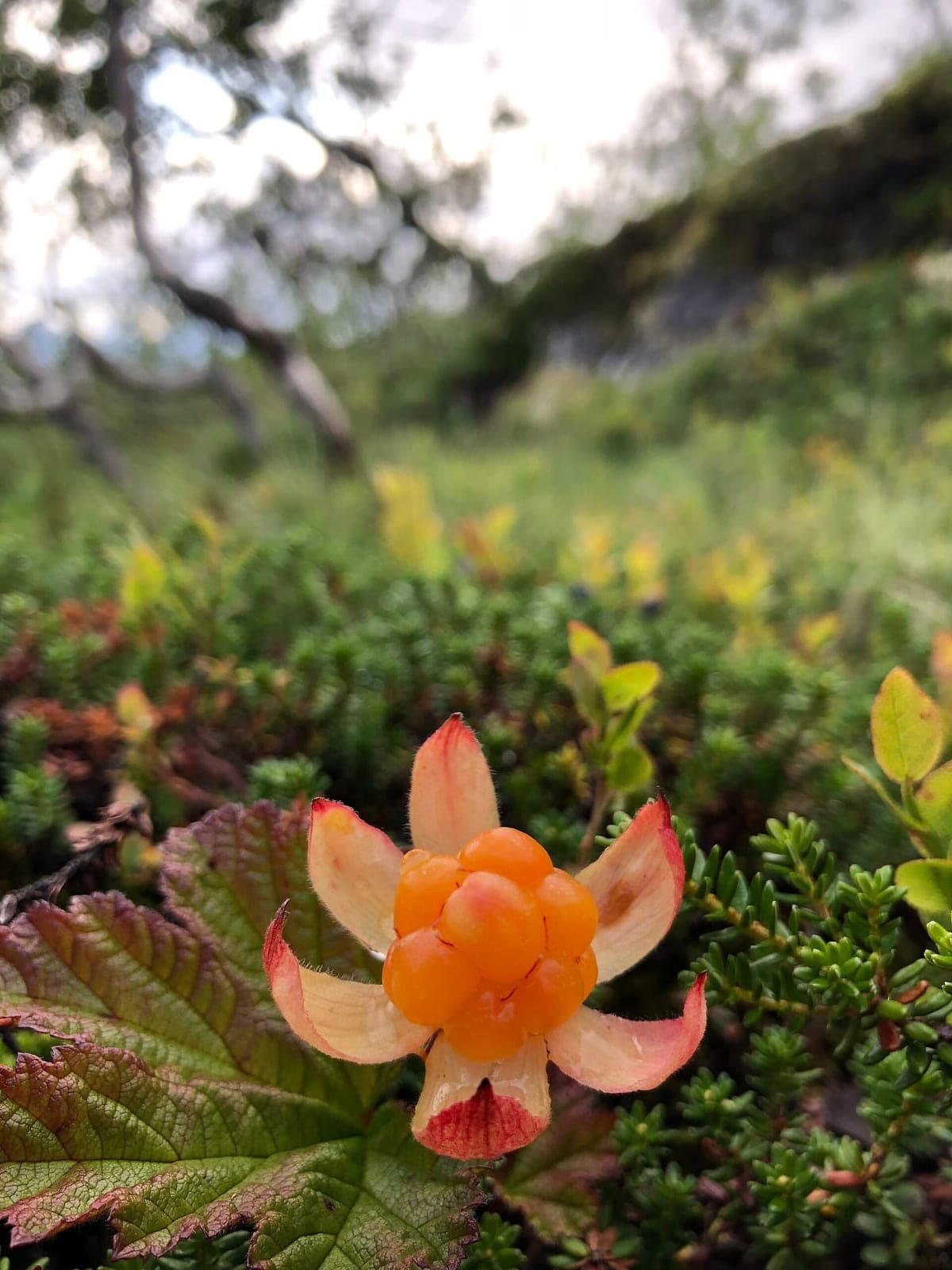
Cloudberry is a low-growing, dioecious perennial native to arctic and subarctic bogs, fens, and tundra across the Northern Hemisphere. Its golden-amber berries are among the most prized wild fruits in Scandinavia, Finland, and Atlantic Canada, where they are rarely available commercially. Gardeners in zones 2–6 with naturally boggy, acidic ground can cultivate it, but success requires conditions that closely match its native habitat.
The plant spreads by creeping rhizomes to form low mats and dies back to ground level each winter. It requires highly acidic soils (pH 3.5–5.0), consistently wet conditions, and cold winters for dormancy and bud set; it will not tolerate heat, drought, or alkaline soils. Both male and female plants are necessary for fruiting - plant at least one male for every two to three females. Peat mulch helps maintain soil moisture and acidity at the root zone.
The berries contain exceptional levels of vitamin C and ellagic acid; Arctic and subarctic peoples have relied on them for centuries as protection against scurvy. In Scandinavia the fruit is made into jams, liqueurs, and dessert sauces; in Newfoundland it is called bakeapple and widely preserved. Leaves and berries have a documented history in Nordic and indigenous traditional medicine for inflammation and wound care.
Ecoregions:TundraTaigaHudson PlainNorthern ForestsNorthwestern Forested MountainsMarine West Coast ForestEastern Temperate Forests
Botrytis (grey mould)
Grey fuzzy mould on petals and stems, worst in cool wet conditions.
Remove affected parts immediately. Improve air circulation. Avoid overhead watering. Apply copper fungicide if severe.
Rust
Orange to brown raised pustules on the undersides of leaves, with yellow spotting on the upper surface. Heavy infections cause leaves to yellow and drop.
Remove and destroy infected leaves. Avoid overhead watering and improve air circulation. Apply a sulfur or copper-based fungicide if it spreads. Clear plant debris in fall.
Cane Anthracnose
Small purple spots on young canes that enlarge into gray, sunken lesions with purple borders. Severe infections weaken canes and reduce fruit quality.
Prune and destroy infected canes. Improve air circulation by thinning. Apply lime sulfur during dormancy before bud break. Avoid overhead watering.