
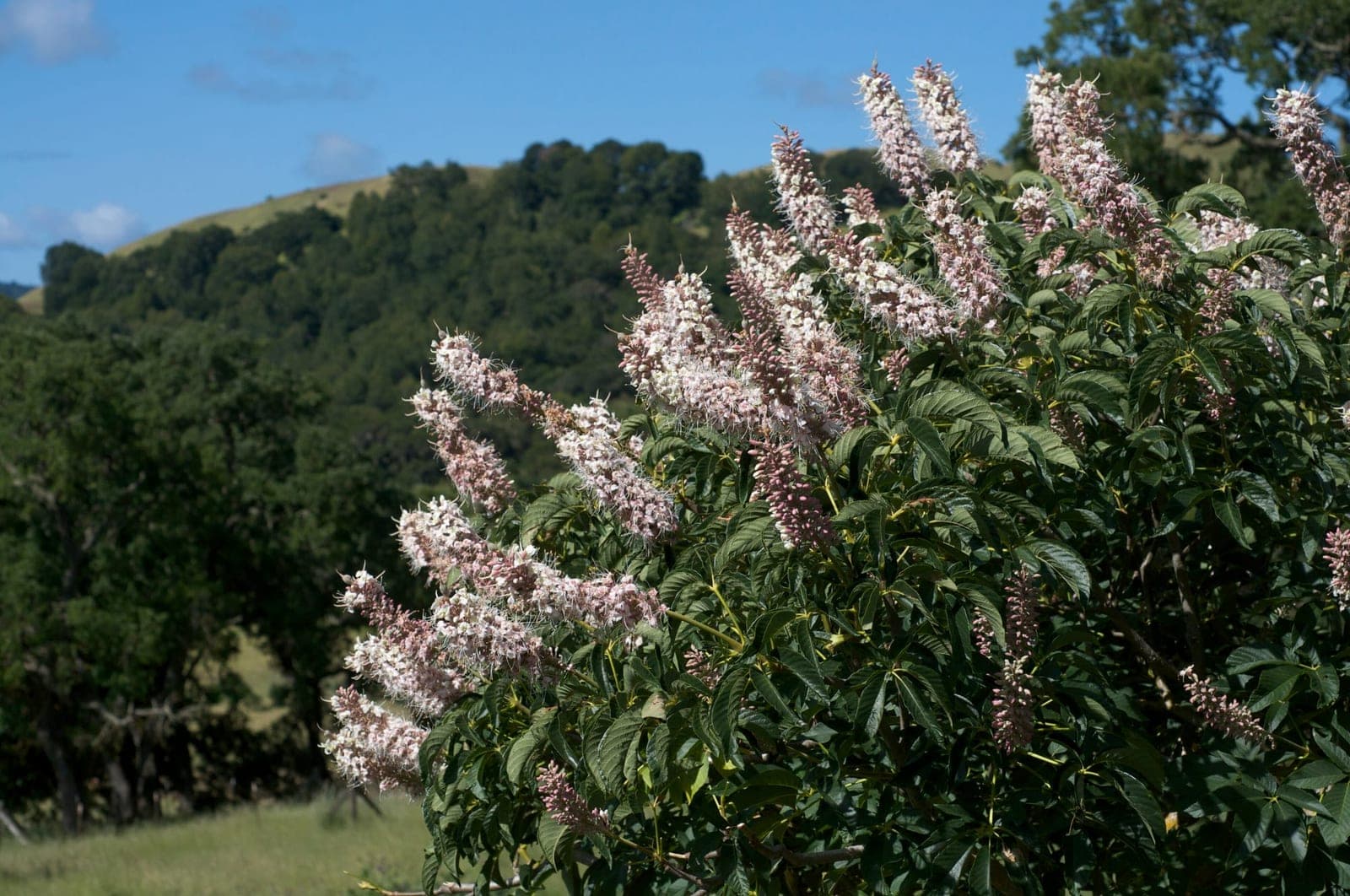
California buckeye is a deciduous large shrub or small tree native to the foothills, canyons, and coast ranges of California and southwestern Oregon. It typically grows 15–30 ft tall with multiple stout trunks and a broad, dome-shaped crown that often spreads wider than it is tall, making it a strong structural specimen in naturalistic or California-native plantings.
This species is summer deciduous, shedding its leaves by midsummer in response to seasonal drought - an adaptation that distinguishes it from virtually all other deciduous trees in cultivation. Palmately compound leaves emerge among the earliest in spring, followed in May and June by upright clusters of white to pale pink flowers that attract hummingbirds and native bumblebees. Large smooth-skinned capsules develop through summer and split by September to release glossy chestnut-brown seeds. Established trees require no supplemental irrigation and decline with summer watering; plant on dry, rocky, or sandy well-drained slopes. Suckers may form at the base and can be left to develop the multi-trunk form typical of wild plants or removed to maintain a single-trunk tree form.
All plant parts - seeds, nectar, and foliage - are toxic to honey bees, horses, cattle, and humans without processing. Native Californians neutralized seed toxins through prolonged water leaching and roasting to produce an edible starchy meal; mashed seeds and leaves were also used as a stream fish stupefacient. Despite the honey bee toxicity, the early abundant nectar is a critical spring resource for native bumblebees, hummingbirds, and western tiger swallowtails.
Ecoregions:Northwestern Forested MountainsMarine West Coast ForestMediterranean California
Powdery mildew
White or grey powdery coating on leaves - usually starting on older growth in humid conditions or when nights cool.
Improve air circulation by thinning plants. Apply neem oil or potassium bicarbonate spray at first sign. Avoid overhead watering.
Armillaria Root Rot
Thinning, yellowing canopy with progressive dieback; white, fan-shaped mycelial mats visible beneath bark at or just below the soil line; honey-colored mushroom clusters appearing at the trunk base or on surface roots in autumn.
No chemical cure exists. Improve drainage and avoid any injury to roots or trunk. Remove severely infected trees along with as much root material as possible. Do not replant susceptible species in the same spot.
Fungal leaf spot
Brown or purplish spots on the leaves, often ringed with a yellow halo, that spread and merge in warm, humid, or wet weather; heavily spotted leaves yellow and drop early.
Pick off spotted leaves and clear fallen debris to remove overwintering spores. Improve air circulation by thinning, and water at the base so foliage dries quickly. If it persists, apply a copper- or sulfur-based fungicide at the first sign.