
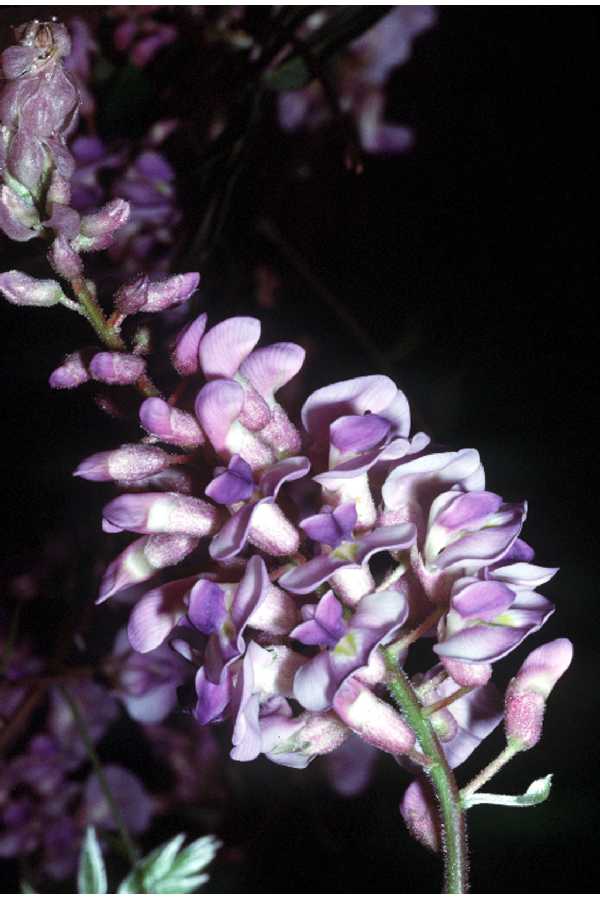
American wisteria is a native twining vine of wet woodlands, streambanks, and swamp margins across the eastern and southeastern United States. It flowers after its leaves have fully emerged, producing dense, compact 4–6 inch racemes of lilac-purple in late spring, all opening in a tighter, more uniform cluster than the loose, elongated chains of the Asian species. A lighter rebloom sometimes follows on new growth through summer.
Unlike Chinese and Japanese wisteria, American wisteria is not classified as invasive anywhere in its range - it's a well-behaved native alternative that still delivers a genuine wisteria-scale spring display. It remains vigorous and needs a sturdy arbor, pergola, or fence to climb, but it doesn't seed aggressively into surrounding woodland or girdle host trees the way the Asian species do. It tolerates wet, poorly drained soil better than almost any other flowering vine, reflecting its streambank origins, though it also performs well in ordinary garden soil with consistent moisture.
As with all wisteria, the seed pods and seeds contain wisterin and lectins that are toxic if ingested - site it away from areas where pets or children might be tempted by the pods. Cutting back hard after bloom and again in the dormant season keeps growth in bounds and encourages the short flowering spurs that produce next year's racemes.
Ecoregions:Eastern Temperate ForestsGreat Plains
Powdery mildew
White or grey powdery coating on leaves - usually starting on older growth in humid conditions or when nights cool.
Improve air circulation by thinning plants. Apply neem oil or potassium bicarbonate spray at first sign. Avoid overhead watering.
Phytophthora Root Rot
Wilting despite moist soil, yellowing leaves, stunted growth, and dark, decayed roots and crown tissue. Vines may collapse during hot weather.
Plant in well-draining soil and avoid waterlogging. Remove and destroy affected vines. Improve drainage with raised beds or amended soil and avoid overwatering.