
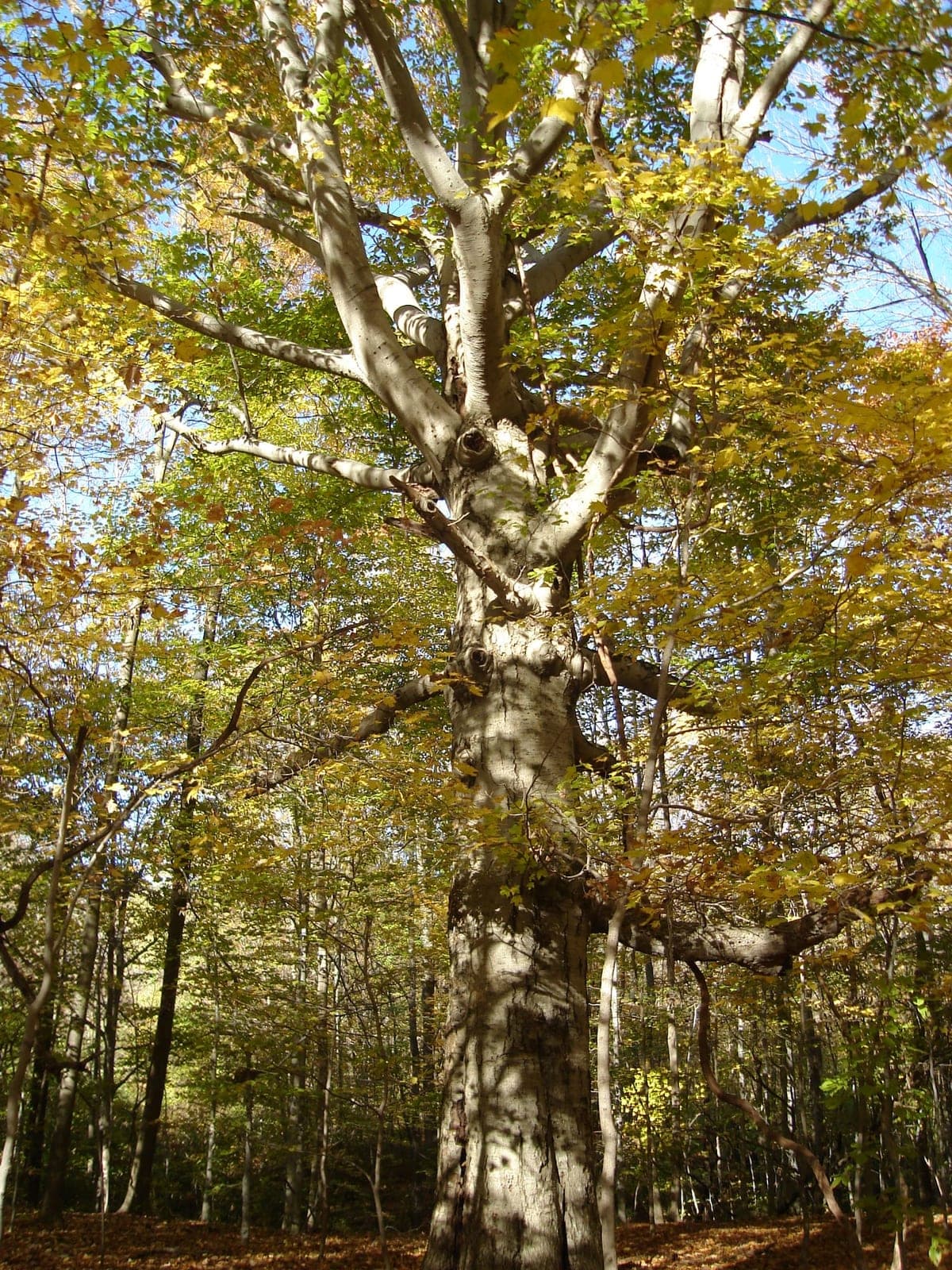
American beech is a large deciduous tree native to eastern North America, typically reaching 60–80 ft tall. It is immediately recognizable by smooth silver-gray bark and wide-spreading horizontal branching. Long-lived specimens can stand for 300–400 years and anchor entire forest communities.
Beech is among the most shade-tolerant large trees in the region, occurring naturally as a climax-forest dominant. It performs best in moist, slightly acidic, well-drained soil and is intolerant of compaction, poor drainage, and urban air pollution. Optimal pH is 5.0–6.5. Marcescent foliage - dead leaves that cling through winter - provides off-season structure. The tree spreads by root suckers requiring regular removal to maintain single-trunk form. Young trees establish slowly but become largely self-sufficient once rooted.
Mature trees produce beechnuts after roughly 40 years; these small triangular nuts are a critical mast crop for bear, deer, wild turkey, blue jays, and squirrels. Young spring leaves have been eaten raw. Eastern tribes recorded bark preparations for fever, burns, frostbite, and kidney complaints. American beech is currently under severe pressure from beech bark disease and the emerging beech leaf disease nematode, both of which are reshaping its native range.
Ecoregions:Northern ForestsEastern Temperate Forests
Beech Bark Disease
White woolly masses of beech scale insects (Cryptococcus fagisuga) appear on smooth bark. Scale feeding opens entry points for Neonectria fungi, which produce sunken, weeping cankers. Bark cracks and dies in patches; progressive crown dieback follows and trees can die within several years of heavy infection.
Scrub light scale infestations from bark with a stiff brush before Neonectria establishes. Remove and destroy cankered limbs; sterilize tools between cuts. No curative treatment exists for established disease. Avoid mechanical bark wounds. Select naturally resistant individuals where available for replanting.
Beech Leaf Disease
Dark green interveinal banding visible when leaves are held up to light; foliage later becomes puckered, thickened, and distorted. Affected buds fail to open normally. Repeated defoliation causes progressive crown dieback; trees may die within several years of symptom onset.
No registered curative control. Avoid moving soil or plant material from infested sites. Maintain tree vigor through appropriate irrigation and mulching to slow decline. Phosphonate trunk injections and nematicide treatments are under active research but not yet broadly approved.
Powdery mildew
White or grey powdery coating on leaves - usually starting on older growth in humid conditions or when nights cool.
Improve air circulation by thinning plants. Apply neem oil or potassium bicarbonate spray at first sign. Avoid overhead watering.
Armillaria Root Rot
Thinning, yellowing canopy with progressive dieback; white, fan-shaped mycelial mats visible beneath bark at or just below the soil line; honey-colored mushroom clusters appearing at the trunk base or on surface roots in autumn.
No chemical cure exists. Improve drainage and avoid any injury to roots or trunk. Remove severely infected trees along with as much root material as possible. Do not replant susceptible species in the same spot.
Fungal leaf spot
Brown or purplish spots on the leaves, often ringed with a yellow halo, that spread and merge in warm, humid, or wet weather; heavily spotted leaves yellow and drop early.
Pick off spotted leaves and clear fallen debris to remove overwintering spores. Improve air circulation by thinning, and water at the base so foliage dries quickly. If it persists, apply a copper- or sulfur-based fungicide at the first sign.