
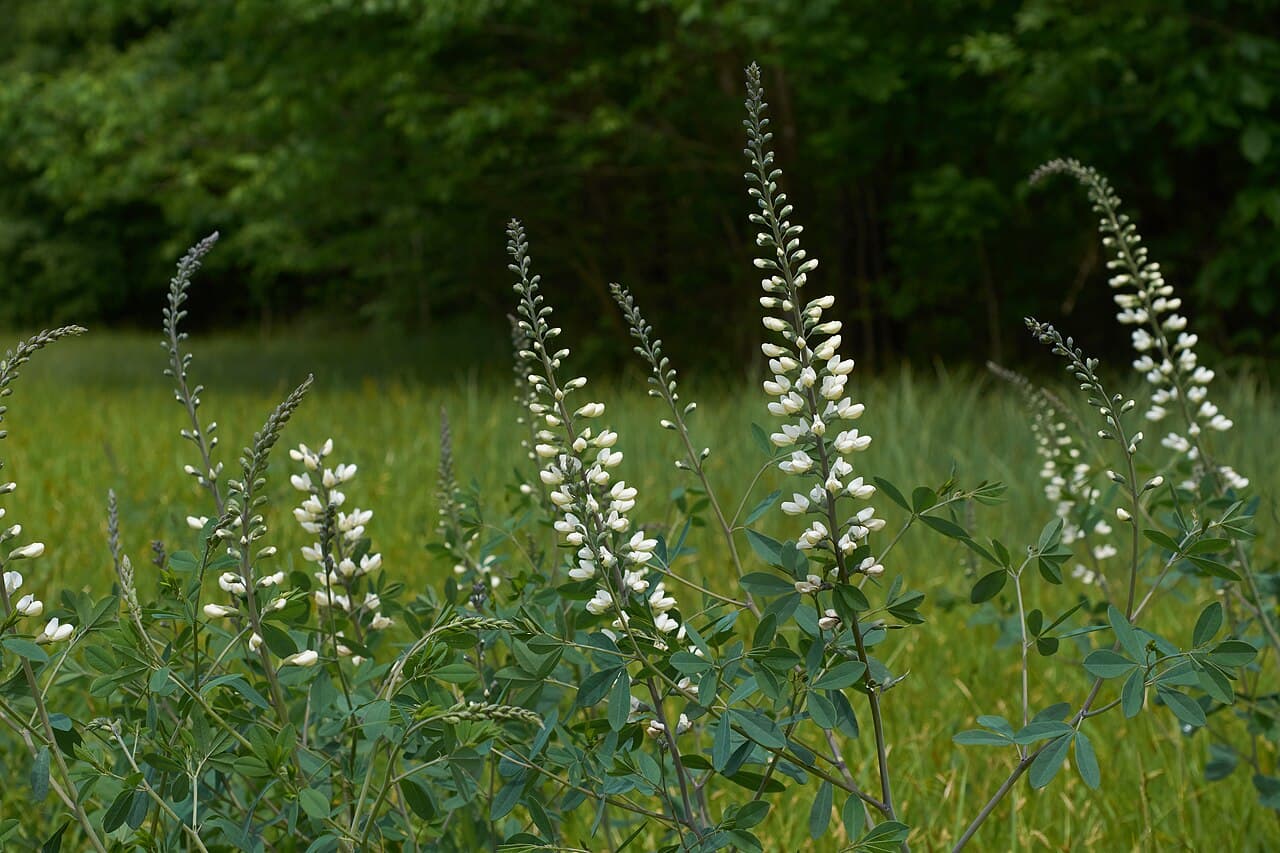
White wild indigo (long sold as Baptisia leucantha, also B. lactea) is a long-lived native herbaceous perennial in the legume family, occurring in prairies, open woodlands, and disturbed roadsides across eastern North America. In late spring and early summer it produces upright stems densely set with blue-green trifoliate leaves and racemes of white pea-shaped flowers. Inflated charcoal-gray seed pods follow and persist well into fall, providing structural interest long after the foliage fades.
The plant develops a deep, woody taproot that enables exceptional drought tolerance but makes established specimens impossible to move successfully. Growth is slow in the first two to three years while the root system matures; once established, plants are essentially self-sufficient and can persist for decades without division. As a legume it fixes atmospheric nitrogen, gradually enriching soil for neighbors. It spreads modestly by rhizome and self-seeds in open ground. A soil pH of 5.5–7.0 suits it well; avoid waterlogged or heavy clay sites. It requires no supplemental fertilizer.
Baptisia is strongly deer resistant and is an important early forage plant for native bumblebees. The rattling dried pods are used in dried arrangements. Indigenous peoples of eastern North America used Baptisia roots as an antiseptic and to treat fever and infections, and modern phytotherapy research has investigated the genus for immune-modulating compounds.
Ecoregions:Eastern Temperate ForestsGreat Plains
Powdery mildew
White or grey powdery coating on leaves - usually starting on older growth in humid conditions or when nights cool.
Improve air circulation by thinning plants. Apply neem oil or potassium bicarbonate spray at first sign. Avoid overhead watering.
Fungal leaf spot
Brown or purplish spots on the leaves, often ringed with a yellow halo, that spread and merge in warm, humid, or wet weather; heavily spotted leaves yellow and drop early.
Pick off spotted leaves and clear fallen debris to remove overwintering spores. Improve air circulation by thinning, and water at the base so foliage dries quickly. If it persists, apply a copper- or sulfur-based fungicide at the first sign.
Root rot
Plants wilt, yellow, and stunt even in moist soil; lower stems and roots turn brown, soft, and mushy and the plant may collapse. Most common in heavy, wet, or poorly drained ground.
Improve drainage and stop overwatering, and never plant too deep. Lift and destroy badly affected plants along with the soil around the roots. Grow in raised or free-draining beds to prevent it returning.