
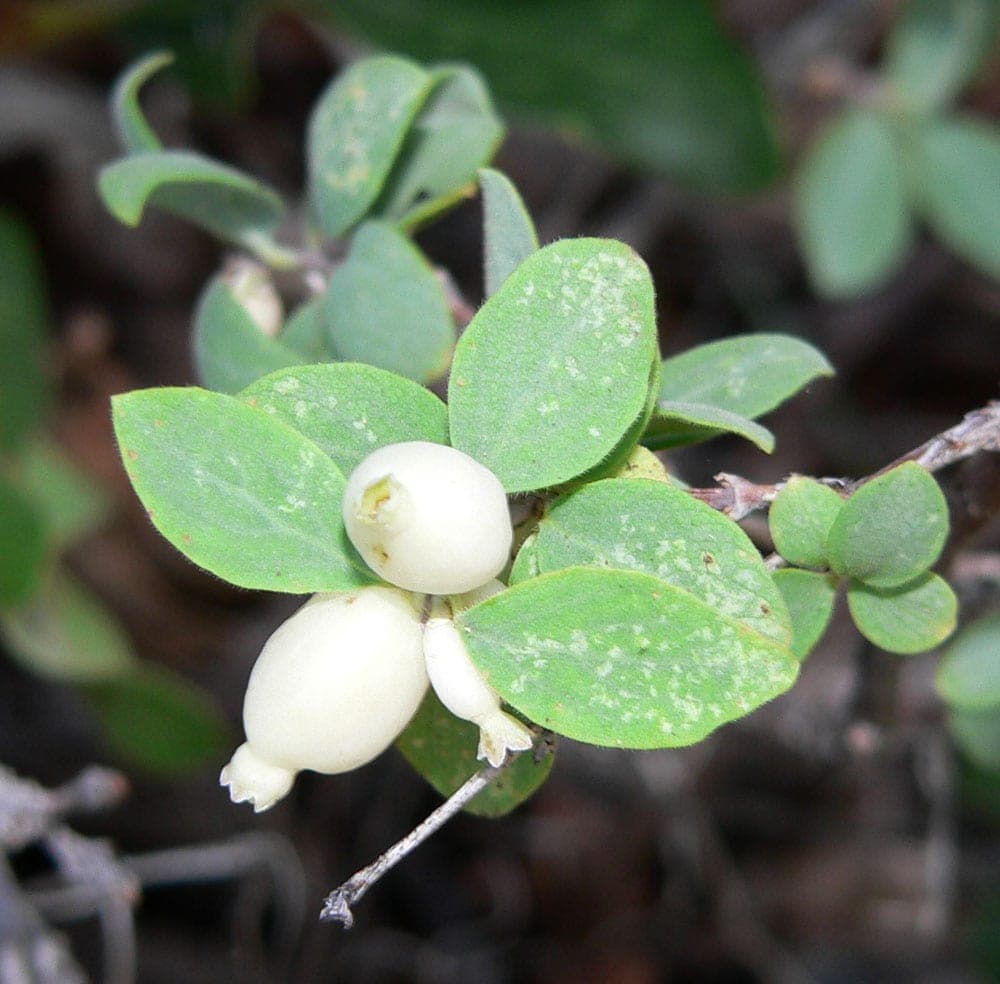
Mountain snowberry is a deciduous native shrub of western North America, found across mountain slopes, canyon edges, and open woodlands from the Rocky Mountains to the Great Basin. It produces small pinkish-white tubular flowers in early summer followed by clusters of waxy white berries that persist well into winter, making it a reliable four-season wildlife plant.
This shrub spreads by underground rhizomes and suckers, forming dense thickets that stabilize steep rocky slopes and streambanks. It tolerates thin, rocky, and alkaline substrates and handles drought once established. The suckering habit is useful for mass plantings and erosion control but requires active management when grown in a defined space. Fruit production is heaviest in full sun; plants in part shade under open pines remain healthy but berry less prolifically. A layer of gravel mulch suits it better than organic mulch on dry sites.
Several Native American groups, including the Shoshone and Ute, used mountain snowberry medicinally. Bark and leaf preparations were applied to treat eye inflammation and skin conditions; berries were used in controlled quantities as a purgative. The berries contain saponins and are toxic to humans in quantity.
Ecoregions:Northwestern Forested MountainsGreat PlainsNorth American DesertsSouthern Semi-Arid HighlandsTemperate Sierras
Powdery mildew
White or grey powdery coating on leaves - usually starting on older growth in humid conditions or when nights cool.
Improve air circulation by thinning plants. Apply neem oil or potassium bicarbonate spray at first sign. Avoid overhead watering.
Fungal leaf spot
Brown or purplish spots on the leaves, often ringed with a yellow halo, that spread and merge in warm, humid, or wet weather; heavily spotted leaves yellow and drop early.
Pick off spotted leaves and clear fallen debris to remove overwintering spores. Improve air circulation by thinning, and water at the base so foliage dries quickly. If it persists, apply a copper- or sulfur-based fungicide at the first sign.