
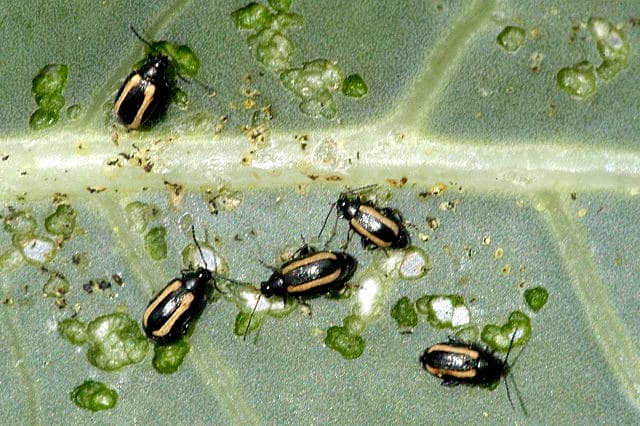
Flea Beetle
Flea beetles are a large group of small jumping beetles in the leaf beetle family Chrysomelidae. They get their name from their enlarged hind legs, which let them leap when disturbed. Multiple species attack vegetable gardens in upstate New York, with brassicas, eggplant, tomatoes, peppers, and potatoes among their preferred hosts.
Adults overwinter in soil and leaf litter, then emerge in early spring and begin feeding on young foliage almost immediately. They chew small, irregular pits and holes through leaf surfaces, producing the characteristic "shothole" pattern. Seedlings and fresh transplants are the most vulnerable — heavy feeding at this stage can stunt or kill a plant before it establishes. Larvae develop underground and feed on fine roots, but root damage is rarely severe enough to cause visible problems. Adult populations often drop off as summer progresses and plants grow beyond the most susceptible stage.
Flea beetles are foliage-feeding pests that damage a wide range of vegetable crops, most severely at the seedling stage.
Small round shot-holes scattered across leaves; tiny dark beetles that jump when disturbed. Heavy feeding stunts young plants.
Use floating row covers on seedlings. Remove crop debris and weeds that harbor beetles. Apply kaolin clay or spinosad if damage is severe.