
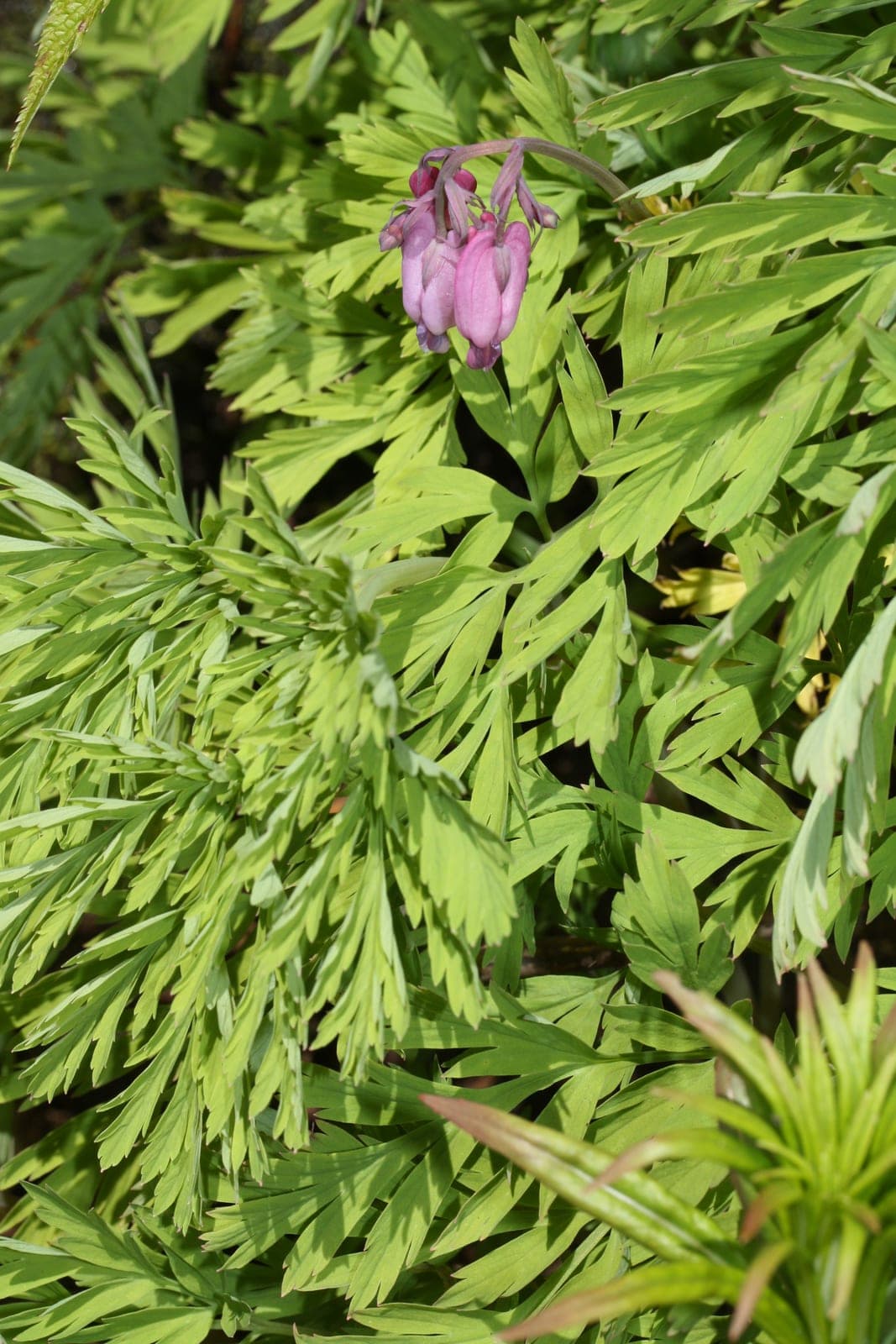
Dicentra formosa is a native perennial of the Pacific Northwest, found in moist woodland understories from British Columbia to central California. It produces blue-green, finely divided foliage and arching clusters of drooping, heart-shaped flowers in pink, rose, or occasionally cream. It works well as a ground cover under deciduous trees and in shade borders.
The plant spreads by rhizomes to form loose colonies. In hot, dry summers it may go partially or fully dormant, with foliage yellowing and dying back - this is normal, not disease. In cool, consistently moist sites it often reblooms in late summer or fall. It prefers humus-rich, slightly acidic soil and a 2–3 inch layer of organic mulch to moderate root temperature. Rhizomes are cold-hardy through zone 4 but benefit from protection against repeated freeze-thaw cycles.
All parts of the plant are toxic if ingested, containing isoquinoline alkaloids. Some Pacific Northwest tribes used the roots in small amounts for toothache relief. The alkaloid bulbocapnine, present in Dicentra species, has been studied for central nervous system activity, though no clinical applications are established.
Ecoregions:Northwestern Forested MountainsMarine West Coast ForestMediterranean California
Bleeding Heart Stem Rot
Soft, water-soaked dark lesions at the stem base; stems collapse and a white fungal growth may appear near the soil line in wet conditions.
Remove and destroy affected stems and crowns. Improve drainage and air circulation, avoid overhead watering, and do not overcrowd plants. Replant divisions in well-draining soil.
Botrytis (grey mould)
Grey fuzzy mould on petals and stems, worst in cool wet conditions.
Remove affected parts immediately. Improve air circulation. Avoid overhead watering. Apply copper fungicide if severe.
Phytophthora Root Rot
Wilting despite moist soil, yellowing leaves, stunted growth, and dark, decayed roots and crown tissue. Vines may collapse during hot weather.
Plant in well-draining soil and avoid waterlogging. Remove and destroy affected vines. Improve drainage with raised beds or amended soil and avoid overwatering.