
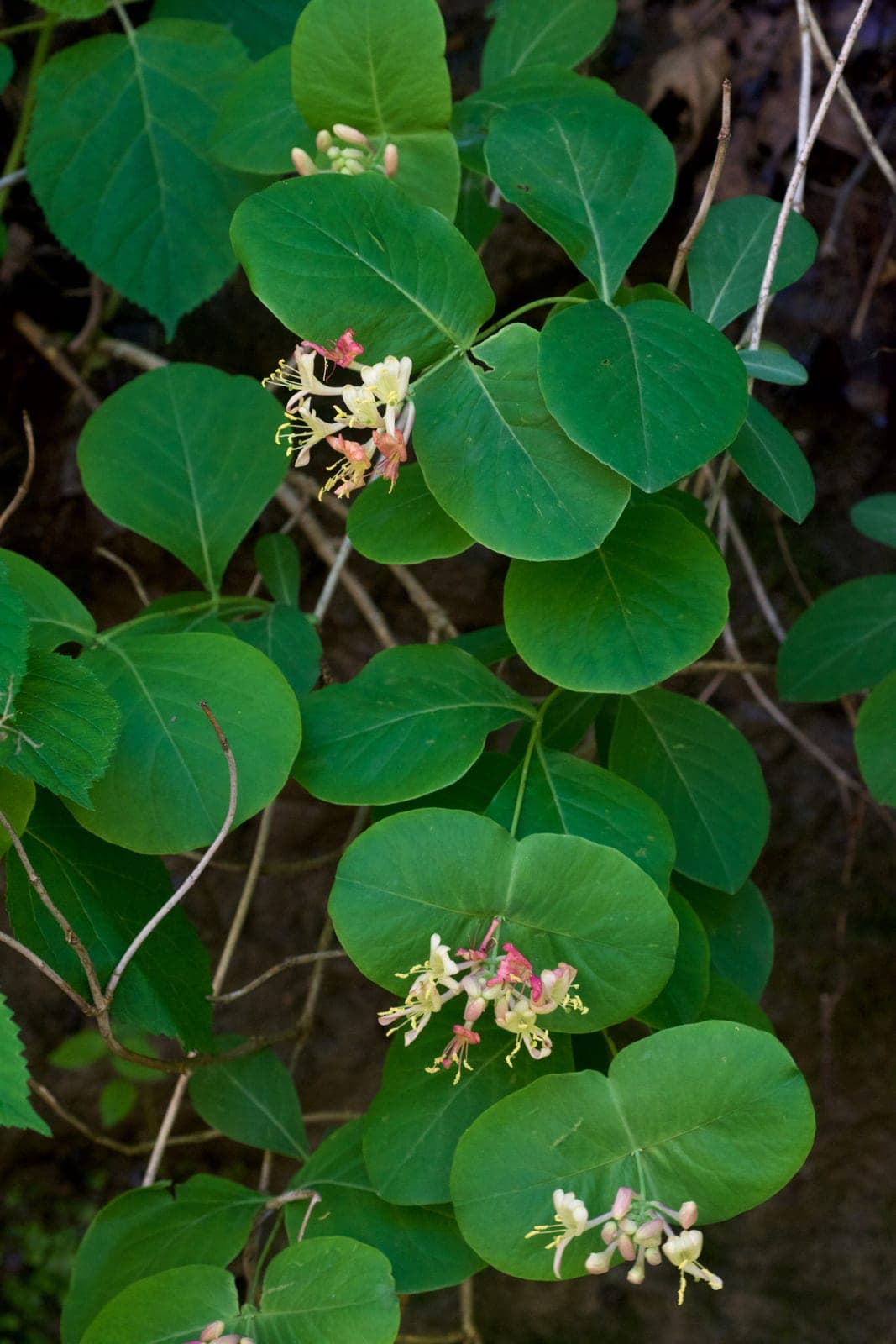
Lonicera reticulata is a native North American twining woody vine found in open woods, rocky slopes, prairies, and forest edges from Ontario and the Great Lakes states south through the central plains. It produces tubular yellow-orange flowers that attract hummingbirds and native long-tongued bees, followed by small red berries that persist into fall and feed migrating songbirds.
Unlike invasive exotic honeysuckles such as L. japonica or L. maackii, grape honeysuckle is non-aggressive and self-limiting in spread. It climbs by twining and requires a trellis, fence, or coarse shrub for support. Full sun produces the best growth, though the vine tolerates part shade toward the southern end of its range. Upper leaf pairs are typically connate-perfoliate - the stem appears to pass through fused leaf bases - a reliable field identification feature. Established plants are moderately drought-tolerant; mulching the root zone helps retain moisture and suppress competition.
The berries are mildly toxic to humans in quantity but are a documented food source for thrushes, warblers, and other native songbirds. Dense twining stems provide nesting cover, and the flowers bridge the nectar gap between spring ephemeral and midsummer-dominant species in native plant gardens.
Ecoregions:Eastern Temperate ForestsGreat Plains
Powdery mildew
White or grey powdery coating on leaves - usually starting on older growth in humid conditions or when nights cool.
Improve air circulation by thinning plants. Apply neem oil or potassium bicarbonate spray at first sign. Avoid overhead watering.
Honeysuckle Leaf Blight
Brown or black spots on leaves that enlarge and merge, followed by curling, browning, and early leaf drop, often worse in wet seasons.
Remove and destroy infected leaves, thin growth to improve airflow, avoid overhead watering, and apply a copper-based fungicide if the problem recurs.