
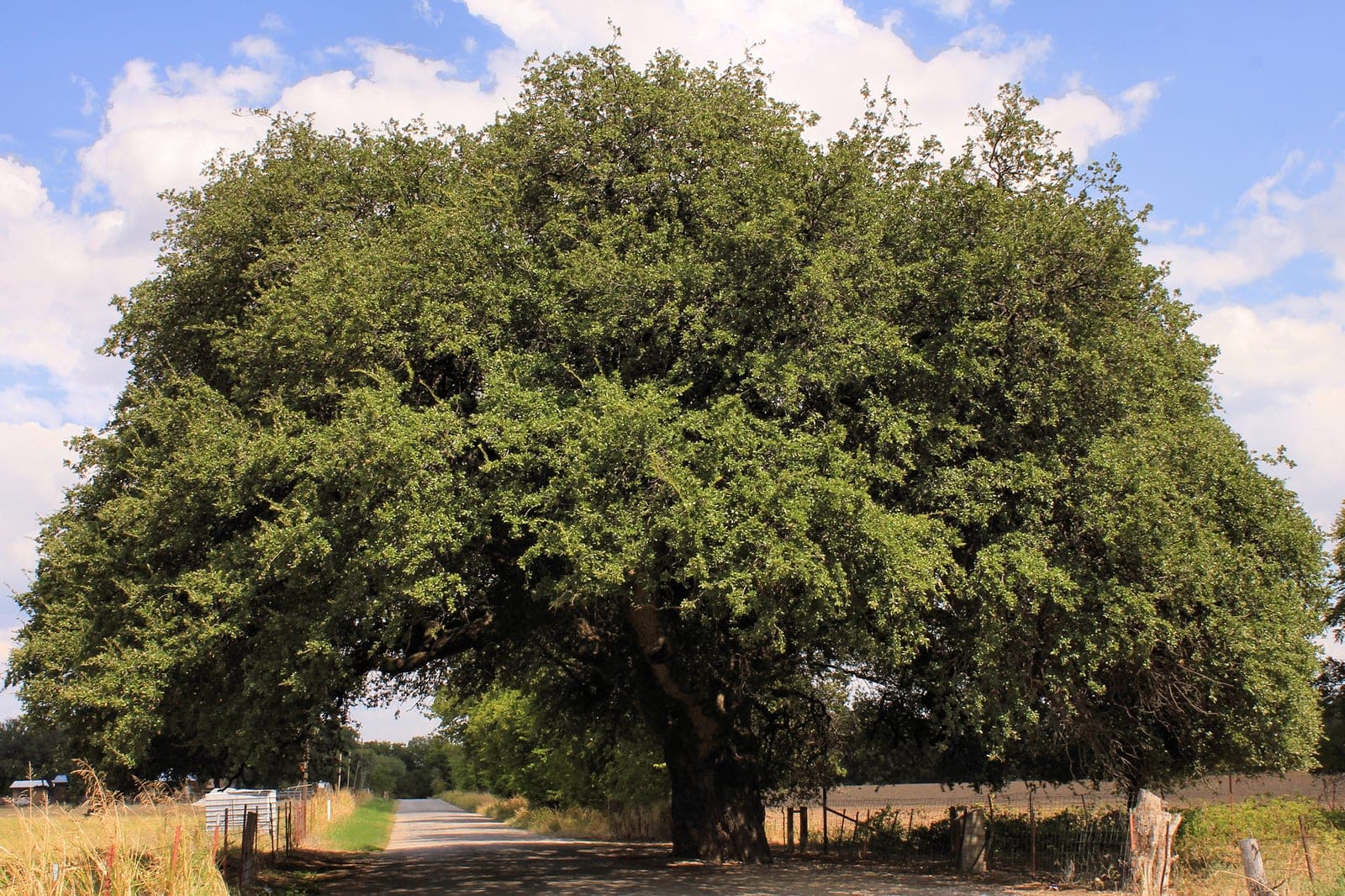
Quercus fusiformis is a native evergreen oak centered on the Edwards Plateau of Texas, ranging into southwestern Oklahoma and northeastern Mexico. It is a keystone species of the Texas Hill Country, where dense clusters called mottes define the regional landscape. Gardeners value it as a long-lived, low-maintenance shade tree that holds its foliage year-round and is among the most drought-tolerant large trees available for the southern Great Plains.
The tree is adapted to thin, rocky, alkaline soils over limestone bedrock and requires supplemental irrigation only during the first two to three years after planting. It spreads by root sprouts, which can be removed at the base to maintain a single-trunk form or left in place to develop the characteristic motte structure. Pruning must be restricted to December through February; cuts made between March and June attract nitidulid beetles that vector oak wilt, which is lethal. Fresh wounds made at any time of year should be sealed with pruning paint as a precaution.
Acorns are a critical hard-mast crop for white-tailed deer, wild turkey, squirrels, and numerous cavity-nesting birds. Oak bark is rich in tannins and has a documented history across Indigenous cultures for use as an astringent in treating diarrhea, reducing inflammation, and dressing wounds.
Ecoregions:Eastern Temperate ForestsGreat Plains
Oak Wilt
Leaves wilt and brown starting at branch tips, progressing rapidly toward the trunk. Discoloration may appear as brown or yellow veining across the leaf blade. Individual branches or the entire canopy can defoliate within days to weeks. A cross-section of affected branches reveals dark streaking in the outer sapwood ring.
Contact a certified arborist for trunk injection of propiconazole fungicide, which is most effective as a preventive measure or at earliest symptom onset. Sever root grafts between infected and neighboring live oaks by cutting a trench 3–4 ft deep between trees to prevent fungal spread through connected root systems. Remove and immediately chip, burn, or bury all infected wood; do not store as firewood. Avoid any pruning from March through July when nitidulid sap-feeding beetles that carry the pathogen are most active. Apply wound sealant to all cuts made outside this window within minutes of cutting.
Texas Root Rot
Sudden wilting of branches or the entire canopy, often following a wet period. White cottony fungal mats develop on infected roots. Wood at the crown appears dark and water-soaked. Decline can progress to tree death within weeks.
No effective chemical cure exists. Ensure excellent drainage and avoid overwatering. Remove and destroy all infected plant material. Avoid replanting susceptible species in the same soil for several years.
Hypoxylon Canker
Outer bark sloughs off stressed limbs to reveal gray, tan, or black crusty fungal stromata on the exposed wood surface; affected branches die back progressively and cross-sections of sapwood show brown streaking.
No effective chemical control exists. Remove affected limbs promptly and dispose of all infected wood off-site - do not chip or compost it on the property. Reduce predisposing stress by providing deep irrigation during drought and avoiding mechanical injury to roots and bark. The fungus is opportunistic; healthy, unstressed trees resist infection.