
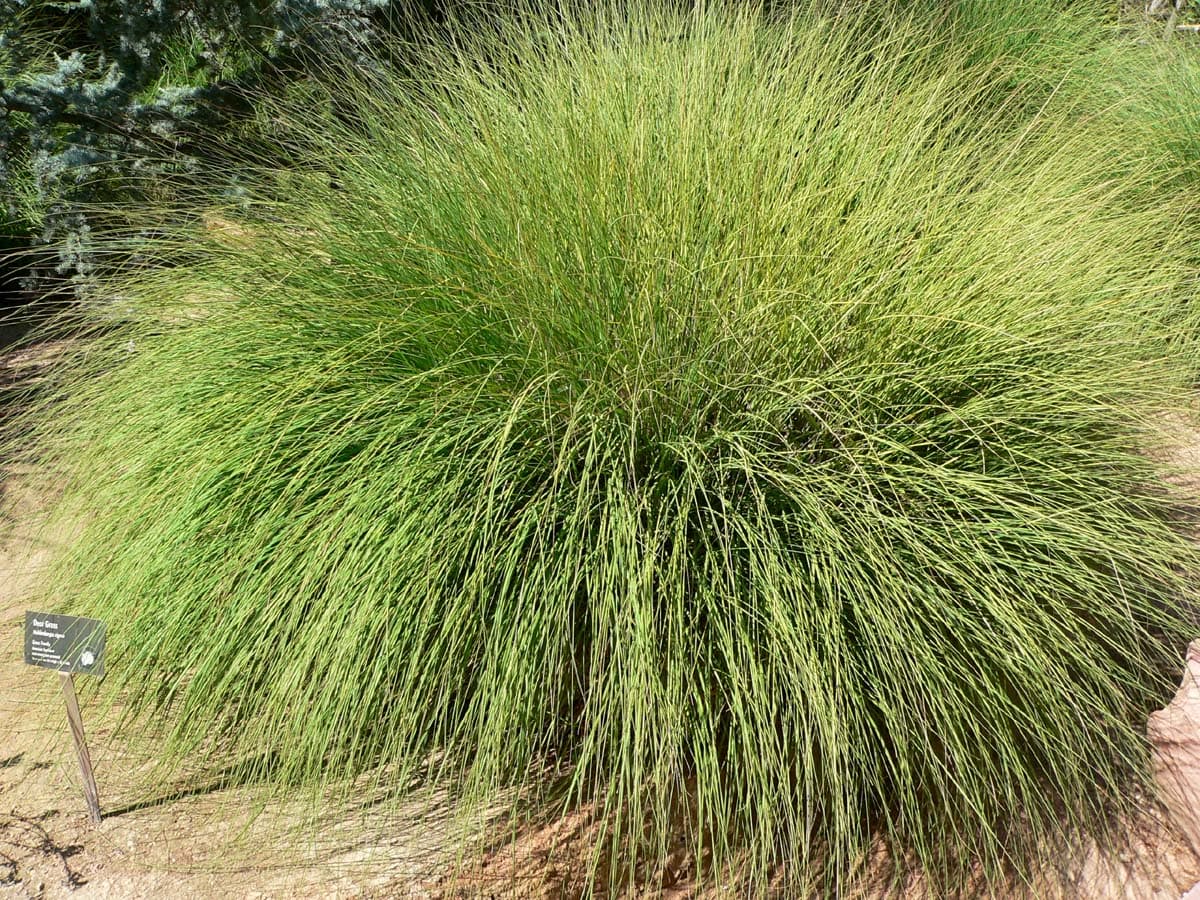
Muhlenbergia rigens is a perennial bunchgrass native to the southwestern United States and northern Mexico. It forms dense, arching clumps of narrow gray-green foliage with slender seed-bearing stalks rising above the mound in late summer. Its tolerance for heat, drought, and infertile soils makes it a reliable structural element in water-conscious western gardens.
A warm-season grass, it grows actively through summer and sets seed in fall, then goes dormant in winter. It performs best in full sun with excellent drainage and tolerates clay soils as long as water does not pond at the crown. Once established it requires little to no supplemental irrigation. Plants grow naturally below 7,000 feet in chaparral, oak woodland margins, and desert scrub, often on sandy or gravelly slopes where competition from other vegetation is reduced. Old clumps may develop hollow centers after many years but can otherwise persist for decades without intervention.
Several California indigenous groups, including the Chumash, harvested the long straight stems for coiled basket weaving - the stems are prized for their uniformity and strength. The seed heads support granivorous birds through fall and winter, and the clumps serve as larval habitat for several skipper butterfly species, including the Umber Skipper.
Ecoregions:Northwestern Forested MountainsNorth American DesertsMediterranean CaliforniaSouthern Semi-Arid HighlandsTemperate Sierras
Crown Rot
Lower leaves yellow and wilt; the base of the rosette turns brown and soft, sometimes with white fungal threads at the soil line. Plants collapse in wet conditions.
Remove and destroy affected plants. Improve drainage and avoid overhead watering. Do not mulch directly against the crown. Space plants for airflow and avoid replanting in the same wet spot.
Rust
Orange to brown raised pustules on the undersides of leaves, with yellow spotting on the upper surface. Heavy infections cause leaves to yellow and drop.
Remove and destroy infected leaves. Avoid overhead watering and improve air circulation. Apply a sulfur or copper-based fungicide if it spreads. Clear plant debris in fall.