
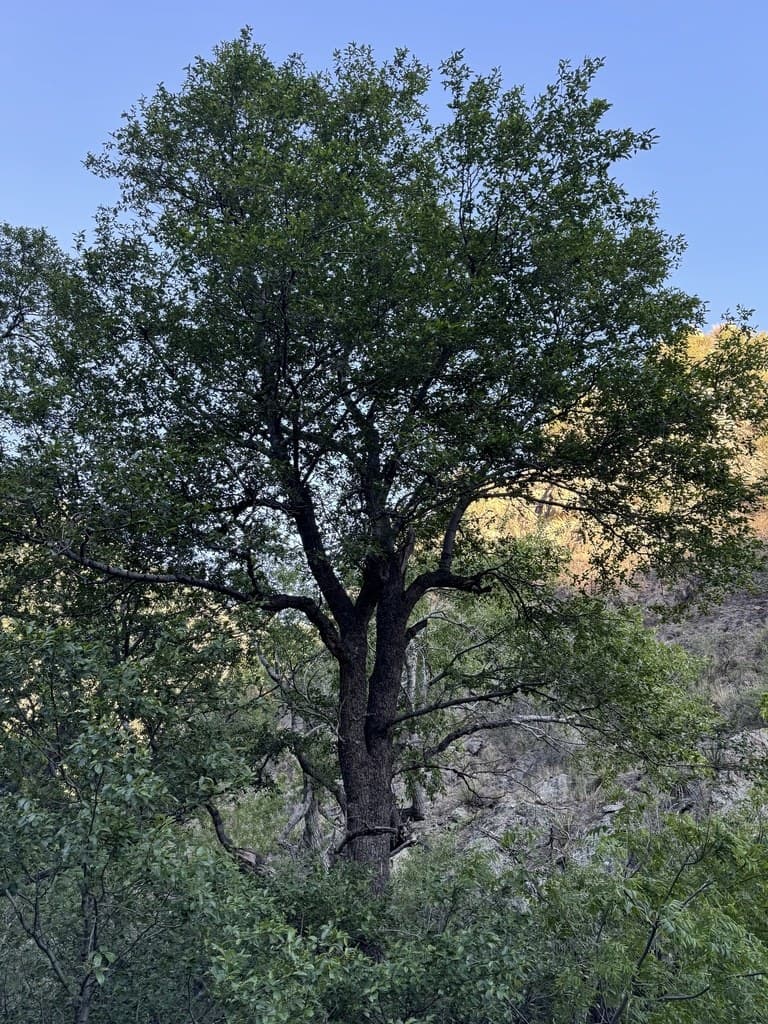
Arizona alder is a large deciduous tree native to permanent streams and canyon bottoms in the mountains of Arizona, western New Mexico, and northern Sonora, Mexico. It is one of the few sizable broadleaf trees of the desert Southwest uplands and serves as a structural canopy anchor in riparian corridors. Gardeners with a stream bank, rain garden, or irrigated low spot can use it to establish fast, substantial shade and wildlife habitat at elevation.
The species grows rapidly in moist conditions, reaching 40–70 feet with a rounded crown and toothed, oblong leaves that turn yellow in fall. Male catkins open in late winter before leaves emerge, providing early-season pollen for native bees. Like all alders, Arizona alder hosts Frankia bacteria in root nodules that fix atmospheric nitrogen, enriching soil for neighboring plants. It tolerates periodic flooding and is a reliable choice for streambank stabilization and erosion control in mountain and high-desert riparian settings. Prefers slightly acidic to neutral soil and does not perform well in arid garden beds without supplemental irrigation.
Bark of Alnus species has a documented history of use by Indigenous peoples of the Southwest as an astringent preparation for wounds and to manage fever, reflecting the genus-wide tannin content.
On the Pacific coast, plant red alder instead; across the northern states and the Rockies, gray alder.
Ecoregions:North American DesertsSouthern Semi-Arid HighlandsTemperate Sierras
Alder Tongue Gall
Catkin scales elongate into strap-shaped, waxy, tongue-like structures up to 2 inches long. Affected catkins are distorted and fail to release pollen or viable seed. Leaves may develop puckered, reddish-green blisters in heavy infections.
The disease is cosmetic and rarely threatens tree health. Remove and dispose of visibly infected catkins before spore release to reduce local inoculum. Improve canopy air circulation where feasible. No fungicide is warranted under typical conditions.
Phytophthora Root Rot
Wilting despite moist soil, yellowing leaves, stunted growth, and dark, decayed roots and crown tissue. Vines may collapse during hot weather.
Plant in well-draining soil and avoid waterlogging. Remove and destroy affected vines. Improve drainage with raised beds or amended soil and avoid overwatering.
Armillaria Root Rot
Thinning, yellowing canopy with progressive dieback; white, fan-shaped mycelial mats visible beneath bark at or just below the soil line; honey-colored mushroom clusters appearing at the trunk base or on surface roots in autumn.
No chemical cure exists. Improve drainage and avoid any injury to roots or trunk. Remove severely infected trees along with as much root material as possible. Do not replant susceptible species in the same spot.
Fungal leaf spot
Brown or purplish spots on the leaves, often ringed with a yellow halo, that spread and merge in warm, humid, or wet weather; heavily spotted leaves yellow and drop early.
Pick off spotted leaves and clear fallen debris to remove overwintering spores. Improve air circulation by thinning, and water at the base so foliage dries quickly. If it persists, apply a copper- or sulfur-based fungicide at the first sign.