
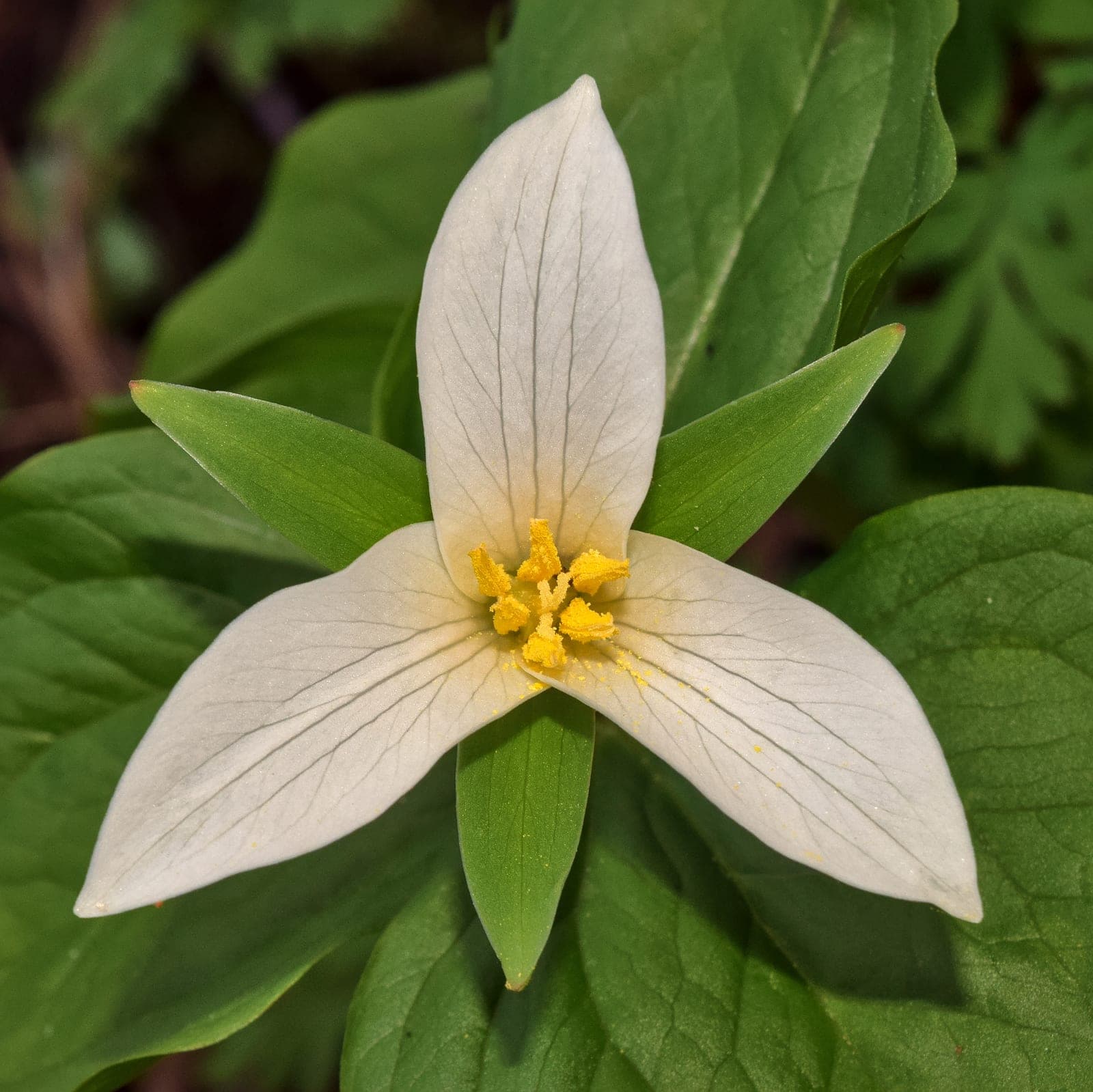
Trillium ovatum is a native woodland perennial of western North America, ranging from British Columbia south to central California and east to the Rocky Mountains. Its type specimen was collected by Meriwether Lewis in 1806 on the return leg of the Lewis and Clark Expedition. Each plant produces a single stem bearing three leaves, three sepals, and three white petals that gradually age from pink to deep rose-purple over their weeks-long display. Trillium is slow to establish but exceptionally long-lived under the right conditions.
Seeds are dispersed by ants via elaiosomes - lipid-rich attachments that ants carry to their nests, incidentally burying the seed. Plants grown from seed require 7 or more years to produce a first flower, and the entire plant goes fully dormant by midsummer. Purchase only nursery-propagated stock; wild collection damages native populations and is illegal in many states. Undisturbed, humus-rich, consistently moist soil with dappled to deep shade closely mimics old-growth forest floor conditions. Mark clumps with a stake before dormancy to protect rhizomes from accidental digging. Tolerates a fairly wide pH range but declines in strongly alkaline soil.
Several Indigenous peoples of the Pacific Northwest used the rhizome as a parturient herb to hasten labor contractions and as a poultice for eye inflammation. Roots contain steroidal saponins; internal use is not safe without expert ethnobotanical guidance.
Ecoregions:Northwestern Forested MountainsMarine West Coast ForestNorth American DesertsMediterranean California
Rust
Orange to brown raised pustules on the undersides of leaves, with yellow spotting on the upper surface. Heavy infections cause leaves to yellow and drop.
Remove and destroy infected leaves. Avoid overhead watering and improve air circulation. Apply a sulfur or copper-based fungicide if it spreads. Clear plant debris in fall.
Botrytis (grey mould)
Grey fuzzy mould on petals and stems, worst in cool wet conditions.
Remove affected parts immediately. Improve air circulation. Avoid overhead watering. Apply copper fungicide if severe.