
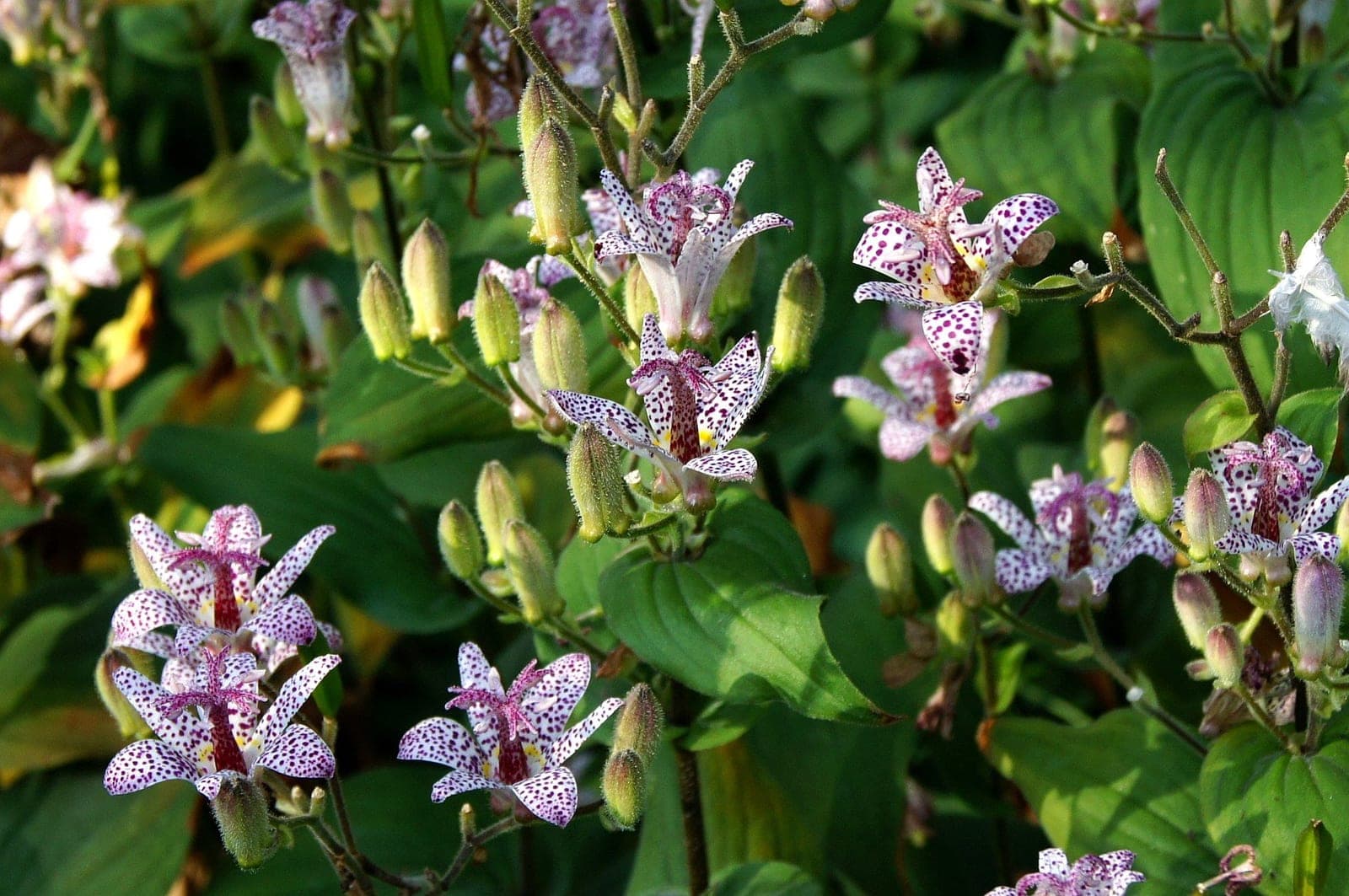
Tricyrtis formosana is a shade-tolerant herbaceous perennial native to Taiwan and the Ryukyu Islands. It fills a genuine gap in the shade garden by producing orchid-like white to soft-lilac flowers, heavily spotted with purple, from late August into October - a period when most woodland perennials have little to offer.
It spreads gradually by rhizomes and self-seeds modestly where conditions suit it. Humus-rich, consistently moist, well-drained soil under a deciduous or high canopy is ideal. Mulching conserves moisture, moderates soil temperature, and protects roots through winter in colder zones. Standing water or heavy clay promotes root and crown rot, and the plant does not recover from waterlogged conditions. In zones 4 and 5, late spring frosts can damage emerging shoots; leaving light mulch in place until growth is several inches tall reduces this risk.
Foliar nematodes (Aphelenchoides spp.) are the most damaging pest of this genus. Infected leaves show yellowing and browning between veins, followed by distortion. Overhead watering spreads the microscopic organisms; drip irrigation and prompt removal of affected foliage are the primary controls.
Foliar Nematode
Angular brown patches appear between leaf veins, progressing upward from lower leaves. The geometric, vein-bounded pattern distinguishes nematode damage from fungal leaf spots. Heavily infested leaves yellow and drop prematurely.
Remove and dispose of all affected foliage away from the garden; do not compost. Switch to drip or base watering to keep foliage dry - water on leaves allows nematodes to migrate between plants. Divide clumps only from clean, symptom-free sections. No chemical treatment is reliably effective once established; strict sanitation and dry foliage are the primary controls.
Fungal leaf spot
Brown or purplish spots on the leaves, often ringed with a yellow halo, that spread and merge in warm, humid, or wet weather; heavily spotted leaves yellow and drop early.
Pick off spotted leaves and clear fallen debris to remove overwintering spores. Improve air circulation by thinning, and water at the base so foliage dries quickly. If it persists, apply a copper- or sulfur-based fungicide at the first sign.
Botrytis (grey mould)
Grey fuzzy mould on petals and stems, worst in cool wet conditions.
Remove affected parts immediately. Improve air circulation. Avoid overhead watering. Apply copper fungicide if severe.
Root rot
Plants wilt, yellow, and stunt even in moist soil; lower stems and roots turn brown, soft, and mushy and the plant may collapse. Most common in heavy, wet, or poorly drained ground.
Improve drainage and stop overwatering, and never plant too deep. Lift and destroy badly affected plants along with the soil around the roots. Grow in raised or free-draining beds to prevent it returning.
Powdery mildew
White or grey powdery coating on leaves - usually starting on older growth in humid conditions or when nights cool.
Improve air circulation by thinning plants. Apply neem oil or potassium bicarbonate spray at first sign. Avoid overhead watering.