
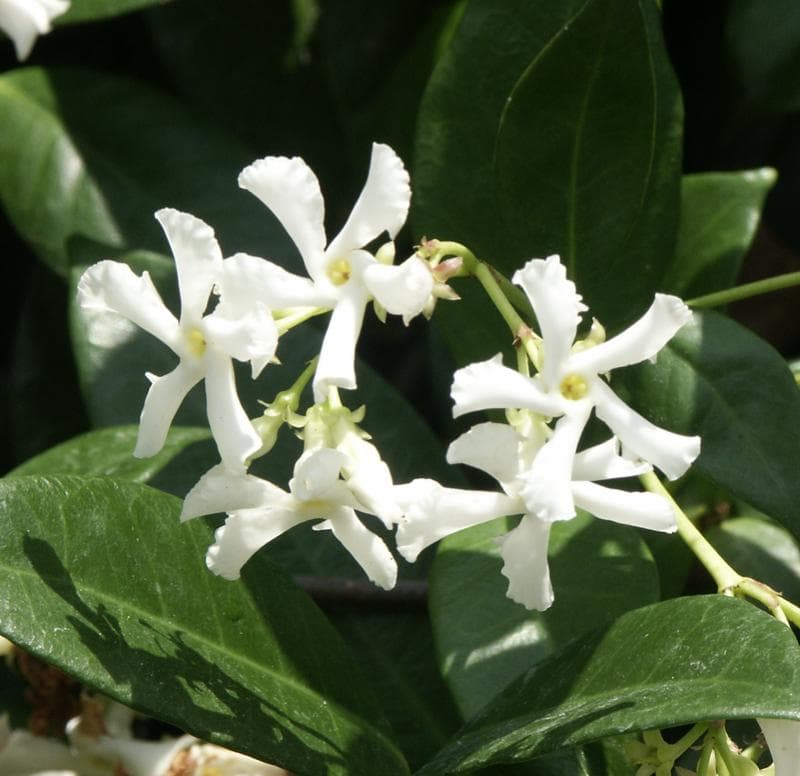
Star jasmine is an evergreen climbing vine native to eastern and southeastern Asia, grown widely in warm climates for its intensely fragrant white pinwheel flowers and glossy, dark green foliage. It performs well on fences, trellises, arbors, and masonry walls, and makes a dense weed-suppressing groundcover where it is not trained upward. Like other members of Apocynaceae, it produces a milky latex that is mildly toxic if ingested.
The plant grows at a moderate pace once established and tolerates drought after the first season or two. It stays fully evergreen in zones 8b and above; in zone 8a, hard freezes may cause stem and foliage dieback, though roots typically survive and resprout. Optimal soil pH is 6.0–7.0; highly alkaline soils may cause leaf chlorosis. Prune immediately after the main flowering flush ends to shape and control spread without sacrificing buds set for the following year.
In traditional Chinese medicine, the dried stems are sold as Luoshiteng and used to relieve joint pain, stiffness, and rheumatic conditions and to promote blood circulation. Modern studies have identified trachelogenin and related iridoid compounds with demonstrated anti-inflammatory properties.
Growing it indoors up north? See the indoor care guide - light, water, and the rhythm that keeps it flowering as a houseplant.Powdery mildew
White or grey powdery coating on leaves - usually starting on older growth in humid conditions or when nights cool.
Improve air circulation by thinning plants. Apply neem oil or potassium bicarbonate spray at first sign. Avoid overhead watering.
Phytophthora Root Rot
Wilting despite moist soil, yellowing leaves, stunted growth, and dark, decayed roots and crown tissue. Vines may collapse during hot weather.
Plant in well-draining soil and avoid waterlogging. Remove and destroy affected vines. Improve drainage with raised beds or amended soil and avoid overwatering.
Crown Rot
Lower leaves yellow and wilt; the base of the rosette turns brown and soft, sometimes with white fungal threads at the soil line. Plants collapse in wet conditions.
Remove and destroy affected plants. Improve drainage and avoid overhead watering. Do not mulch directly against the crown. Space plants for airflow and avoid replanting in the same wet spot.
Sooty Mold (Scale-Associated)
Black, powdery or crusty coating on upper leaf surfaces and stems. Affected leaves may yellow and drop in severe cases. The mold grows on honeydew secreted by scale insects, mealybugs, or aphids feeding on the plant.
Control the underlying pest infestation first using horticultural oil or neem oil applied thoroughly to stems and leaf undersides. Once pest populations are reduced, sooty mold stops spreading and weathers away over time. Rinse foliage with a strong stream of water to dislodge existing mold deposits.