
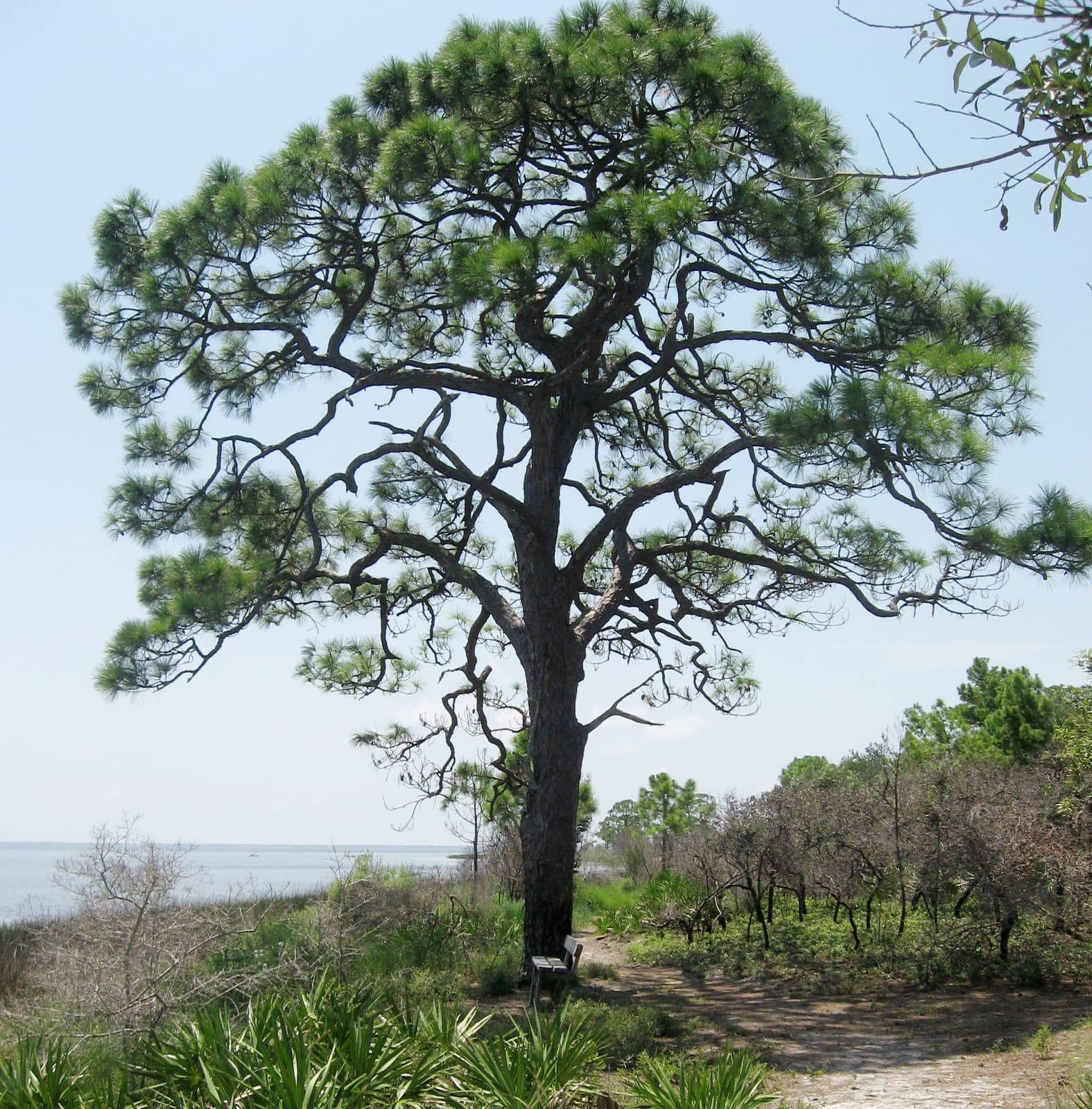
Slash pine (Pinus elliottii) is a fast-growing native pine of the southeastern coastal plain, ranging from South Carolina to Florida and west to Louisiana. Its name comes from the 'slashes'-low, wet, shrubby thickets-that define its natural habitat. The wood is unusually dense and strong for a pine, exceeding many hardwoods in structural properties and approaching the density of black ironwood.
Two botanical varieties exist: var. elliottii across most of the range, and var. densa confined to south Florida, which is slower-growing and has shorter needles. Slash pine tolerates periodic flooding and grows well in sandy, acidic soils, adapting to drier upland sites once established. It is widely planted for reforestation, windbreaks, and wildlife habitat across the Deep South. Mature specimens provide nesting cavities for the red-cockaded woodpecker, a federally listed species that depends on old southern pines.
Slash pine was the backbone of the historical naval stores industry, tapped commercially for resin to produce turpentine and rosin. Turpentine derived from pine resin has documented traditional and early commercial use as a topical rubefacient, expectorant, and antiseptic.
Fusiform Rust
Spindle-shaped galls form on stems and branches of young pines, most commonly on trees under 10 years old. Galls enlarge over multiple seasons; orange, powdery spore masses erupt from the gall surface each spring. Branches die back beyond the gall; a stem gall can girdle and kill the entire tree.
No fungicide eliminates established galls. Cut out infected side branches cleanly below the gall and dispose of material off-site. Trees with main-stem galls cannot recover and should be removed. Avoid siting loblolly pine directly adjacent to oaks, which host the alternate spore stage of the fungus. Select rust-resistant seedling stock from nurseries or state reforestation programs when planting in high-pressure areas.
Brown Spot Needle Blight
Yellow to brown bands encircle individual needles, typically starting at the tip and progressing toward the base. Infected needles die and drop early. On grass-stage longleaf pine seedlings, dense browning across the needle tuft is the most visible sign; severe or repeated infections stunt root development and delay the onset of vertical growth.
Remove and dispose of heavily infected needle clusters. Avoid overhead irrigation. Apply a copper-based fungicide when new needles are half-elongated in spring, repeating every three to four weeks through needle expansion. In natural or semi-natural plantings, a low-intensity prescribed burn in late winter removes infected litter and reduces inoculum load - the most effective management tool within the species' native range.
Pine Pitch Canker
Sunken, resin-soaked cankers on branches and main trunk; shoot tips die back and turn brown; heavy resin bleeding at infected sites; progressive dieback of scaffold branches.
Prune infected branches at least 6 inches below visible canker margins using sterilized tools; destroy all removed material. No curative fungicide is available. Maintain tree vigor through correct infrequent watering; avoid mechanical wounds to bark and surface roots.
Dothistroma Needle Blight
Red to dark brown bands form across the middle of current-year needles in late summer. Needle tips die while bases remain green. Small dark fruiting bodies develop within the bands. Heavy infection causes premature needle drop and progressive crown thinning.
Apply copper-based fungicide when new candles are half-elongated in spring, then repeat 3–4 weeks later. Rake and dispose of fallen needles. Avoid overhead irrigation. Increase spacing between trees to improve air circulation and reduce canopy humidity.
Diplodia Tip Blight
New shoot tips wilt and collapse in spring while needles are still expanding, turning brown and remaining stunted. Small black fungal fruiting bodies (pycnidia) form at the base of infected needles and on cone scales. Resinous lesions may develop at the base of infected branches. Repeated infections cause progressive dieback from branch tips inward.
Apply a registered fungicide (thiophanate-methyl or copper-based) beginning at bud swell, before candles begin to elongate, and repeat at 10–14 day intervals through candle expansion. Prune and destroy all infected shoot tips. Avoid overhead irrigation. Rake and remove fallen needles and cones. Reduce tree stress through adequate soil moisture and avoiding mechanical injury, as the pathogen preferentially attacks weakened plants.
Armillaria Root Rot
Thinning, yellowing canopy with progressive dieback; white, fan-shaped mycelial mats visible beneath bark at or just below the soil line; honey-colored mushroom clusters appearing at the trunk base or on surface roots in autumn.
No chemical cure exists. Improve drainage and avoid any injury to roots or trunk. Remove severely infected trees along with as much root material as possible. Do not replant susceptible species in the same spot.
Pine Needle Scale
White, elongated, oyster-shell-shaped scale encrustations along needle surfaces; heavy infestations cause needle yellowing, premature needle drop, and progressive canopy thinning.
Apply horticultural oil spray in early spring during the crawler stage. A second application in early summer controls late crawlers. Prune and dispose of heavily encrusted shoots.