
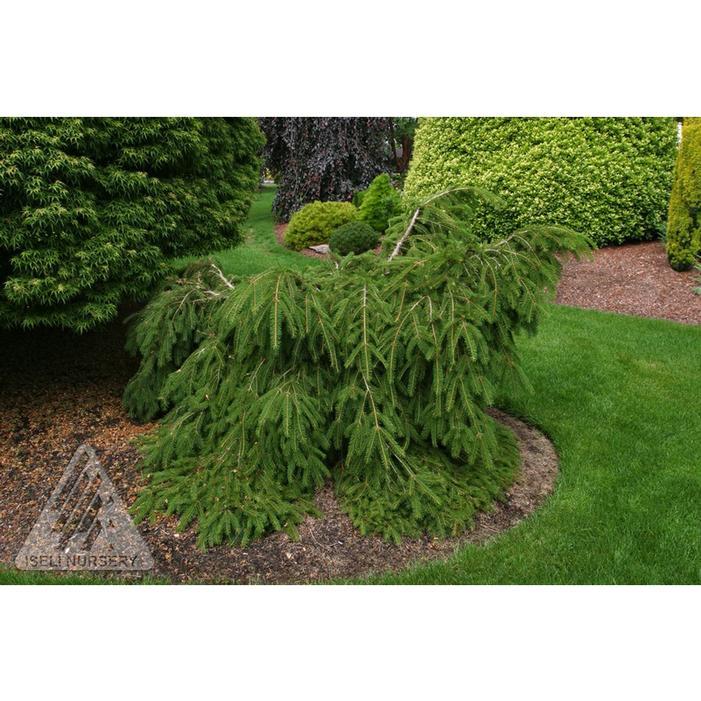
Picea abies 'Formanek' is a prostrate, weeping cultivar of Norway Spruce that grows flat along the ground without support, forming a dense, layered mat of dark green needles. Without staking it rarely exceeds 2 ft in height but spreads 6–10 ft or more over many years, making it one of the most effective evergreen ground covers for cold climates down to zone 3.
Plant in full sun to part shade with well-drained soil; it tolerates moderate drought once established but fails in standing water or compacted clay. Mulch around the base during the first two seasons to moderate soil temperature and retain moisture. When staked as a young plant, 'Formanek' can be trained into a weeping specimen, gaining vertical interest on slopes or in rock gardens. The low canopy suppresses weeds effectively once the plant has spread and filled in.
Selected in the Czech Republic and named for plantsman Miroslav Formanek, this cultivar provides year-round structure and winter texture. Its dense, overlapping branch layers make it one of the more visually complex prostrate conifers available for northern gardens.
These dates are for Zone 6b. Enter your ZIP to time every job to your own frost dates.
- buy · Jan 30 - Feb 13Buy plants - about two months before planting out
- plant · Mar 27 - Apr 24Plant container stock where it can sprawl flat, or stake a leader upright to train it into a weeping form
- cut · Any time in springTrim back branch tips that run onto paths or lawn; cut to a live side shoot, never into bare wood
- watch · Any time in summerIf training it upright, move the stake tie up the new leader each year and loosen ties so they don't girdle the stem
Problems & troubleshooting
Common problems
Rhizosphaera Needle Cast
Needles on inner and lower branches turn purple-brown in their second year and drop prematurely, leaving progressively bare branch sections that work upward through the canopy over multiple seasons. Rows of small black fungal fruiting bodies (pycnidia) are visible along needle undersides under a hand lens.
Apply chlorothalonil or copper-based fungicide when new needles reach half their final length; repeat 3–4 weeks later. Rake and remove fallen needles beneath the tree. Maintain adequate spacing for air circulation. Treat for 2–3 consecutive springs on heavily infected trees before evaluating recovery.
Cytospora Canker
White or blue-white pitch masses ooze from bark on lower branches and the trunk. Affected branches die back progressively from the tip inward; bark beneath the resin is discolored brown and may have a resinous, sunken appearance.
Prune infected branches well below the canker margin into healthy wood and destroy all cuttings. Sterilize pruning tools with 70% isopropyl alcohol between each cut. No effective fungicide is available; prevent recurrence by avoiding drought stress, soil compaction, and mechanical bark injury.
Sirococcus Shoot Blight
Newly elongating shoot tips wilt and turn brown in late spring. Infected needles and stems develop small black pycnidia. Affected shoots may curl into a shepherd's crook shape. Current-year growth is killed and the disease can spread further during prolonged wet periods.
Prune and destroy infected shoot tips as soon as symptoms appear. Apply copper-based fungicide or chlorothalonil at bud break, repeating every two weeks during wet springs. Plant at adequate spacing to maximize air circulation and avoid overhead irrigation.
Phytophthora Root Rot
Wilting despite moist soil, yellowing leaves, stunted growth, and dark, decayed roots and crown tissue. Vines may collapse during hot weather.
Plant in well-draining soil and avoid waterlogging. Remove and destroy affected vines. Improve drainage with raised beds or amended soil and avoid overwatering.