
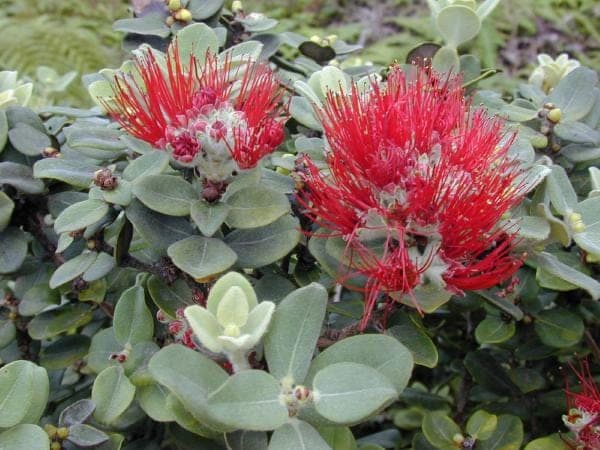
ʻŌhiʻa lehua is the most widespread native tree in Hawaii and the backbone of its native forests. It grows as a tall tree in wet forest, a gnarled shrub in boggy ground, and a pioneer on fresh lava, often the first woody plant to colonize a new flow. The flowers are brushes of stamens, usually red, sometimes orange, yellow or salmon, and they feed native honeycreepers such as the ʻiʻiwi and ʻapapane as well as native insects. In Hawaiian tradition the tree and its blossom, the lehua, carry deep cultural meaning and should be picked sparingly.
Grow it in a spot with full sun to light shade and soil that drains but stays on the acidic side. It is slow growing and long lived, and it does not like to be root-disturbed, so plant a young nursery tree and leave it alone. Established plants handle drought better than most people expect, but they flower and grow best with steady rain or occasional deep watering. Seed is tiny and fine as dust; sow it on the surface of damp media and keep it moist.
Rapid ʻŌhiʻa Death, caused by two Ceratocystis fungi, has killed large numbers of ʻōhiʻa and has been found on more than one island. Buy plants only from a licensed local nursery, do not move ʻōhiʻa plants, wood or soil between islands, and clean tools and shoes after working in or near infected stands. Keep a young tree free of wounds, because the fungus enters through cuts. If a tree browns suddenly across the whole crown, report it to the state or county agricultural office rather than cutting it yourself.
Rapid ʻŌhiʻa Death
Sudden wilting and browning of foliage on one or more branches, with dead leaves remaining attached rather than dropping. Dark brown to black staining in the sapwood is visible when affected branches are cross-sectioned. The entire canopy can collapse within days to weeks. Two syndromes occur: a vascular wilt form caused by Ceratocystis lukuohia progresses rapidly and kills the tree; a bark canker form caused by C. huliohia spreads more slowly through the outer bark and cambium.
No cure exists and infected trees cannot be saved. Do not move wood, bark, soil, or plant material from affected sites. Sterilize all tools and equipment with 70% isopropyl alcohol or a 10% bleach solution before moving between trees. Report confirmed or suspected cases to the Hawaii Department of Agriculture. Preventative management on healthy trees: avoid bark wounding, minimize soil compaction around the root zone, and maintain adequate but well-drained moisture to reduce stress susceptibility.