
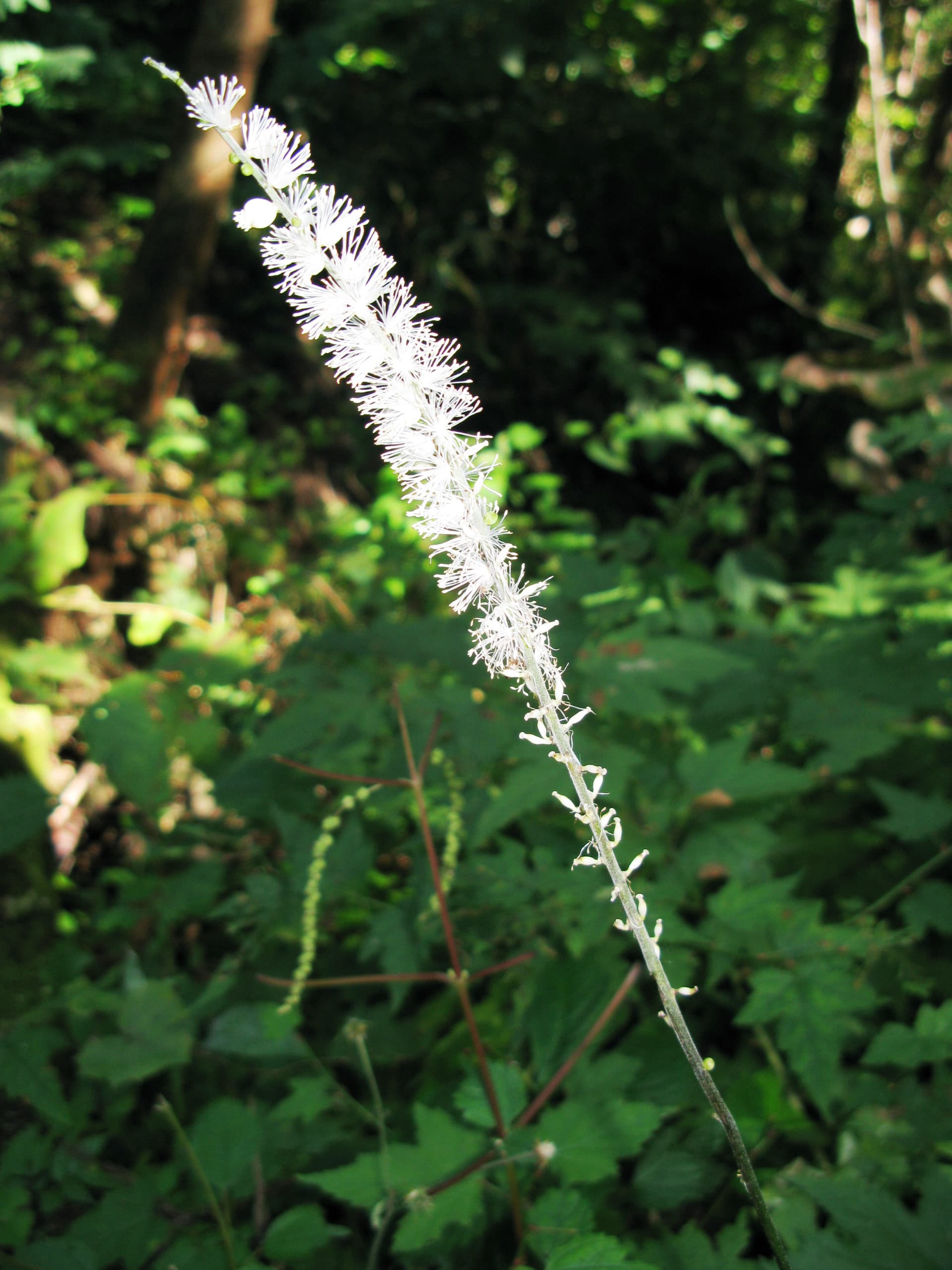
Actaea japonica is a shade-tolerant woodland perennial native to Japan, South Korea, and central and southern China. It produces handsome compound dark green foliage and wiry stems bearing slender white racemes in late summer to early fall - a window when little else blooms in the shade garden. The Royal Horticultural Society rates it a reliable pollinator plant.
The plant spreads slowly by rhizome and gradually forms a substantial clump. It needs consistent soil moisture and a site with dappled or full shade; afternoon sun scorches the leaves. Soil should be humus-rich and slightly acidic. A bark-mulch layer over the root zone conserves moisture and moderates soil temperature through summer. Cold-hardy to zone 4, it is far more sensitive to drought than to cold. Established plants resent disturbance and may take two seasons to re-establish after division.
The rhizomes of Actaea japonica and closely related Cimicifuga species are used in traditional Chinese and Japanese medicine under the collective name sheng ma. Documented traditional applications include fever, sore throat, toothache, and headache. The species shares a suite of triterpene glycosides with the better-researched Actaea racemosa.
Powdery mildew
White or grey powdery coating on leaves - usually starting on older growth in humid conditions or when nights cool.
Improve air circulation by thinning plants. Apply neem oil or potassium bicarbonate spray at first sign. Avoid overhead watering.
Botrytis (grey mould)
Grey fuzzy mould on petals and stems, worst in cool wet conditions.
Remove affected parts immediately. Improve air circulation. Avoid overhead watering. Apply copper fungicide if severe.
Fungal leaf spot
Brown or purplish spots on the leaves, often ringed with a yellow halo, that spread and merge in warm, humid, or wet weather; heavily spotted leaves yellow and drop early.
Pick off spotted leaves and clear fallen debris to remove overwintering spores. Improve air circulation by thinning, and water at the base so foliage dries quickly. If it persists, apply a copper- or sulfur-based fungicide at the first sign.
Root rot
Plants wilt, yellow, and stunt even in moist soil; lower stems and roots turn brown, soft, and mushy and the plant may collapse. Most common in heavy, wet, or poorly drained ground.
Improve drainage and stop overwatering, and never plant too deep. Lift and destroy badly affected plants along with the soil around the roots. Grow in raised or free-draining beds to prevent it returning.